What strikes me most about this story isn’t that AI is outperforming human traders — it’s how fast the label went from “dangerous” to “dominant.”
Key Takeaways
- AI-driven quantitative funds in China are now attracting billions of dollars in investor capital after outperforming human fund managers.
- Just two years ago, these same quant funds were the target of regulatory scrutiny for allegedly causing excessive market volatility.
- The 2mind read: capital is moving faster than regulatory comfort, and China’s simultaneous crackdown on AI “personas” shows regulators drawing a sharp line between AI as a profit engine and AI as a social actor.
What happened
| Domain | China’s current stance |
|---|---|
| AI in quant trading (finance) | Capital flowing in; funds now outperforming human managers |
| AI personas in consumer chatbots | Being shut down ahead of new anthropomorphization rule (effective the 15th) |
AI is reshaping China’s asset management industry at a pace that’s caught even close observers off guard.
AI-powered quantitative funds are now producing investment returns that meaningfully exceed those of traditional human portfolio managers, and investor capital is responding accordingly — flowing toward the large quant shops running these models.
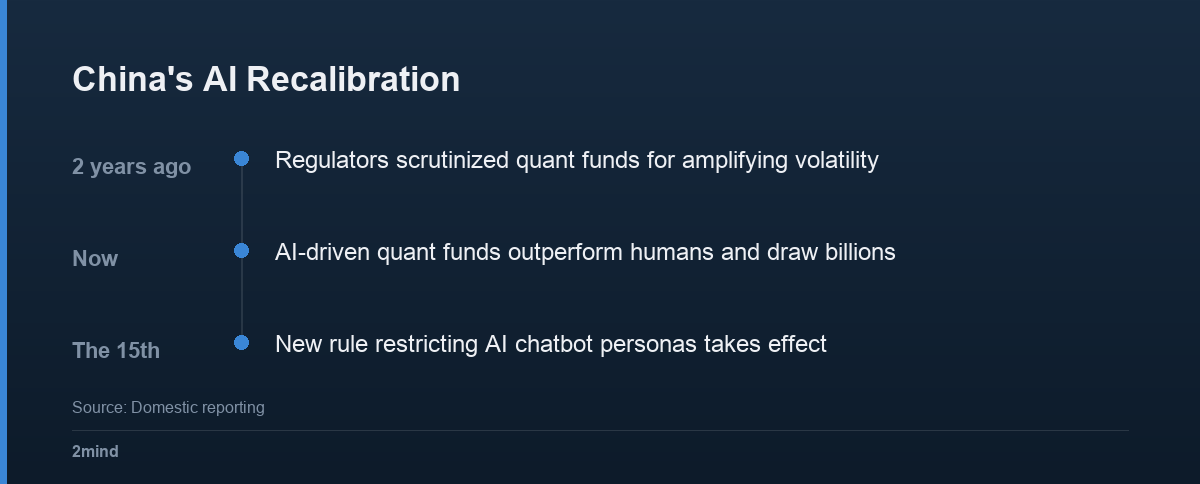
This marks a sharp reversal from just two years ago, when quant funds using algorithmic strategies were viewed with suspicion by regulators, blamed for amplifying volatility during market swings.
The shift is happening alongside a separate but related regulatory story: Chinese tech giants ByteDance and Alibaba are shutting down “AI persona” features in their consumer chatbots — ByteDance’s Doubao and Alibaba’s Qwen — ahead of a new government regulation on AI “anthropomorphization” set to take effect on the 15th.
Both moves reflect the same underlying dynamic: China’s regulators and its markets are recalibrating, in real time, how much autonomy to grant AI systems, but in very different directions depending on the domain.
How big a 20-point outperformance gap actually is
In asset management, a performance gap measured in single percentage points is often enough to redirect billions in capital. A gap over 20 percentage points, sustained across a full year according to the cited data, isn’t a marginal edge.
It’s the kind of number that makes allocators question whether human discretion adds value at all in this specific strategy. That’s exactly why the reversal from “dangerous” to “dominant” happened so fast — capital didn’t need years to notice a gap that size.
The prior scrutiny period matters here too. Regulators weren’t wrong to worry about correlated, fast-moving algorithmic strategies during a downturn — they were worried about a scenario that simply hasn’t been tested yet in this current wave of funds.
The two lenses
Lens one: this is a vindication of financial AI. For years, the knock against algorithmic trading was that it amplified panic — flash crashes, herd behavior, feedback loops nobody fully controlled.
What’s happening now suggests something different: that sufficiently mature AI models, trained on enough data and given enough capital, actually produce more disciplined, less emotionally reactive investment decisions than human managers do.
If that holds up across market cycles — not just a bull run — it’s a genuinely significant data point about where financial decision-making is heading. Institutional capital doesn’t move toward underperforming strategies for long; the fact that it’s moving toward AI-run funds now is a real market signal, not hype.
Lens two: performance chasing during good times tells us little about resilience during bad ones.
Quant funds have historically looked brilliant until a volatility regime they weren’t trained on arrives — and the same models blamed for amplifying crashes two years ago haven’t necessarily become fundamentally safer, they’ve just been performing well in a favorable environment. The regulatory memory here matters: China didn’t scrutinize these funds for no reason.
If capital concentration in a handful of AI-driven funds becomes extreme, the systemic risk argument that worried regulators before could resurface with more force, not less, precisely because more money is now involved.
The line Beijing is actually drawing
Letting AI models make autonomous, high-stakes trading decisions while banning AI chatbots from presenting relatable personas isn’t inconsistent policy — it’s a regulator distinguishing between AI acting on markets and AI acting on people.
One is measured in returns, which are auditable after the fact. The other is measured in influence, which is much harder to trace once it’s shaped how millions of people think or feel about something.
Why it matters
For asset managers and institutional allocators, the practical question is whether AI-driven outperformance is a durable structural edge or a favorable-conditions artifact — and that’s genuinely hard to know in real time.
For regulators, the juxtaposition is worth watching closely: Beijing is simultaneously comfortable with AI systems making autonomous, high-stakes financial decisions while restricting AI systems from presenting themselves as relatable personas to consumers.
That’s not a contradiction so much as a signal about where China sees the actual risk — not in AI’s capability, but in AI’s social influence. As we’ve discussed in earlier coverage of AI agent adoption, the pattern of “expand AI’s functional power while restricting its social presentation” may become a template other regulators borrow.
I’d want to see how these funds perform through a genuine downturn before calling this settled.
What “trained on enough data” is doing quietly in this story
The optimistic reading depends on a specific assumption: that these models generalize beyond the conditions they were trained in. Quant strategies have a long history of performing well in the regime they were built for and struggling outside it.
Nothing in the current data confirms which case applies here. That’s not a criticism of the funds — it’s simply the honest state of the evidence a year into a strong run.
Watching how these funds behave the next time markets turn volatile — not just how they’ve performed during a favorable run — is the actual test this story sets up, whether or not this piece revisits it directly.
FAQ
Q. Why were Chinese quant funds criticized in the past?
A. They were blamed for amplifying market volatility and triggering rapid, destabilizing price swings during past downturns, prompting regulatory scrutiny roughly two years ago.
Q: What is China’s new AI “anthropomorphization” regulation?
A: It’s a rule set to take effect on the 15th that restricts AI systems from presenting themselves with human-like personas, prompting ByteDance and Alibaba to shut down related chatbot features preemptively.
What would change our view
If these quant funds underperform meaningfully during the next real market downturn — not just a temporary dip — the “vindication of financial AI” reading in Lens one would need serious revision.
It would also change if Chinese regulators move to restrict AI-driven trading directly, which would suggest the systemic risk concern from two years ago never actually went away.
Sources
- Hedgeweek / Citic Securities data (44.7% vs 20.3 pp) — 2026-07-01 (data for 2025). AI-driven quantitative funds in China are outperforming human fund managers by 20+ percentage points
- Multiple sources including Caixin, Bloomberg — 2024 (regulatory review period). Two years ago quant funds were target of regulatory scrutiny for market volatility
- Caixin Global — 2026-07-06. ByteDance's Doubao and Alibaba's Qwen are shutting down AI persona features ahead of July 15 regulation
- TechNode — 2026-07-06. China's new AI anthropomorphization rule takes effect July 15, 2026
Leave a Reply