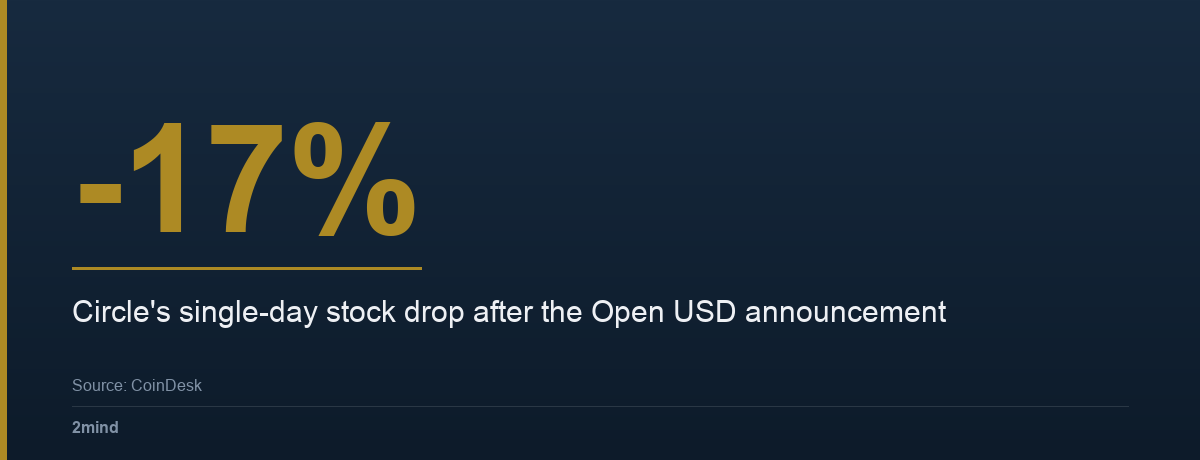
Circle’s single-day 17% stock drop tells a story that goes well beyond one bad trading session.
Key Takeaways
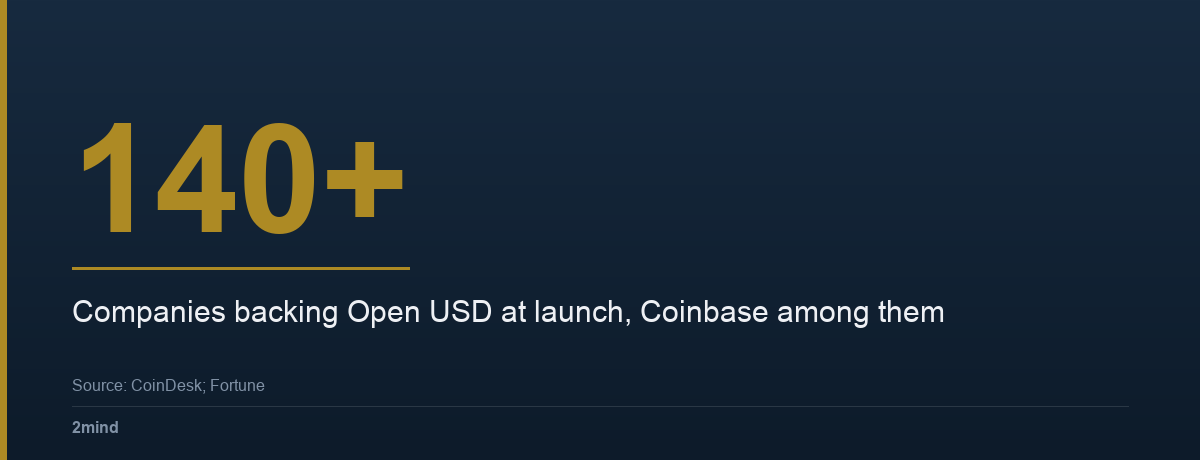
- More than 140 companies — Visa, Mastercard, Stripe, Coinbase, BlackRock and Google among them — backed a new stablecoin called Open USD on June 30, 2026, sending Circle’s stock (CRCL) down more than 17% in a single session. Coinbase stock went the other way and rose.
- The Open USD network represents a direct structural challenge to USDC, the stablecoin co-issued by Circle and Coinbase, which has been the dominant dollar-pegged asset in crypto payments infrastructure.
- The real signal here is not a price move — it is a shift in who controls the rails: traditional payment networks are no longer content to integrate stablecoins, they want to issue them.
What Happened
| USDC | Open USD | |
|---|---|---|
| Issued by | Circle — sole issuer since 2023 | Open Standard — 140+ backers incl. Visa, Mastercard, Stripe, Coinbase, BlackRock |
| Status | Established, dominant | Announced June 30, 2026 |
| Same-day stock reaction | Circle (CRCL) fell more than 17% | Coinbase (COIN) rose |
On June 30, 2026, an initiative called Open Standard announced a new stablecoin, Open USD, backed by more than 140 companies — among them Visa, Mastercard, Stripe, Coinbase, BlackRock and Google.
The announcement sent Circle’s stock down more than 17% in a single session, closing below $63. Coinbase went the other way and rose on the news — it distributes Circle’s USDC and shares in the income its reserves generate, but it is also a launch partner in Open USD rather than a bystander.
The timing is notable. Circle listed on the NYSE at $31 a share in June 2025, positioning itself as the infrastructure backbone of the stablecoin economy. Thirteen months later, the largest payment networks on earth announced they are building a competing product — together.
What the drop looks like against the IPO price
Circle’s stock closing below $63 after a 17% single-day drop is worth placing against where the company started. It listed at $31 a share in June 2025, thirteen months before this announcement. Even after the decline, the stock closed at more than double its IPO price.
That doesn’t make the drop less real, a 17% single-session move is a serious market reaction, but it’s a different story than a company being erased by a rival’s launch.
What Open USD did was compress a rally that had built up over a year, in a single day, rather than push the stock below where it started.
Whether that gap narrows further from here is the more useful thing to watch than the size of one day’s decline on its own.
The Two Lenses
Lens one: The Incumbents Are Finally Moving
For years, Visa and Mastercard integrated stablecoins at the edges — settling transactions, piloting USDC on select corridors. The Open USD announcement is a different category of action.
By forming a consortium that includes both a card network (Visa, Mastercard) and a crypto-native exchange (Coinbase), they are signaling that they want to own the issuance layer, not just the settlement layer.
This is not unprecedented in financial history. When ACH, SWIFT, and card networks were built, the institutions that controlled the infrastructure captured disproportionate long-term value. The stablecoin market is still young enough that the issuance standard has not been locked in. Open USD is a bid to lock it in — on terms favorable to the incumbents.
For Circle, the problem is structural. USDC’s value proposition was that it was the “trusted, regulated” stablecoin, issued by a dedicated fintech rather than a bank or card network. If Visa and Mastercard are issuing a regulated stablecoin themselves, that differentiation largely disappears.
Lens two: This Could Accelerate Adoption, Not Just Competition
There is a second reading worth considering. The entry of Visa, Stripe, and Mastercard into stablecoin issuance could be the legitimacy event that the broader market has been waiting for. When the world’s largest payment processors stake their brand on a dollar-pegged digital asset, merchants and consumers who were previously skeptical have a familiar name to trust.
Circle’s loss may be the market’s gain. If Open USD drives stablecoin usage into everyday retail payments — not just crypto-to-crypto settlement — the total addressable market expands significantly.
A larger pie does not automatically mean Circle loses its slice, either. USDC remains deeply embedded in DeFi protocols, cross-border remittance corridors, and institutional custody arrangements that Open USD will take years to replicate.
Europe’s MiCA regime, whose hard enforcement deadline falls on July 1, 2026, is also reshaping which stablecoin issuers can operate at scale there. The combination of regulatory pressure and now direct competition from payment giants means Circle’s path to dominance has narrowed considerably.
Why It Matters
The immediate impact falls on two groups. First, Circle shareholders and anyone holding USDC-adjacent positions are now watching a competitive dynamic that did not exist 48 hours ago. Second, DeFi protocols and crypto-native platforms that built their infrastructure around USDC will need to monitor whether liquidity begins migrating toward Open USD over time.
What to watch: whether Open USD is issued under a U.S. federal stablecoin license (if the GENIUS Act or equivalent legislation passes), how quickly Stripe integrates it into merchant checkout flows, and whether Coinbase’s participation in Open USD creates internal conflict with its existing USDC obligations to Circle.
The deeper question is whether this is a winner-takes-most market or one that sustains multiple major stablecoins. Payment infrastructure historically consolidates. The fact that Coinbase is simultaneously a Circle partner and an Open USD consortium member is the single most interesting tension to track from here.
Two deadlines landing within a day of each other
The Open USD announcement came on June 30, one day before Europe’s MiCA regime moved into hard enforcement on July 1. Circle was facing a scheduled regulatory compliance deadline in one major market at almost the same moment a competing consortium announced itself in another.
Neither event caused the other, and there’s no indication the timing was coordinated.
But the effect for Circle was that a known, scheduled regulatory pressure point and an unscheduled competitive one arrived close enough together that they’re difficult to evaluate separately, European compliance costs and a new source of competition for USDC’s core market both became live issues in the same 48 hours.
FAQ
Q. What is Open USD, and how is it different from USDC?
A. Open USD is a new stablecoin announced on June 30, 2026 by Open Standard, an initiative with more than 140 corporate backers.
USDC is an existing stablecoin issued by Circle alone — Coinbase co-founded its original governance consortium, but that was wound down in 2023 and Coinbase now distributes USDC and shares in its reserve income.
Both are dollar-pegged, but Open USD is backed by a broad group of payment and technology companies, whereas USDC was built by a dedicated crypto-native firm.
Q. Why did Coinbase’s stock rise when Open USD competes with USDC?
A. Because Coinbase is inside Open USD rather than outside it.
Coinbase distributes Circle’s USDC and shares in the interest income its reserves generate, so a successful rival could erode that — but as a launch partner in Open USD, Coinbase also stands to earn from whatever replaces it.
On the first day the market read that balance as good for Coinbase and bad for Circle.
What would change our view
Our reading would shift if Open USD fails to secure a federal stablecoin license once relevant U.S. legislation is finalized, or if Stripe doesn’t integrate it into merchant checkout at meaningful scale within the next year, either outcome would make this look more like a defensive coalition than a genuine issuance threat.
It would also change if USDC’s volumes in DeFi and cross-border settlement show measurable erosion over the following two quarters rather than holding steady.
Sources
- CoinDesk, Circle tumbles as Stripe, Coinbase and BlackRock back rival stablecoin network (30 June 2026)
- Fortune, Stripe, Visa and over 140 other businesses to launch a stablecoin (30 June 2026)
- Yahoo Finance, Coinbase just joined a 140-company stablecoin alliance
- StockStory, Coinbase (COIN) stock is up — what you need to know (2 July 2026)
- Circle, Circle announces pricing of upsized initial public offering (4 June 2025)
- Circle, Ushering in the next chapter for USDC (21 August 2023)
- Kraken, MiCA enforcement begins July 1
Leave a Reply