I keep coming back to the same split screen when I read about SK Telecom’s data center buildout. On one side, gigawatts and cloud partners stacking up in an official press release.
On the other, a much smaller number — 18 people — that has almost nothing to do with servers and everything to do with who gets to say an AI system is safe to trust. Both numbers came out of Korea within a month of each other, and I don’t think that timing is an accident.
On July 5, 2026, SK Telecom laid out a target of 15GW of AI data center capacity, built in stages with two of the biggest names in AI infrastructure already signed on. It’s the kind of plan that reads as pure momentum.
But sitting next to it is a much quieter story about how few people in the country — or anywhere — are trained to check AI systems for reliability before they ship. I think the gap between those two stories is the actual news here.
Key Takeaways
- SK Telecom’s official target is 15GW of AI data center capacity, announced July 5, 2026.
- The Yeongnam region, centered on Ulsan, is planned at 2GW or more; Honam is planned at 1GW.
- Rollout is staged: 5GW is planned to come online starting in 2029, building toward the full 15GW.
- SK Telecom’s AWS partnership was announced June 22, 2025; its NVIDIA partnership followed June 8, 2026.
- With NVIDIA, SK Telecom plans an AI Factory starting operations in 2027, meant to scale toward gigawatt-level capacity.
- Separately, ThinkForBL (씽크포비엘) has certified only 18 people in its first AI reliability expert cohort — a sign of how thin the human-oversight layer still is.
Where the 15GW is supposed to come from
SK Telecom’s press release frames this as a national buildout, not a single site. Ulsan anchors the Yeongnam allocation, and it’s where both major partnerships are attached — AWS first, then NVIDIA about a year later. Honam’s 1GW is smaller and, as of the announcement, less detailed in terms of partners.
That asymmetry is worth noting: both major partners sit in one region, while the second-largest allocation is described mostly by its size.
The company isn’t promising 15GW on day one. The staging matters: 5GW is the figure tied to 2029, which reads less like “we’re done” and more like “here’s the first real checkpoint.”
According to The Korea Times’ July 5, 2026 report on the announcement, the full buildout is framed as a multi-year plan running out toward 2035 — which, if accurate, puts the “15GW” headline number nearly a decade out from today.
| Element | Detail |
|---|---|
| Total target | 15GW |
| Yeongnam (Ulsan-centered) | 2GW+ |
| Honam | 1GW |
| First phase online | ~5GW from 2029 |
| AWS partnership announced | June 22, 2025 |
| NVIDIA partnership announced | June 8, 2026 |
| AI Factory with NVIDIA | Operations starting 2027 |
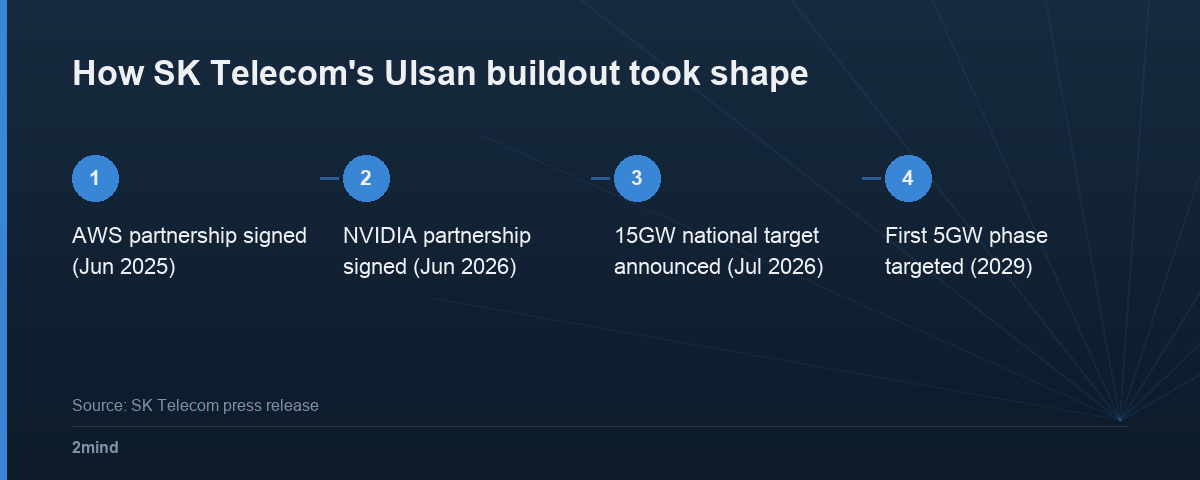
The AWS and NVIDIA deals aren’t the same kind of commitment. AWS came in first, more than a year before the 15GW figure was made official, which suggests Ulsan’s role was decided early.
NVIDIA’s AI Factory, announced this June, is described as starting operations in 2027 and scaling toward gigawatt-level capacity over time — it’s a build-out plan, not a finished facility.
The 2027 start lands two years before the first 5GW milestone. Getting the NVIDIA-anchored compute running then reads like the step meant to prove the model works before SK Telecom scales toward the broader 2029 phase.
Two Lenses
Lens one: the infrastructure math finally has partners attached to it
For a while, “Korea wants to be an AI hub” was mostly a slogan. What’s different about this announcement is that it comes with named partners and dates rather than aspirational totals.
AWS signed on in mid-2025, NVIDIA followed roughly a year later, and the 15GW figure was only made public once both were in place.
Read that way, SK Telecom isn’t announcing an idea — it’s announcing a schedule with two anchor tenants already committed.
The staging toward 2029 also reads as realistic rather than inflated. Data center buildouts of this size routinely slip, so putting a concrete milestone (5GW) years before the full total is a way of giving outsiders something to check the company against, instead of just a number to believe.
Lens two: capacity is scaling faster than the people who are supposed to check it
Here’s what nags at me. SK Telecom can point to two confirmed hyperscaler-grade partners and a phased build plan. Nobody I’ve read has produced anything close to that specificity for the workforce that’s supposed to evaluate whether the AI running inside all this capacity is doing what it claims.
Park Ji-hwan, CEO of ThinkForBL (씽크포비엘), put it plainly: even globally, there aren’t many training programs for AI reliability experts, because companies are focused on performance competition, not on the less glamorous job of watching AI systems and catching when they’re wrong.
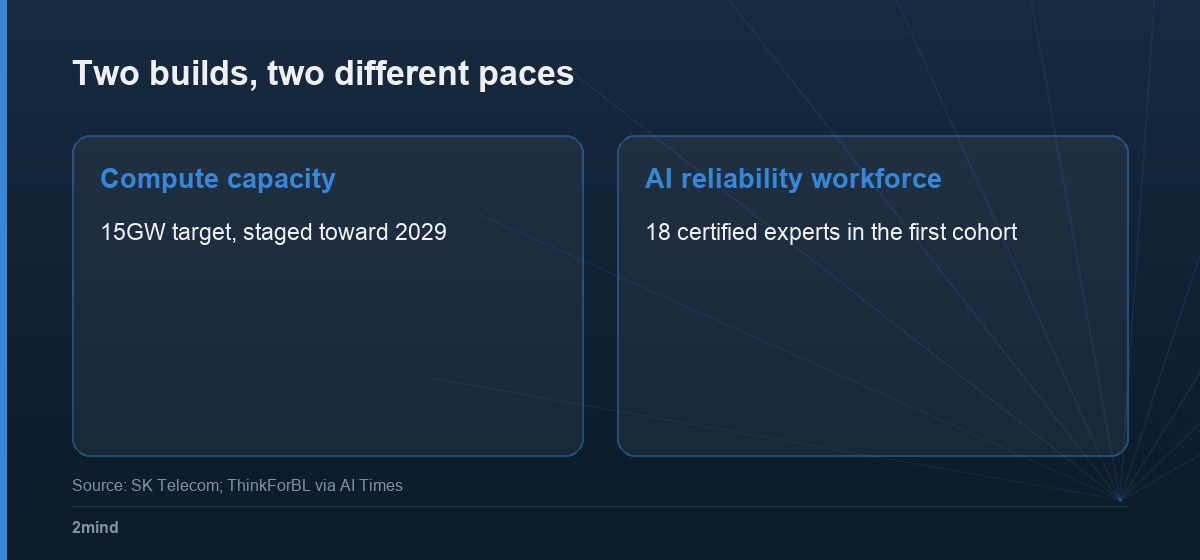
ThinkForBL’s own numbers back that up. Its first certification cohort — a curriculum the company built itself, aiming for official private-certification status later this year — produced 18 people. Eighteen. Against 15 gigawatts of planned compute.
I’m not saying those two figures should be equal, obviously they measure completely different things, but the contrast is stark enough that it’s hard to unsee once you notice it.
The missing job nobody’s hiring for
What I find most telling is Park’s framing: it’s not that AI reliability work is hard to do, it’s that almost nobody is being trained to do it, because the incentive structure inside AI companies rewards shipping faster models, not slowing down to check them.
That’s a structural problem, not a technical one, and it doesn’t get solved by building more data centers.
It’s also worth naming what doesn’t exist yet.
There’s no public commitment I could find — from SK Telecom, from a Korean ministry, or from anyone else — to fund AI reliability training at anywhere near the scale of this data center buildout.
The capacity has two hyperscaler partners and a published timeline behind it. The people meant to check what runs on that capacity have one small firm and a curriculum it built on its own.
I don’t think SK Telecom’s buildout is the villain in this story — someone has to build the compute, and doing it with named partners and staged milestones is more disciplined than a lot of the vague “AI hub” announcements I’ve seen out of other countries.
But a 15GW plan with a real timeline deserves a real question sitting next to it: as that capacity comes online through 2029 and beyond, who is checking what runs on it, and how many of them will there actually be?
What would change our view
If SK Telecom publishes site-level operational data once the first phase goes live around 2029 — actual GW online, not just projections — that would let us judge whether the staged plan is holding.
On the other side, if ThinkForBL’s certification track scales meaningfully beyond its first cohort of 18, or if a comparable government or industry body sets its own AI reliability workforce target, that would suggest the trust gap is closing rather than widening.
Right now we don’t have evidence pointing either way yet.
FAQ
Q. Is SK Telecom’s 15GW target already built?
A. No. The 15GW figure is a staged target. The company’s own framing points to roughly 5GW coming online starting in 2029, with the full 15GW planned over a longer horizon.
Q. What role do AWS and NVIDIA actually play?
A. AWS partnered with SK Telecom on the Ulsan data center in June 2025. NVIDIA followed in June 2026, and the two are building an “AI Factory” together that’s set to start operating in 2027 and expand toward gigawatt scale.
Q. What does the AI reliability workforce shortage have to do with data centers?
A. Nothing structurally — they’re separate stories. But they’re happening in the same country in the same window of weeks, and one measures how fast AI capacity is scaling while the other measures how few people are trained to check what that capacity produces.
Sources
- SK Telecom — SK Telecom Pursues 15GW AI Data Center Buildout, Aiming to Become Asia’s AI Infrastructure Hub (July 5, 2026)
- The Korea Times — SK Telecom plans 15GW AI data center buildout across Korea by 2035 (July 5, 2026)
- AI Times — Park Ji-hwan, ThinkForBL CEO, on the shortage of AI reliability experts
Fifteen gigawatts is a number you can plan a groundbreaking around. Eighteen certified people is a number that tells you who’s actually checking the work — and I don’t think those two numbers are growing at the same speed.
Leave a Reply