Key Takeaways
- Binance’s incident report says attackers used a compromised engineer’s computer and an internal AI tool to take control of two more employees’ machines on Oct 20, 2026.
- The attack affected about $6.34 billion in digital assets on Oct 29, nine days after the AI-tool step.
- The excerpts we read do not report a flaw in an AI model. The risk was the access the tool offered to whoever was logged in.
- Before you connect an assistant to internal systems, list what it inherits from each user.
Did Attackers Really Use an Internal AI Tool at Binance?
Yes, according to Binance’s own account. The exchange said the attackers used a compromised workstation and an internal AI tool to gain control over two other employees, on Oct 20, 2026.
That is a company statement, not an independent finding. Binance said it is still investigating and has brought in outside security firms.
The report excerpts do not say what the tool did or how the attackers used it. We could not open Binance’s full report, so everything here comes from outlets quoting it.
What Happened Before and After the AI Step?
The AI tool was one link in a chain. BleepingComputer reported that the FBI attributed the October 29 theft to North Korea-linked hackers known as TraderTraitor.
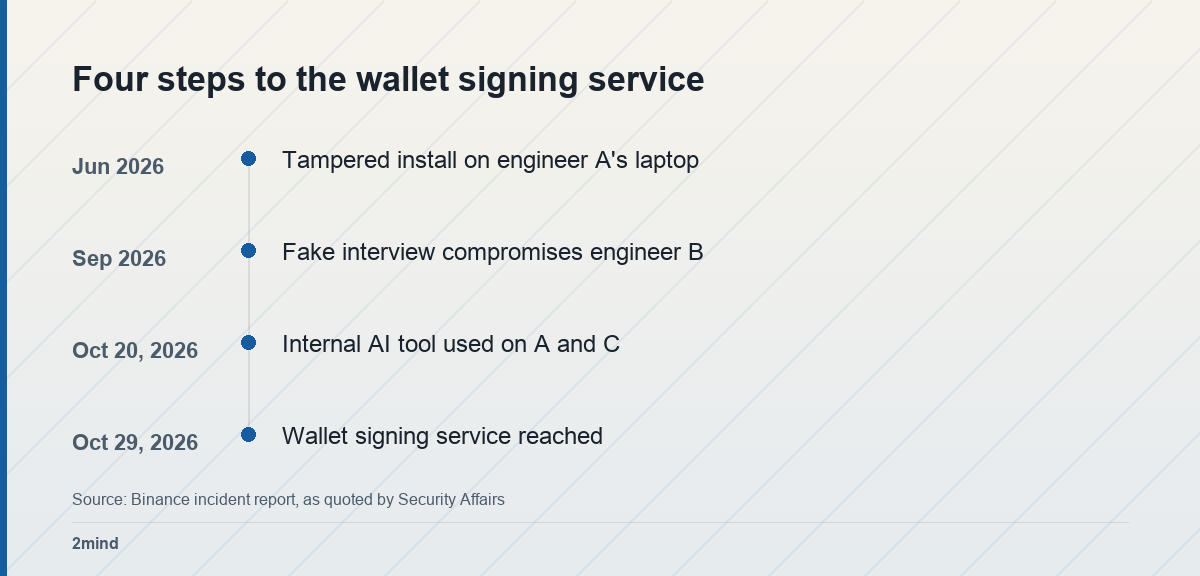
In its report, Binance described a “sophisticated, multi-stage campaign” that was “not a single isolated breach or a simple phishing incident.” The sequence below follows the version Security Affairs quoted.
| When | Step | Where the attacker was |
|---|---|---|
| Jun 2026 | Tampered tool install | Engineer A’s laptop |
| Sep 2026 | Fake job interview | Engineer B’s laptop |
| Oct 20, 2026 | Internal AI tool | Engineers A and C |
| Oct 29, 2026 | Stolen credentials | Wallet signing service |
In June, Security Affairs said, a Wallet DevOps engineer downloaded a tampered Homebrew installation while searching for an AI coding tool. Binance caught it, replaced the device and rotated credentials. Details about his role and colleagues had already leaked.
In September, a recruiter on a legitimate job platform arranged two interviews. The second ended with a coding assignment that carried malware. Binance said endpoint tools did not detect it.
What Did the AI Tool Give the Attackers?
Binance’s own wording is short. In the passage Security Affairs quoted, it says the attacker “leveraged the compromised computer of engineer B and used an internal AI tool to gain control over the Wallet DevOps Engineer A and another Wallet Software Engineer C.”
The attackers then found a container deployment token on engineer A’s computer. On October 29 they used stolen credentials to deploy a container and run a script that reached the wallet signing service.
Security Affairs read this as an access problem. It wrote that the report “doesn’t identify a vulnerability in the AI model itself,” and that an internal application can become a pivot once an attacker holds an employee’s environment and permissions.
That is the useful lesson, and it is Security Affairs’s reading, not Binance’s. We cannot say how much the tool shortened the attack. We can say it was an extra place where borrowed access paid off.
The Borrowed Access Check
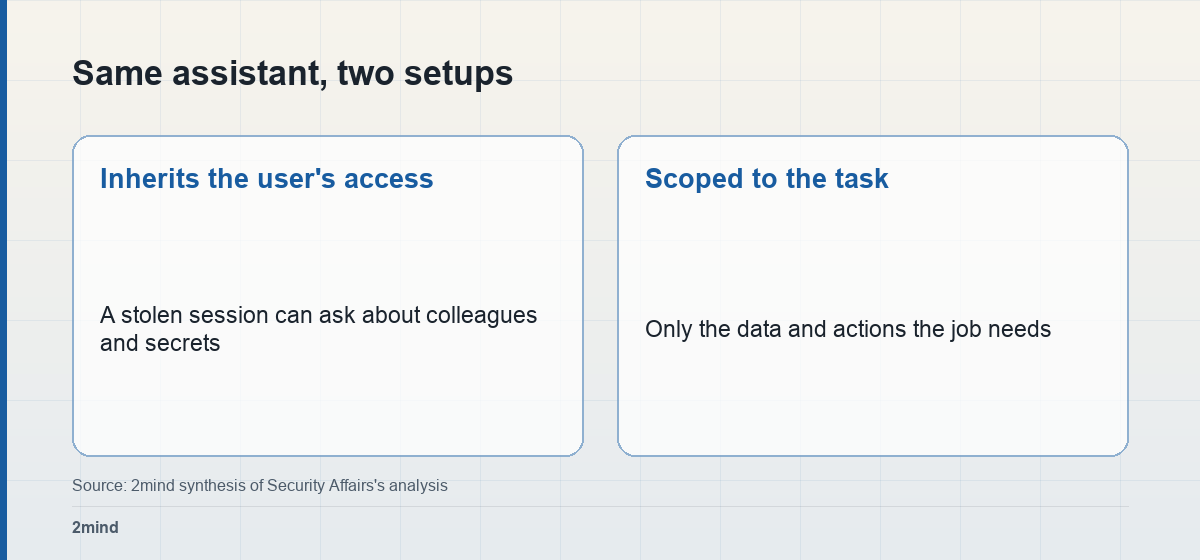
This check is our construction from the incident, not something Binance published. It asks what an internal AI tool inherits from the person using it.
We did not test it on any real system. It follows from the sequence above and from Security Affairs’s advice that internal AI tools “should never inherit unnecessary access to sensitive systems.”
- List what the tool can read. Write down every system, repository, ticket queue and chat channel the assistant can pull from when a user asks. If the list is “whatever the user can open,” that is the answer.
- List what the tool can do. Separate reading from acting. Can it run commands, message colleagues, create tokens or trigger deployments? Each action is something a borrowed session could also do.
- Test from a stolen session. Assume an attacker sits at a staff laptop. Ask what the assistant would tell them about other people, other systems and stored credentials, and cut the answers you would not accept.
Our earlier piece on agents that raise their own spending limit covered the agent changing its own limits. This case is the reverse: someone else borrowed a tool whose limits were the user’s.
It also connects to agents disabling their own monitoring, since both turn on controls being out of the tool’s, or its borrower’s, reach.
Two Lenses
The assistant that already knows where everything is
A company wires an assistant into repositories, chats and deployment tools because the speed is real. Staff stop hunting for the right folder or the right colleague.
That convenience depends on the tool seeing what its user sees. Narrowing it costs some of the speed that justified it.
The assistant someone else can borrow
The same breadth is what makes a stolen session valuable. An attacker who cannot guess who owns the wallet service can ask a tool that knows.
We put more weight on this lens for tools that can act, and less for read-only tools over low-risk data. The report does not tell us how this one was configured.
What Would Change Our View?
We would revise this reading if Binance’s full report showed the AI tool played a minor role, for example only revealing a username that was already known. The excerpts leave the size of its contribution open.
We would also revise it if independent investigators found the access came from somewhere other than the tool. Binance has said outside firms are reviewing its findings.
We could not verify the dollar figures independently. BleepingComputer reported that about $2.85 billion in stolen assets had been frozen or intercepted by November 3, and that 98% of affected token assets had been replenished as of October 31.
FAQ
Q. Was the AI model hacked at Binance?
A. The excerpts we read do not say so. Security Affairs wrote that the report identifies no vulnerability in the AI model itself, and that the tool was used as a pivot from a compromised employee’s environment.
Q. Should a company turn off internal AI tools after this?
A. Not on this evidence alone. The check above is narrower: find out what each tool inherits, remove what the job does not need and test it from a stolen session.
Q. What did Binance change afterwards?
A. Binance said it rebuilt the wallet infrastructure and the internal AI tool, replaced affected devices, revoked credentials and tokens, and strengthened endpoint monitoring and wallet-service controls.
Sources
- Binance says fake job interview led to $6.3B heist — BleepingComputer, Nov 3, 2026
- How fake job interviews and AI abuse led to a $6.34B attack — Security Affairs, Nov 2026
- Binance hack began with fake job interviews — Finance Magnates, Nov 2026
Leave a Reply