What struck me most about this week’s OpenAI news wasn’t the benchmark scores — it was what Sam Altman said about government.
Key Takeaways
- OpenAI released GPT-5.6 in three variants — Sol, Terra, and Luna — with Luna reportedly challenging GLM-5.2’s position on external benchmark rankings.
- Altman told CNBC the release involved close prior coordination with the U.S. government, a shift from his earlier resistance to government regulation of model launches.
- I think this signals that “move fast” AI companies are starting to treat government cooperation as a competitive advantage rather than a constraint.
What happened
| Before | Now | |
|---|---|---|
| Altman on government regulation | Pushed back against regulating model launches | Coordinated closely with the U.S. government before releasing GPT-5.6 |
| GLM-5.2’s benchmark position | Benchmark leader | Reportedly challenged by GPT-5.6’s Luna variant |
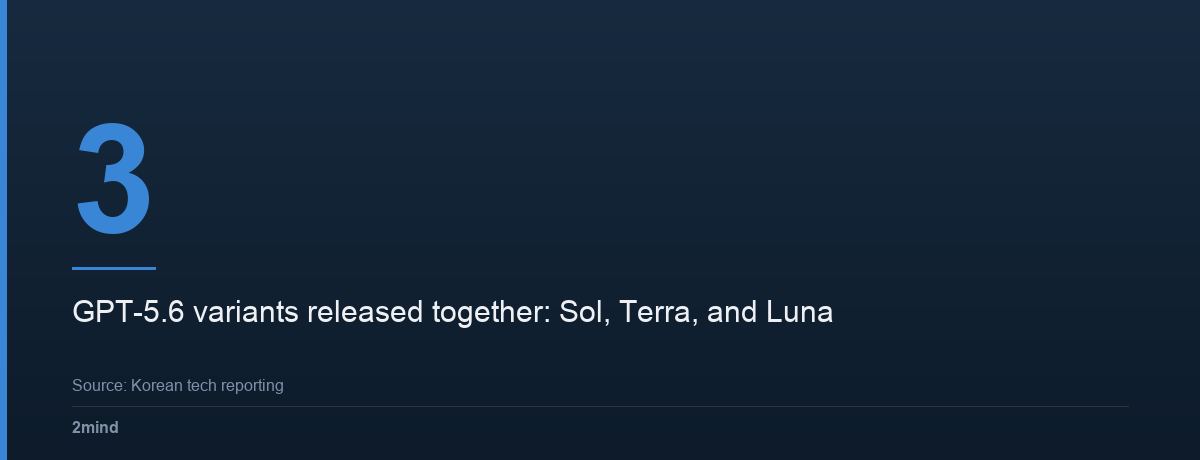
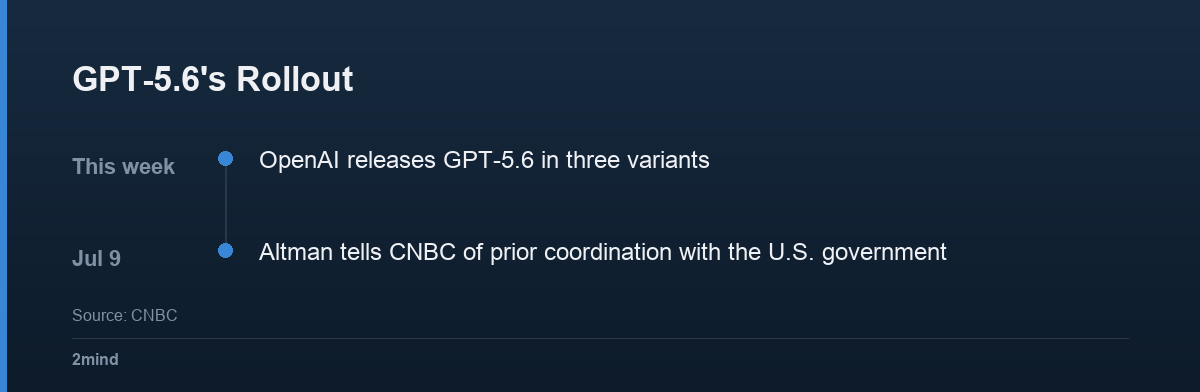
OpenAI released its GPT-5.6 model family this week in three versions — Sol, Terra, and Luna — according to reporting cited by Korean tech outlets.
External benchmark evaluations reportedly showed the models maintaining top-tier intelligence scores while significantly cutting costs, which commentators described as an unusually strong cost-to-performance ratio for a flagship release.
The Luna variant in particular is said to be challenging GLM-5.2, which had been a benchmark leader.
Separately, and more notably from a policy standpoint, Sam Altman told CNBC on July 9 that the GPT-5.6 release involved close prior coordination with the U.S. government.
That’s a departure from his earlier public stance, in which he pushed back against government regulation of AI model launches. Altman’s comments came in an interview alongside discussion of U.S. policy figures, suggesting the coordination wasn’t informal.
What ‘cost-to-performance’ means for Luna’s benchmark position
Benchmark leadership and cost efficiency are usually a tradeoff — models get cheaper by getting smaller, or more capable by costing more to run.
Luna reportedly challenging GLM-5.2 while cutting costs is notable specifically because it claims both at once, which is why commentators flagged the ratio as unusual rather than just noting the benchmark score alone.
A model that’s merely competitive on intelligence scores but still expensive doesn’t shift adoption decisions the way a genuinely cheaper option does.
Whether that holds up outside benchmark conditions — in real production workloads with the kind of variance benchmarks don’t capture — is a separate question the available reporting doesn’t answer yet.
Cost-performance claims like this one are also the easiest kind of benchmark result to overstate, since ‘cost’ depends heavily on which workloads get measured and how.
Luna’s position against GLM-5.2 is also a reminder that benchmark rankings shift quickly in this market — a leader named this month is rarely the leader named six months later.
The two lenses
Lens one: Responsible maturation. One way to read this is that OpenAI is growing up.
As models get more capable, the argument that “we should just ship and let the market decide” becomes harder to defend, especially for a company whose products are used by hundreds of millions of people and increasingly touch sensitive areas like coding infrastructure, financial advice, and content generation at scale.
Altman’s own quote — that the industry needs to “prove safety” rather than simply assert it — suggests a recognition that public trust, not just technical capability, is now the bottleneck for AI adoption.
Under this lens, pre-launch coordination with regulators is a sign OpenAI is taking its systemic importance seriously, and possibly trying to get ahead of stricter rules before they’re imposed externally.
Lens two: Strategic regulatory capture. The more skeptical reading is that “close coordination with government” often benefits large incumbents more than it protects the public.
When the dominant player in a market voluntarily works with regulators to shape how new AI rules get written, smaller competitors and open-source labs — including Chinese developers building large open-weight models — may end up facing a regulatory environment tailored to what OpenAI can already comply with.
This isn’t unique to AI; it’s a pattern seen in finance, pharmaceuticals, and telecoms, where “safety-first” cooperation from a leader often becomes the template that locks in that leader’s advantage.
Whether that’s happening here is unclear from the available reporting, but the shift in Altman’s rhetoric — from opposing regulation to embracing coordination — is exactly the kind of move worth watching for that dynamic.
The specific quote worth sitting with
Altman telling CNBC the industry needs to ‘prove safety’ rather than assert it is a meaningfully different framing than his earlier public resistance to regulating model launches.
Words like that tend to get quoted back at a company later, especially once regulation moves from voluntary coordination to binding rules.
The shift is notable regardless of which lens turns out to be right. A CEO who spent years arguing against pre-launch government involvement now describes close coordination as part of how his company operates.
That’s the kind of reversal that reshapes what ‘normal’ looks like for every lab that comes after, whether or not OpenAI intended it that way.
If competitors, including Chinese labs building large open-weight models, don’t get the same seat at the table OpenAI apparently had, the practical effect becomes clearer than the framing itself.
None of this means the coordination was improper. It means the rhetoric shift is measurable in a way that the substance of what was actually agreed to, so far, is not.
Why it matters
This affects three groups differently: consumers who use GPT-5.6 directly, competing labs (including Chinese firms reportedly building open-weight models with parameter counts in the trillions), and policymakers who are still drafting AI-specific legislation in multiple jurisdictions.
As we’ve discussed in prior coverage of AI benchmark races, cost-performance improvements tend to matter more for adoption than raw intelligence scores, so Luna’s positioning against GLM-5.2 is worth tracking over the next few months.
What I’d watch next is whether other major labs — Google, Anthropic, Chinese developers — follow OpenAI’s lead on pre-launch government coordination, or whether this remains an OpenAI-specific strategy that competitors decline to match.
It’s a subtle shift, but subtle shifts in how the biggest AI lab talks about government are usually worth paying attention to.
FAQ
Q. What’s different about GPT-5.6 compared to previous OpenAI releases?
A. According to benchmark reporting, GPT-5.6’s three variants reportedly achieve strong intelligence scores at notably lower cost than prior flagship models, which is being described as a favorable cost-performance tradeoff.
Q: Did OpenAI change its policy stance because of new regulation?
A: Not exactly — no new binding regulation was cited in this reporting. Altman described the shift as voluntary coordination with the government prior to release, not compliance with a newly passed law.
What would change our view
I’m treating the regulatory-capture reading as a possibility worth watching, not a conclusion — the available reporting doesn’t show what was actually discussed in that coordination.
My view would firm up if future AI rules visibly track OpenAI’s existing compliance posture more closely than competitors’ approaches.
It would ease if Google, Anthropic, and open-weight labs get comparable pre-launch access to the same officials, or if OpenAI’s coordination turns out to be informal and non-binding.
Sources
- OpenAI Developer Community — 2026-07-09. OpenAI released GPT-5.6 in three variants — Sol, Terra, and Luna
- CNBC — 2026-07-09. Sam Altman told CNBC release involved close prior coordination with US government
- LLM Stats — 2026-07. Luna variant challenges GLM-5.2's benchmark position
Leave a Reply