I’ve watched enough tech partnerships fall apart to know that the friendliest press releases often precede the ugliest lawsuits.
Key Takeaways
- Apple has filed a lawsuit against OpenAI alleging theft of AI hardware trade secrets, reported by Reuters and CNBC on July 10.
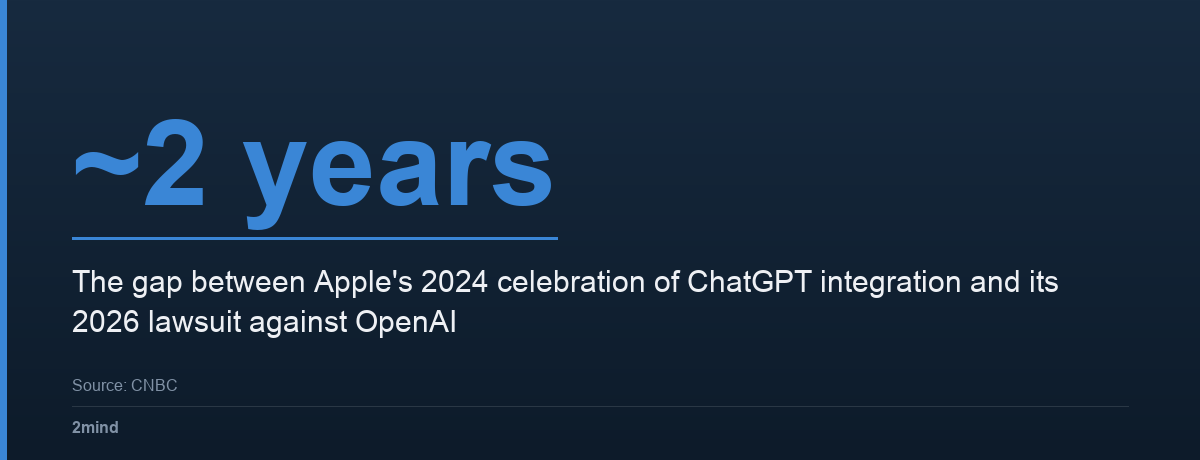
- The suit arrives roughly two years after the two companies publicly celebrated integrating ChatGPT into iPhones in 2024.
- The dispute signals that AI hardware — not just software models — has become the new battleground where former partners turn into courtroom rivals.
What happened
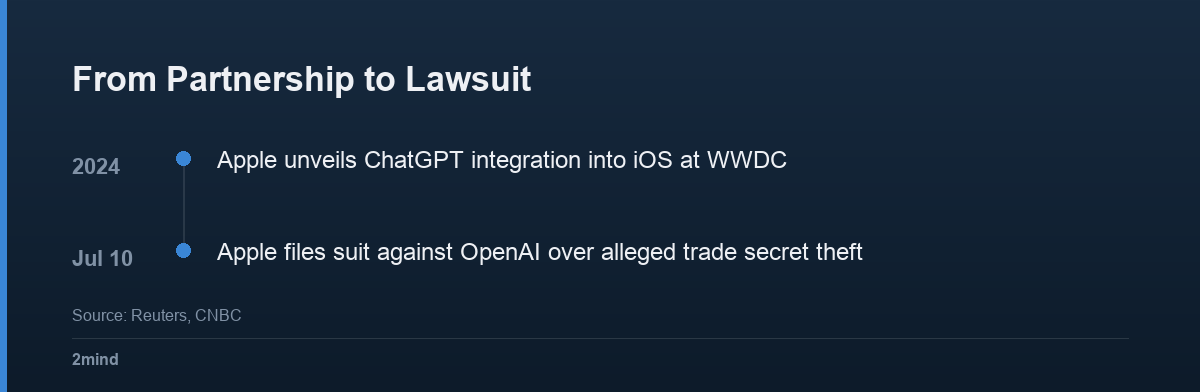
| 2024 | 2026 | |
|---|---|---|
| Public framing | Apple announces ChatGPT integration into iPhones at WWDC | Apple sues OpenAI over alleged trade secret theft |
| Reported by | Apple’s WWDC keynote | Reuters, CNBC (July 10) |
According to Reuters and CNBC, Apple has filed a legal complaint against OpenAI centered on alleged misappropriation of trade secrets related to AI hardware development.
What the last big Silicon Valley trade secret case actually cost
The closest recent precedent for a headline AI-adjacent trade secret suit between two well-resourced tech companies is Waymo v. Uber (2017-2018), over self-driving car technology. Waymo sought $1.9 billion in damages. The case settled — five days into trial, before a jury verdict — for $245 million in Uber equity, roughly 13% of what Waymo had asked for, according to reporting from IPWatchdog, NBC News, and CNBC at the time.
| Waymo v. Uber (2017-2018) | Apple v. OpenAI (2026) | |
|---|---|---|
| Damages sought | $1.9B | Not yet disclosed |
| Outcome | Settled for $245M equity (~13% of ask) | Pending |
| How it ended | Settled mid-trial, no jury verdict | Unknown |
That precedent is a useful anchor for expectations, not a prediction: the pattern in comparable cases is that headline damages figures get discounted sharply in settlement, and most never reach a jury verdict at all. If Apple v. OpenAI follows the same arc, the number that eventually matters won’t be whatever figure appears in early coverage — it will be a settlement reached well below it, likely before either side’s internal roadmaps are exposed in discovery.
The timing stands out: it was just 2024 when Apple’s WWDC announcement of ChatGPT integration into iOS was treated as one of the biggest AI partnership stories of the year, positioning Apple as pragmatic about working with an outside AI leader rather than building everything in-house.
Two years later, that same relationship has apparently deteriorated into what CNBC’s coverage frames as a dispute over confidential hardware designs and engineering approaches — the kind of dispute companies typically only pursue in court when internal negotiations have completely broken down.
Neither company has publicly detailed the full scope of the alleged trade secrets in question, based on available reporting, but the fact that Apple — a company famously litigation-averse when it comes to airing disputes publicly — chose to sue rather than settle quietly, suggests the stakes are considered significant internally.
Two years is a meaningful gap in a legal dispute like this. Trade secret claims typically require a company to show it took the misappropriation seriously from close to when it discovered it — which suggests whatever prompted this lawsuit either surfaced fairly recently or took considerable internal review before Apple decided litigation was the right response.
The framing point about Apple’s litigation history is worth grounding further. Apple has pursued IP disputes before, typically against rival hardware makers building competing products — not against a company it had just publicly partnered with two years earlier. That pairing, a recent collaborator turned defendant, is what makes this dispute distinct from Apple’s usual pattern.
Neither company’s silence on specifics should be read as confirmation either way. Active litigation is precisely the situation where both sides have the strongest incentive to say as little as possible publicly, which means most of what’s known right now comes from the fact of the filing itself, not its contents.
The two lenses
Lens one: This is standard competitive friction as AI moves into physical devices. Apple has spent years developing proprietary silicon and device architecture, and any serious hardware collaboration — even an informal one built around software integration — inevitably involves sharing sensitive technical details about power management, thermal design, or on-device inference capabilities.
OpenAI, meanwhile, has been reportedly exploring its own hardware ambitions, including past reports of device projects. In this reading, some legal friction was almost inevitable once two companies with overlapping hardware interests worked closely together, and this lawsuit is simply Apple protecting its IP the way it has against many other companies over the decades.
Lens two: This marks a structural shift in the AI industry’s power dynamics. For the past several years, the dominant AI story was software — models, chatbots, benchmarks.
This lawsuit suggests the real prize now is who controls the hardware layer where AI actually runs efficiently: on-device chips, low-power inference silicon, and the physical form factor of AI products.
If Apple believes OpenAI took hardware insights gained through their software partnership and is now using them independently, that reframes the entire 2024 “friendly integration” narrative as something closer to a Trojan horse.
This connects to what we’ve been noting about SK Hynix’s blockbuster Nasdaq debut this same week — the fight over who supplies and controls AI compute hardware is intensifying across the entire industry, not just between Apple and OpenAI.
The two lenses split mainly on how much good faith to assume between two companies with overlapping hardware interests. Lens one assumes friction was structurally likely once real collaboration began. Lens two assumes something crossed a line severe enough to justify a public complaint from a company that usually resolves disputes quietly.
What would help distinguish between them is scope. A narrow claim about a specific design detail looks more like the ordinary friction Lens one describes. A broad claim touching multiple areas of hardware development would support the more serious reframing of the 2024 partnership that Lens two suggests.
Both lenses also share an assumption worth naming: that AI hardware is now valuable enough to fight over in court. A dispute over on-device inference silicon between a phone maker and a chatbot company would once have been a strange sentence. That it isn’t anymore is itself part of the story.
Why it matters
This matters to every company currently negotiating AI partnerships with hardware-adjacent components, because it signals that today’s collaborator can become tomorrow’s litigant once product roadmaps diverge. It matters to OpenAI’s broader hardware ambitions, which now face public scrutiny during active litigation.
And it matters to Apple’s own AI strategy, which has already faced criticism for lagging behind competitors — a public trade secret dispute could either validate that Apple has more proprietary hardware AI work underway than assumed, or expose how dependent it had become on OpenAI’s technical input.
What’s worth watching next is whether either company seeks a swift settlement to avoid discovery exposing internal roadmaps, or whether this becomes a prolonged court battle that reveals real details about how AI hardware integration actually works behind the scenes.
I’d treat this as an early signal of where AI competition is heading, not a one-off spat.
The SK Hynix connection mentioned in the piece is a useful reminder that this dispute isn’t happening in isolation. Hardware supply and control have become contested ground across the AI industry broadly, not just between Apple and OpenAI specifically, which is part of why this case is being watched beyond the two companies directly involved.
For companies currently negotiating their own AI hardware partnerships, the practical lesson isn’t about who’s right here — it’s that even friendly, publicly celebrated integrations can leave enough ambiguity around shared technical knowledge to end up in court once the parties’ roadmaps diverge.
I’d also flag that litigation outcomes rarely arrive on the timeline outside observers expect. Trade secret cases in particular can stretch for years before any public resolution, which means this story is more likely to fade from headlines long before it’s actually settled.
FAQ
Q. What exactly is Apple accusing OpenAI of doing?
A. Based on Reuters and CNBC reporting, Apple alleges OpenAI misappropriated trade secrets related to AI hardware development, though the full technical details haven’t been made public.
Q. Does this affect the ChatGPT integration currently in iPhones?
A. Available reporting doesn’t indicate the existing iPhone ChatGPT integration is being removed or altered as a result of the lawsuit; the dispute appears focused on hardware trade secrets rather than the current software feature.
What would change our view
If Apple and OpenAI settle quickly without public disclosure of the underlying technical details, the ordinary-friction reading in Lens one would gain support.
If this proceeds to discovery and surfaces evidence of deliberate misuse of shared hardware information, that would strengthen the more serious reframing described in Lens two.
Sources
- [Apple suing OpenAI over alleged trade secret theft] — CNBC
- [Uber settles trade secret case with Waymo for $245 million] — IPWatchdog
Leave a Reply