
Key Takeaways
- We installed Anthropic’s official
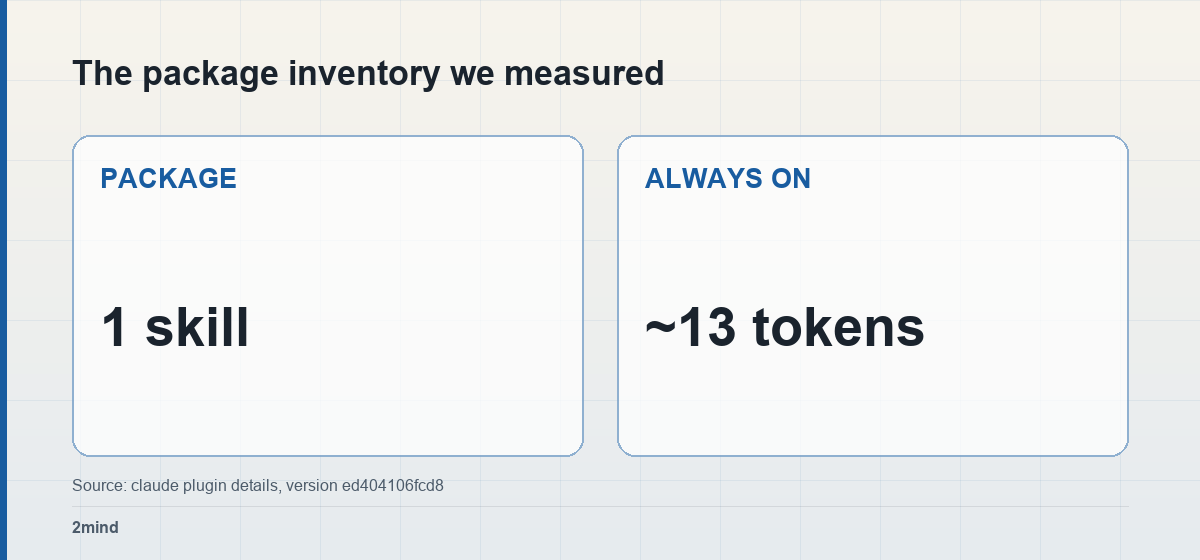
code-reviewplugin and found 1 skill and 0 packaged agents, hooks, MCP servers, or LSP servers. A skill may still orchestrate agents at runtime; they simply were not separate package components. marketplace addonly registers a catalog. The plugin became usable only after the separateplugin installcommand.- For version
ed404106fcd8, Claude Code estimated ~13 always-on tokens and ~1,800 when invoked. Re-run the details command after updates because these are version-specific estimates.
Anthropic opened an official plugin marketplace for Claude Code, and the honest answer to “should you use it instead of a skill” is: it depends on what the plugin actually contains, not on the word “plugin.”
We applied the same rule from our repeat-task test of AI agents: run the tool and inspect its boundary instead of trusting the label. The official code-review package contained one skill and no packaged agents, hooks, MCP servers, or LSP integrations.
What We Ran and How to Reproduce It
We ran three commands, in this order, against the official Anthropic marketplace:
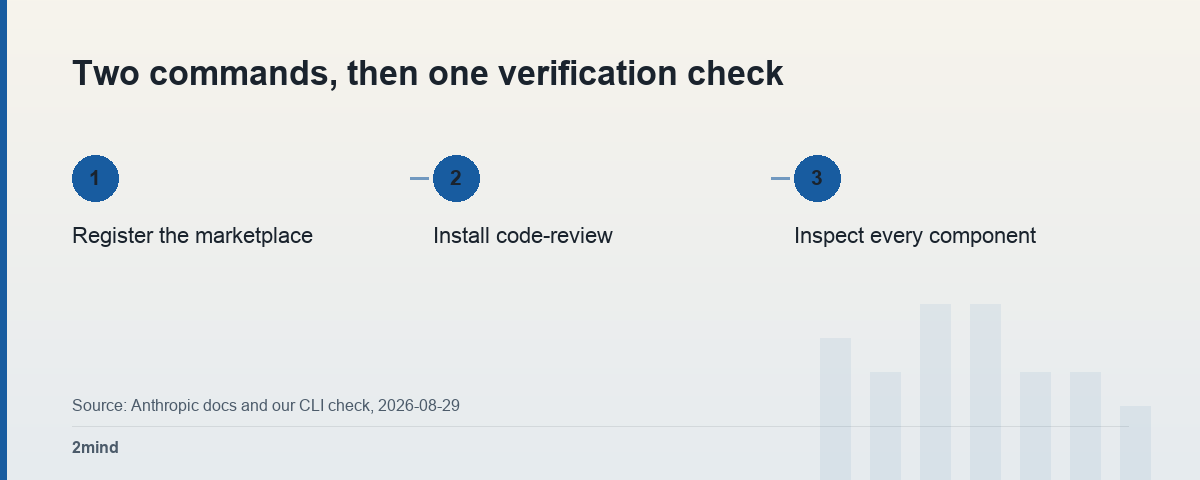
claude plugin marketplace add anthropics/claude-plugins-official
claude plugin install code-review@claude-plugins-official
claude plugin details code-review@claude-plugins-official
The first command alone did not make code-review usable. The marketplace was registered — Anthropic’s repository was now a known source — but the skill itself did not show up in our active plugin list until the second command ran.
Anthropic’s own docs describe this as a deliberate two-step design (“Add the marketplace… No plugins are installed yet” → “Install individual plugins”), and our test matched that description exactly. If you only run marketplace add and stop, you have added a catalog, not a capability.
We repeated the details command on August 29, 2026. For version ed404106fcd8, it returned one skill, no other packaged components, about 13 always-on tokens, and about 1,800 tokens on invocation. Claude Code explicitly labels token counts as estimates that may differ from actual usage.
That version detail matters. Our earlier August 28 check showed higher estimates, which means a naked token number goes stale when plugin contents change. Treat claude plugin details as a versioned snapshot, not a permanent price tag.
A Short Checklist Before Installing a Plugin Instead of Writing a Skill
- Check the component count first.
claude plugin detailsbefore deciding whether this is “just a skill” or something with agents and hooks attached. - Check for a name collision against your existing skills directory before installing.
- Remember
addandinstallare two steps. Registering a marketplace does not activate anything inside it. - Record the plugin version with the estimate. Otherwise a future update can change the number while the article still looks current.
Beyond code-review, the same official marketplace lists several other packaged plugins — session-report, plugin-dev, security-guidance, and frontend-design among them, per the repository’s own directory listing. We only installed and checked code-review; we’re not claiming the same component breakdown or token estimate for the others without checking each one the same way.
Skill, Plugin, or Marketplace: What Each Word Actually Means
The three terms get used loosely, including by us before today. Here’s what we could verify by installing one, not by reading a glossary.
| Component | Meaning | Action |
|---|---|---|
| Skill | Runtime instruction file | Add the file |
| Plugin | Bundle of skills and optional tools | Install the package |
| Marketplace | Catalog of plugins | Register the source |
A plugin is a container. What’s inside the container is the thing that actually matters, and the interactive /plugin panel does show a component breakdown before you install — but the fastest way to check from a script or a terminal you’re not sitting in front of is claude plugin details, which is what we used.
Two Lenses
The Mistake We Almost Made: Treating “Plugin” as a New Skill System
Our first instinct, before installing anything, was to assume a marketplace plugin would be a heavier, more capable version of a skill — something that might make our hand-written skills redundant. That assumption didn’t survive the install.
code-review unpacked to exactly one skill: the same file format we already write by hand in .claude/skills/. The marketplace didn’t add a new capability tier above skills.
It added a distribution channel for the same building block, plus optional room for agents, hooks, and MCP servers if a plugin author chooses to include them. Nothing here forced us to rethink our existing skill files.
What We Actually Checked Before Trusting the Install
The question that mattered more than “does it work” was “what did we just add, and what does it cost.” We ran claude plugin details rather than taking the marketplace description at face value.
That exposed both the component breakdown and a useful discrepancy: the description mentions specialized agents, while the package inventory contains no separate agent components.
We also checked our own .claude/skills/ directory for a name collision before installing. There wasn’t one, but that’s worth checking every time — a plugin skill and a project skill with the same trigger words can both try to answer the same request.
It’s the same “check the boundary, don’t assume it” habit we wrote about when drawing the line between an AI copilot and an autonomous agent: the label on the box tells you less than opening it.
What Would Change Our View
If a future plugin from the same marketplace bundles multiple agents, hooks, or an MCP server inside one install, the “it’s basically a skill” read above would need to change — that would be a genuinely heavier unit than what we tested.
code-review happened to be the simplest possible case. We’re not claiming the marketplace’s other plugins (session-report, plugin-dev, security-guidance, and more) are equally light without checking each one.
FAQ
Q. Is a Claude Code plugin the same thing as a skill?
A. Not necessarily. A plugin is a package that can contain a skill, an agent, a hook, an MCP server, or a combination of these. The one we installed and checked, code-review, contained exactly one skill and nothing else — but that’s a property of that specific plugin, not a rule for all plugins.
Q. Does installing an official marketplace plugin overwrite our own project skills?
A. In our case, no — we checked our .claude/skills/ directory for a naming conflict before installing code-review and found none. We can’t confirm what happens if a plugin skill and a project skill share the same name, because that’s not the scenario we tested.
Q. Does registering a marketplace automatically install everything in it?
A. No. marketplace add only registers the source. The plugin did not appear as usable until we separately ran plugin install for that specific plugin.
Sources
- GitHub,
anthropics/claude-plugins-official— official Anthropic-managed plugin directory, confirmed repository structure (plugins/,external_plugins/). - Anthropic, “Discover and install prebuilt plugins through marketplaces” — confirms the two-step add/install process and that the official marketplace auto-registers on first interactive launch.
- Anthropic, “Plugins reference” — component and command specifications.
- Anthropic, “Create plugins” — plugin structure and submission process.
Leave a Reply