Meta’s pledge to distribute AI power to “every individual” is only partly verified so far. One open model checks out; a $1 billion fund and a jobs program don’t have public numbers yet.
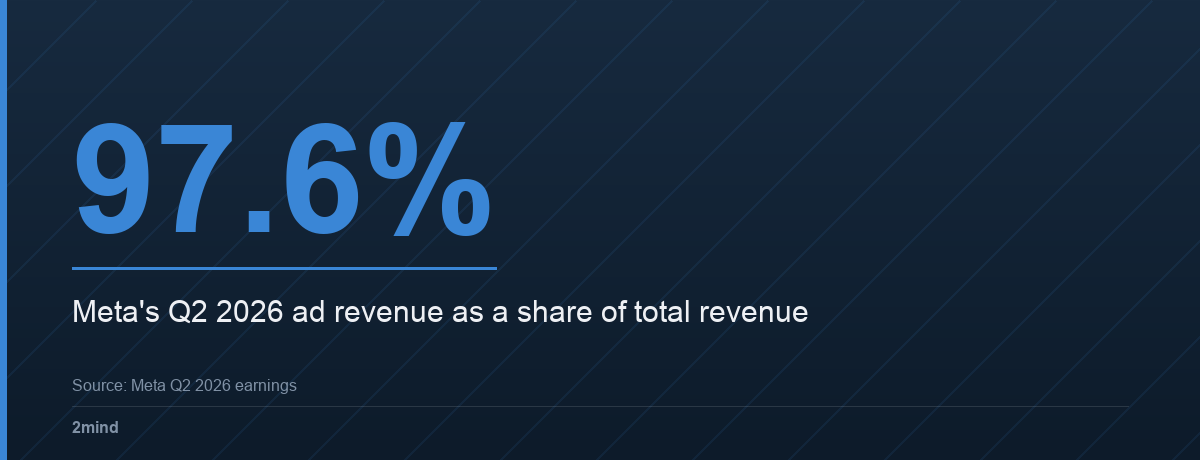
The business funding all of it still pulled 97.6% of its revenue from advertising last quarter — a model built on watching individuals closely, not handing them power.
Mark Zuckerberg made the wider promise in an August 10 essay, arguing AI should reach “every individual” rather than stay concentrated among a handful of labs or governments. That gap doesn’t prove the pledge is empty — some of it already checks out. Below is what’s verified, what isn’t, and how the numbers actually compare.
Key Takeaways
- Zuckerberg’s essay argues AI should go to “every individual” rather than concentrate among a few companies, calling this “personal superintelligence.”
- Meta released Muse Glimmer, a 30-billion-parameter model, under an Apache 2.0 license with no monthly-user cap — its first fully ungated release since Llama 4 added a 700M-MAU clause.
- The accompanying $1 billion community fund targets towns near Meta’s own data centers. That figure is under 1% of Meta’s disclosed 2026 AI capex range of $130–145 billion.
- 97.6% of Meta’s $60.8 billion Q2 2026 revenue came from advertising — the business the empowerment pledge doesn’t touch.
What Did Zuckerberg Actually Promise?
The essay, titled “The Future Is for Everyone,” lays out a philosophy rather than a product roadmap. “We propose a philosophy based on individual empowerment as the source of prosperity, invention as the primary purpose of superintelligence, and balance of power as the foundation of safety,” Zuckerberg wrote.
On open models specifically, the essay is narrower than the headline framing suggests: “Now that Meta Superintelligence Labs are up and running, we will resume releasing some open source models soon.” Not all models. Not on a stated schedule.
Three concrete things shipped alongside the essay: Muse Glimmer, the $1 billion “Future Is for Everyone Fund,” and confirmation that Meta’s worker training program, America’s Workforce Academy, had graduated its first class. It’s the latest move in what we’ve tracked as Meta’s four-layer AI strategy — infrastructure, models, distribution, and now, public positioning.
What’s Verified So Far?
| Pledge | Confirmed | Still unclear |
|---|---|---|
| Open model | Muse Glimmer, Apache 2.0, no user cap | Whether frontier-class models (Muse Spark tier) get the same terms |
| Community fund | $1B fund, targets data-center host towns | Selection criteria and disbursement timeline not published |
| Jobs program | Workforce Academy graduated its first class | Total worker count and placement numbers not disclosed |
Muse Glimmer is the clearest win for the pledge. It’s a 30B-parameter model built for local, offline agent tasks, and unlike Llama 4’s license, it carries no revenue or user-count gate. Developers can download, fine-tune, and ship it without asking Meta first.
That’s a real, checkable difference from Meta’s last two years of “open-ish” releases, which we compared against four other labs’ license files in an earlier piece.
The fund and the jobs program are announced, not yet measurable. Meta has named a dollar figure and a program name; it hasn’t published who qualifies, how much has moved, or how many workers have gone through training. Those are the parts of the pledge that still rest on a company’s word.
How Big Is the $1 Billion Fund, Really?
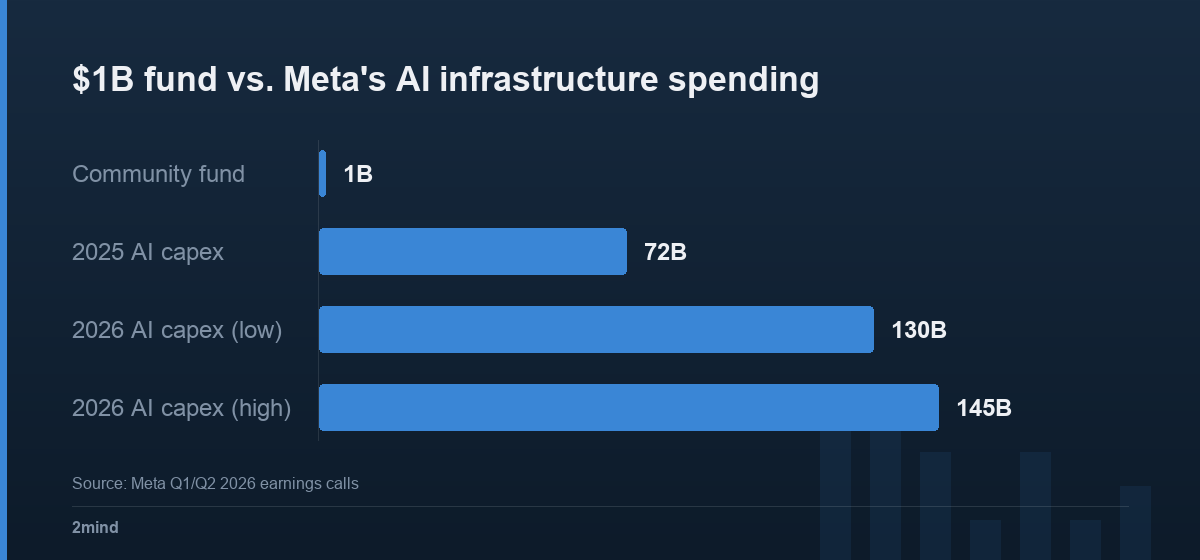
Meta guided 2026 capital expenditure to $130–145 billion, up from roughly $72 billion in 2025. The company describes the increase as “almost entirely” AI infrastructure.
Set the $1 billion fund next to that range and it comes out to 0.7–0.8% of this year’s AI spending alone — our own division, not a figure Meta has published as a ratio.
That doesn’t make the fund meaningless to the towns receiving it. A billion dollars split across a handful of data-center counties is real money locally. But measured against what Meta is spending to build the infrastructure the essay’s “superintelligence” runs on, the fund is a rounding error, not a counterweight.
Why Does the Ad Business Still Matter Here?
The essay’s core claim is that AI should empower individuals rather than concentrate power in a few hands. Meta’s own revenue structure sits awkwardly next to that claim. Advertising made up $59.36 billion of Meta’s $60.80 billion Q2 2026 revenue, per the company’s own earnings report. That business works by profiling individual users precisely enough to predict what they’ll click.
None of the August 10 announcements change that ratio. Muse Glimmer doesn’t touch the ad stack, and the $1 billion fund is aimed at physical communities, not ad-targeted users. The company distributing “personal superintelligence” still earns almost all its money from knowing individuals better than they’d choose to be known.
That’s not a contradiction Zuckerberg needs to resolve to be sincere about the open model or the fund. It’s a reminder that “personal superintelligence” describes the AI Meta is releasing, not the business funding its release.
How Do You Check an AI Company’s Pledge Like This One?
Before treating any lab’s “open” or “for everyone” announcement as settled, we check three things:
- The license file itself, not the press release describing it — Meta’s own Muse Glimmer license on Hugging Face confirms the no-gate terms.
- Whether the dollar figure is measured against something, like total spending, or just stated on its own — Meta hasn’t published the $1B fund as a share of anything.
- Whether the company’s core revenue model changed, or only the side project did — Meta’s ad-revenue share is unchanged from before the essay.
Two Lenses
Trusting the license because, this time, there’s no catch
Muse Glimmer really did ship without the gate that made Llama 4 controversial. For a developer who got burned budgeting around a 700M-MAU clause before, an Apache 2.0 license with nothing hidden in it is worth taking at face value — that’s a specific, checkable improvement over Meta’s last open release, not a marketing claim.
Noticing the business the license doesn’t touch
The same reader who trusts the license can still ask what it costs Meta to give it away. A 30B local-agent model doesn’t compete with the ad-ranking systems that generate 97.6% of Meta’s revenue. Giving away a model that doesn’t threaten the core business is a smaller bet than the essay’s language suggests.
What would change our view
If Meta releases a Muse Spark-class frontier model under the same no-gate terms as Muse Glimmer, or publishes concrete disbursement numbers for the $1 billion fund, that would narrow the gap between the essay’s language and what’s actually measurable.
If Meta’s ad-revenue share keeps climbing while capex for “personal superintelligence” infrastructure grows even faster, that would weigh against reading the essay as a shift in how the company itself operates, rather than a description of what it ships to others.
FAQ
Q. Is Meta’s new AI model actually open source?
A. Muse Glimmer is released under Apache 2.0 with no user-count gate, which is closer to open source than Meta’s previous Llama 4 license. Whether Meta’s larger, frontier-class models get the same terms hasn’t been confirmed.
Q. How much of Meta’s revenue actually comes from AI products?
A. The company hasn’t broken that out. What’s disclosed is that advertising made up 97.6% of Meta’s $60.8 billion Q2 2026 revenue — AI is currently a cost center funded by that ad business, not yet a separate revenue line.
Q. Is the $1 billion fund the same as Meta’s AI investment?
A. No. The fund is a one-time $1 billion commitment to communities near Meta’s data centers. Meta’s 2026 AI infrastructure capex guidance is $130–145 billion — over 130 times the size of the fund.
Sources
- The Future Is for Everyone — Meta, Aug 2026
- Meta launches Muse Glimmer open-weight AI model — CNBC, Aug 2026
- Meta is back with Muse Glimmer — Hugging Face, Aug 2026
- Meta unveils $1B community fund — CryptoBriefing, Aug 2026
- Meta Q2 2026 earnings — ad revenue, capex guidance — Digital Applied, Jul 2026
- Meta capex tracker, 2025–2026 — Value Add VC, Aug 2026
Leave a Reply