Key Takeaways
- Hyperscalers depreciate AI servers over 5 to 6 years; critics say the real life is 2 to 3.
- Effective 2025, Amazon cut its server-life estimate to five years; Meta raised its own to 5.5.
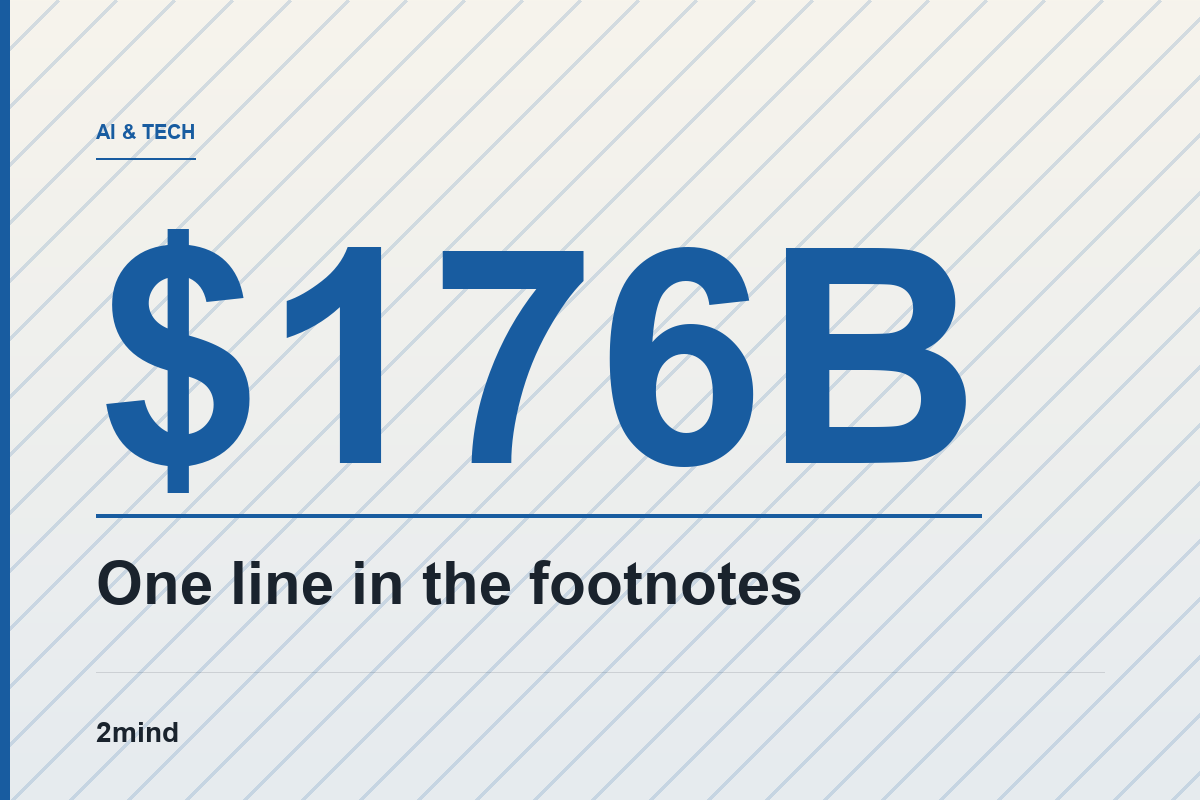
- Michael Burry estimates the stretch hides $176 billion of depreciation across Big Tech through 2028.
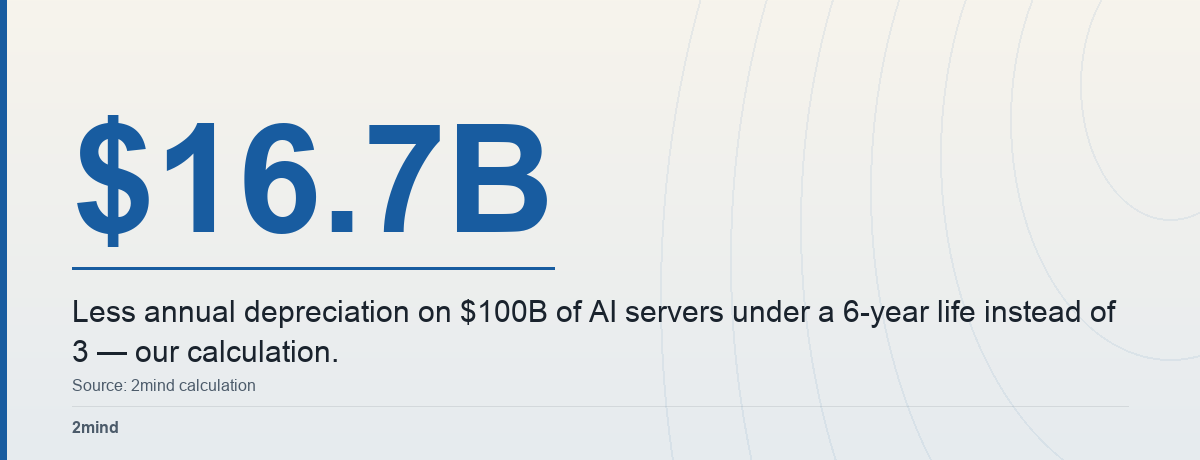
- On $100B of servers, six years instead of three adds about $16.7B a year to pre-tax profit (our math).
AI chip depreciation is how many years a company spreads a server’s cost across its profits. A longer estimate lifts reported profit now; a shorter one lowers it.
How AI Chip Depreciation Splits the Bill
When a company buys a server, the cash leaves at once. The income statement does not take the hit all at once. It spreads the cost evenly across the asset’s assumed useful life, a little each year.
A longer assumed life means a smaller slice per year, which means higher reported profit now. A shorter life front-loads the expense and lowers profit now.
Nothing about the cash changes. The money is already gone. What moves is the reported earnings number and the timing of tax.
The estimate turned into a public fight in November 2025. The investor Michael Burry laid out a short thesis built on it, then wound down his fund, calling stretched depreciation schedules “one of the most common frauds in the modern era.” The companies he named have not changed course.
That is why the estimate matters so much right now. Compute is a growing share of hyperscaler capital spending, and the four largest buyers are on track to spend well over $500 billion this year. A one-year change in the assumed life of that hardware moves tens of billions of reported dollars.
This is the same spending we tracked in when the AI buildout pays back. Depreciation is the clock that decides when it shows up as a cost.
It also sits below the gross-margin line we mapped in why AI cloud companies lose money at high margins. That is how a business can look profitable on one line and not the next.
What Four Companies Actually Assume
The filings show the big buyers moving in different directions.
Microsoft set its server and network equipment life at six years effective fiscal 2023, up from four. CFO Amy Hood told analysts the change would lift that year’s operating income by about $3.7 billion. Alphabet followed in 2023, raising servers from four years to six.
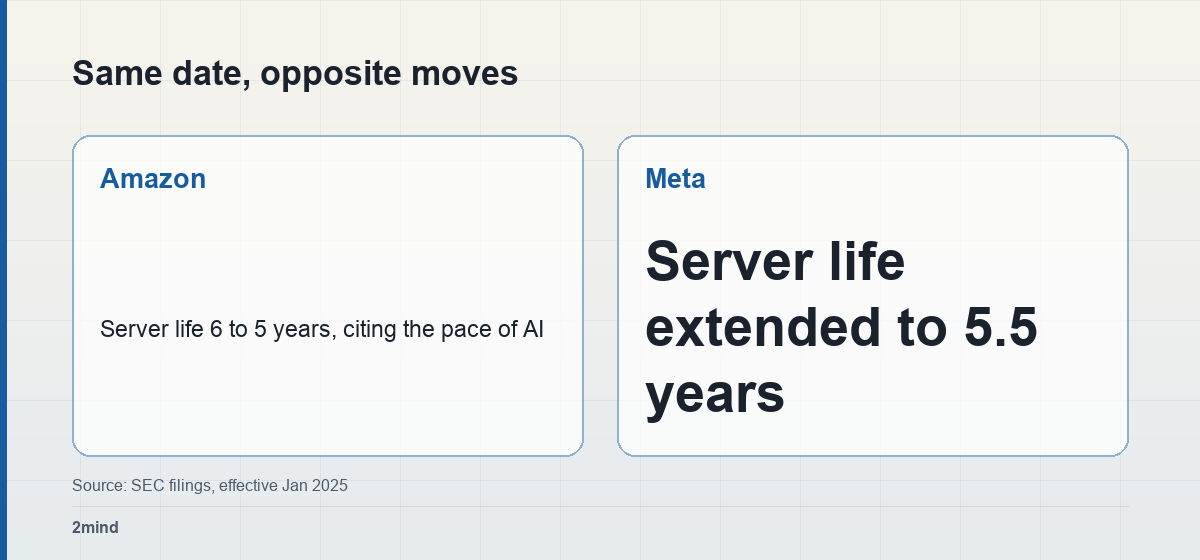
Then, effective January 2025, the two largest cloud operators split. Amazon shortened a subset of its servers from six years to five, citing “the increased pace of technology development, particularly in the area of artificial intelligence and machine learning.” Meta went the other way, extending certain servers and network assets to 5.5 years.
| Company | Server life assumed | Latest move | Effective |
|---|---|---|---|
| Amazon | 5 years | Cut from 6, citing AI pace | Jan 2025 |
| Microsoft | 6 years | Raised from 4 | FY2023 |
| Alphabet | 6 years | Raised from 4 | 2023 |
| Meta | 5.5 years | Extended from 4–5 | Jan 2025 |
Amazon’s own numbers show the direction of the shortening. It recorded roughly $920 million of accelerated depreciation in the fourth quarter of 2024, and the five-year estimate cut nine-month 2025 net income by $677 million versus the old six-year assumption.
Microsoft still uses six years, even as CEO Satya Nadella said in a November 2025 interview that he did not want “to go get stuck with four or five years of depreciation on one generation” of chips.
The Useful-Life Dial, Worked Out in Dollars
Here is what the estimate is worth, in money, on a fixed amount of hardware.
- Take $100 billion of AI servers placed in service, depreciated straight-line with no salvage value.
- At a three-year life, the annual charge is $33.3 billion. At five years, $20.0 billion. At six years, $16.7 billion.
- Moving the estimate from three years to six removes $16.6 billion of expense every year. Pre-tax income rises by the same amount.
- At the 21% US statutory tax rate, that is about $13.1 billion more reported net income a year, before a single extra sale.
This is not a hypothetical. Alphabet disclosed that its 2023 change from four years to six cut depreciation expense by $3.9 billion and raised net income by $3.0 billion, or $0.24 per share, in that year alone, on a base far smaller than today’s.
Burry’s estimate scales that logic across the industry: about $176 billion of understated depreciation from 2026 to 2028, with Oracle and Meta the most exposed, their profits overstated by roughly 27% and 21% by 2028 on his math.
Nvidia has pushed back, telling clients that customers settle on four-to-six-year lives based on how long the chips actually stay in use. Both sides are arguing about the same missing fact: how long an H100-class part earns its keep once a faster one ships.
Two Lenses
The pull to keep spending and the worry about the earnings live in the same shareholder.
The shareholder who wants the capex to keep flowing
If you own Microsoft or Meta, you do not want management to flinch on AI. A shorter useful life is a signal of caution. It says the company expects to replace the gear sooner, which raises the depreciation load and makes the buildout look more expensive.
On this reading, a six-year life is management backing its own demand forecast, and the higher near-term profit is a fair reflection of hardware that will keep serving cheaper workloads for years.
The same shareholder who wants the profit to be cash
The same person reads the earnings release and wants the profit to be real. Depreciation that lags the actual replacement cycle borrows earnings from later years. When the catch-up comes, it lands as a write-down in a quarter no one chose.
We lean toward this lens. The evidence points one way: Amazon shortening its estimate and taking an accelerated charge, and a CEO saying he does not want to be stuck with a long schedule on one chip generation.
The other case rests on a resale and re-use market for old GPUs. No one has shown that market holds up past a few years.
What Would Change Our View
A large accelerated-depreciation or impairment charge on current-generation GPUs at any hyperscaler would settle it. Amazon’s $920 million was small. A multi-billion write-down would confirm the short-life case.
The other direction: if rental and resale prices for H100-class hardware hold firm four and five years out, a six-year life is defensible, and Burry’s number shrinks.
We would also revisit this if the SEC pushes hyperscalers to disclose a useful-life estimate for GPUs on their own, separate from the blended “servers and network equipment” line they report today.
FAQ
Q. Does a longer useful life mean a company is doing something wrong?
A. Not by itself. Useful-life estimates are judgment calls, reviewed by auditors, and a company can reasonably expect a chip to serve lighter workloads for years after it leaves frontier training. The concern is direction: extending lives while the replacement cycle is speeding up.
Q. Which companies are most exposed?
A. On Burry’s estimate, Oracle and Meta, with reported profit overstated by roughly 27% and 21% by 2028. Both lean on longer schedules against fast-growing compute bases.
Q. Do shorter useful lives hurt cash flow?
A. No. Depreciation is a non-cash entry; the money left when the chips were bought. A shorter life lowers reported profit and can reduce near-term taxable income. It does not touch the bank balance.
Sources
- Amazon Q3 2025 10-Q — SEC, Oct 2025
- Alphabet 2023 10-K — SEC, Feb 2024
- Microsoft extends server life to six years — Computer Weekly, Aug 2022
- How long before a GPU depreciates? — CNBC, Nov 2025
- Burry’s AI depreciation thesis, explained — Fortune, Nov 2025
- Meta accounting move on AI servers to boost profit — Bloomberg via Yahoo Finance, Jan 2025
Leave a Reply