Key Takeaways
- A single AI agent uses about 4x the tokens of a chatbot reply; a multi-agent system about 15x (Anthropic).
- Nearly all of the cost is input tokens, re-sent on every step.
- The same task can vary up to 30x in tokens between runs (Stanford).
- Multi-agent pays off only for high-value, parallel work.
An AI agent runs in a loop, and every step re-sends its full history plus each tool result. Anthropic measured single agents at roughly 4x a chat exchange’s tokens, and its multi-agent system at 15x. Which tasks justify that is the real question.
Where Do the Tokens Actually Go?
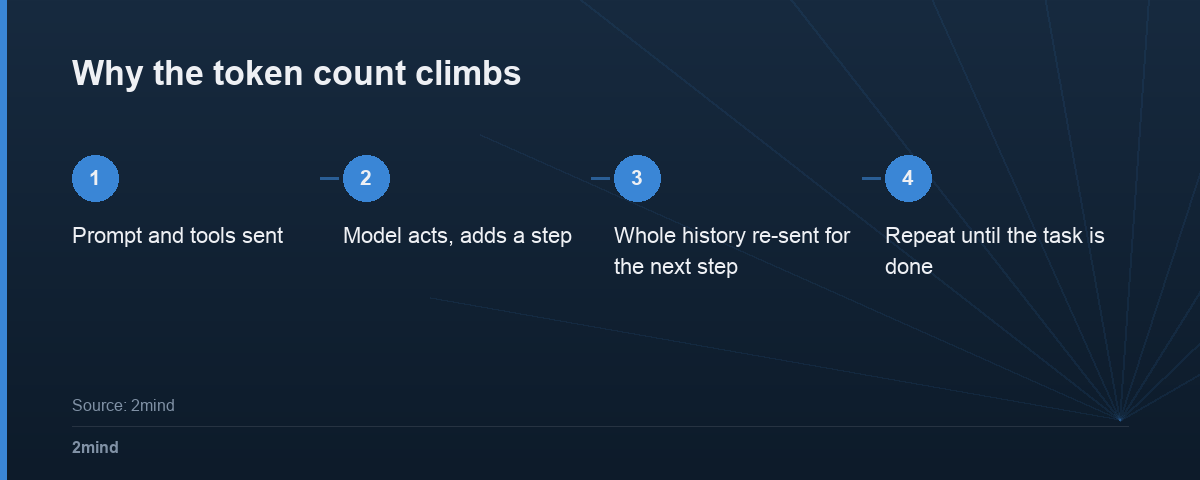
A chatbot answers in one pass. You send a prompt, it sends a reply, and the exchange is over. An agent does not stop there. It plans, calls a tool, reads the result, and decides what to do next, often ten or twenty times before it finishes.
Each of those steps sends the whole conversation so far back to the model: the original instructions, every earlier step, and every tool output.
The Stanford Digital Economy Lab found that for agentic coding, input tokens rather than output tokens drive the expense, and that the same task can consume up to 30 times more tokens on one run than another.
That unpredictability is the hard part. In the Stanford tests, frontier models asked to predict their own token use managed only weak correlations, up to 0.39, and “systematically underestimate real token costs.” The people writing the budget are working from the model’s own low guess.
This cost question is separate from whether you can trust an agent’s output or how much control you hand it. An agent can be reliable and still be expensive to run.
The Token Multiple, Worked Out in Dollars
Uber’s engineering organization spent its entire 2026 AI budget in roughly four months, after Claude Code use jumped from 32% to 84% of its engineers. “I’m back to the drawing board, because the budget I thought I would need is blown away already,” CTO Praveen Neppalli Naga told Fortune.
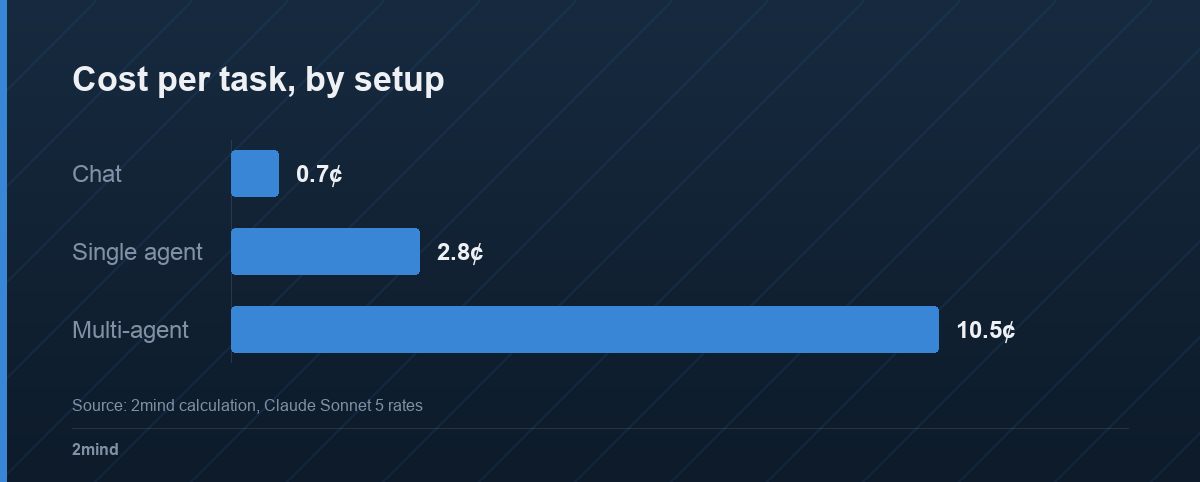
Anthropic’s numbers are token multiples, not prices. Here is the same thing in money, using Claude Sonnet 5 list rates of $2 per million input tokens and $10 per million output tokens.
Assume one chat turn is 1,000 input tokens and 500 output tokens, a short question with a paragraph answer. Then apply Anthropic’s measured multiples.
| Setup | Tokens vs chat | Cost per task | Per 10,000 tasks/month |
|---|---|---|---|
| One chat turn | 1x | $0.007 | $70 |
| Single agent | about 4x | $0.028 | $280 |
| Multi-agent | about 15x | $0.105 | $1,050 |
Three steps reproduce it:
- Price one chat turn at your model’s own rate.
- Multiply by 4 for a single agent, or 15 for a multi-agent system, using Anthropic’s measured averages.
- Multiply by your monthly task volume, then roughly double it to cover the runs that go long.
The table is a floor, not a forecast. Agents skew harder toward input tokens than this even split assumes, and the 30x run-to-run spread means a bad month costs far more than the average.
Why Do Two Labs Disagree on Multi-Agent Systems?
Anthropic and Cognition have both published what they learned building agents, and they landed in different places.
Anthropic’s position is that multi-agent is worth the tokens for the right work. Its research system, with a lead agent and several subagents, “outperformed single-agent Claude Opus 4 by 90.2% on our internal research eval.”
The conditions it names are specific: “tasks where the value of the task is high enough to pay for the increased performance,” plus “heavy parallelization, information that exceeds single context windows, and interfacing with numerous complex tools.”
Cognition, which builds a coding agent, argues the opposite default. In “Don’t Build Multi-Agents,” it writes that “running multiple agents in collaboration only results in fragile systems,” because “the decision-making ends up being too dispersed and context isn’t able to be shared thoroughly enough.” Its advice: “just use a single-threaded linear agent.”
Both can be right. Anthropic is describing research, which splits into independent strands. Cognition is describing coding, where each change depends on the last and a second agent working in parallel breaks things. Anthropic says as much: coding “involve[s] fewer truly parallelizable tasks than research.”
This is the same cost pressure we tracked in why AI cloud companies lose money even at high margins: the inputs to AI work keep getting more expensive faster than the price charged for it.
Two Lenses
The pull toward agents and the fear of the bill live in the same decision.
Letting the agent decide how hard to work
The appeal of an agent is that you stop specifying steps. You describe the goal and let it choose how many tool calls, how many retries, how much reading it needs. For a task you would otherwise do by hand, paying 4x or 15x in tokens to not do it yourself can be an easy trade.
On this reading the token multiple is just the price of delegation, and a fair one when the work has real value.
Paying for a decision you cannot see in advance
The same freedom is why the cost will not sit still. The agent decides how hard to work, and it decides mid-run, after the budget is set. A task that averaged three cents can cost fifty on the run where it loops.
Uber’s fix is telling. It did not stop using agents; it cut its cost per token with prompt caching, changed the default model, and gave engineers a live view of their own spend. The multiple stayed. What changed was making it visible.
We lean toward the second lens for now. The delegation case depends on the average, and the average is the one number these systems are worst at predicting.
When Should You Split One Agent Into Many?
Anthropic’s and Cognition’s conditions combine into a short test. A no on any point argues for a single-threaded agent instead.
- Is the payoff large enough to absorb a roughly 15x token bill? Anthropic’s rule is that the value of the task has to cover the added cost.
- Does the work break into strands that run in parallel without waiting on each other? Research does. Most coding does not.
- Does the material genuinely exceed one context window? If it fits in one, a single agent keeps it coherent for less.
- Can the subtasks avoid sharing state? Cognition’s failure mode is dispersed decisions that conflict because context was not shared.
- Is there exactly one component that writes the final output? Multiple writers produce conflicting edits.
What Would Change Our View
Prompt caching changes the arithmetic. Cached input tokens bill at a fraction of the normal rate, and Uber cut its per-token cost partly that way.
If a team caches the stable part of the context and routes subagents to a cheaper model, a 15x token count can land closer to a 3x to 4x bill, and the delegation case gets stronger.
We would also revisit this if models get better at predicting their own token use. Today the correlation is weak. If it reached the point where a budget could be trusted, the risk premium on agents would drop.
And if a lab publishes a multi-agent result that beats a single agent on tightly coupled work like coding, Cognition’s default would be worth reopening.
FAQ
Q. Do more capable models use more tokens, or fewer?
A. It varies by model, not just by size. In the Stanford tests, Kimi K2 and Claude Sonnet 4.5 used over 1.5 million more tokens than GPT-5 on the same coding tasks. Token efficiency is now its own selection criterion, separate from benchmark scores.
Q. Is the 15x multiple fixed?
A. No. It is an average from Anthropic’s research workload. Simple agent tasks sit lower, long tool-heavy runs go higher, and the same task can vary up to 30x between runs.
Q. Does using a single agent avoid the problem?
A. It reduces it rather than removing it. A single agent still loops and re-sends its context, which is where the roughly 4x comes from. The jump to 15x is the coordination overhead of running several agents at once.
Sources
- How we built our multi-agent research system — Anthropic, 2025
- Don’t Build Multi-Agents — Cognition, June 2025
- How are AI agents spending your tokens? — Stanford Digital Economy Lab, May 2026
- How Do AI Agents Spend Your Money? — Bai et al., arXiv, April 2026
- Claude API pricing — Anthropic
- Uber blew through its 2026 AI budget in four months — Fortune, August 7, 2026
Leave a Reply