Key Takeaways
- CoreWeave closed the first investment-grade GPU-backed loan — $8.5B, rated A3 — in March 2026.
- GMI Cloud is now seeking its second such loan this year: $300M, for a Thailand site tied to Tencent.
- The collateral is the GPU. Hyperscalers say it lasts 5–6 years; critics say 2–3.
A GPU-backed loan is secured by the chips it buys, not the borrower’s general credit.
What Actually Secures a GPU-Backed Loan?
If the AI cloud company can’t pay, the lender’s fallback is the hardware and the contract behind it — not a claim on the whole balance sheet. That structure only started getting bond-market ratings in 2026.
We wrote in August about how Amazon and Meta quietly disagree on how long an AI server lasts. This is the other side of that chip: lenders now price debt against its resale value, while that disagreement stays unresolved.
A lender advances cash against a pool of GPUs, usually at a discount to their appraised value, plus the signed contract from whoever is renting that compute. Two things have to hold:
- The chips keep enough resale value to cover the debt.
- The customer keeps paying rent on time, for the life of the loan.
That is a narrower bet than a normal corporate loan. It does not depend on the borrower’s whole business — it depends on one cluster of hardware and one tenant.
Three Loans, One Structure
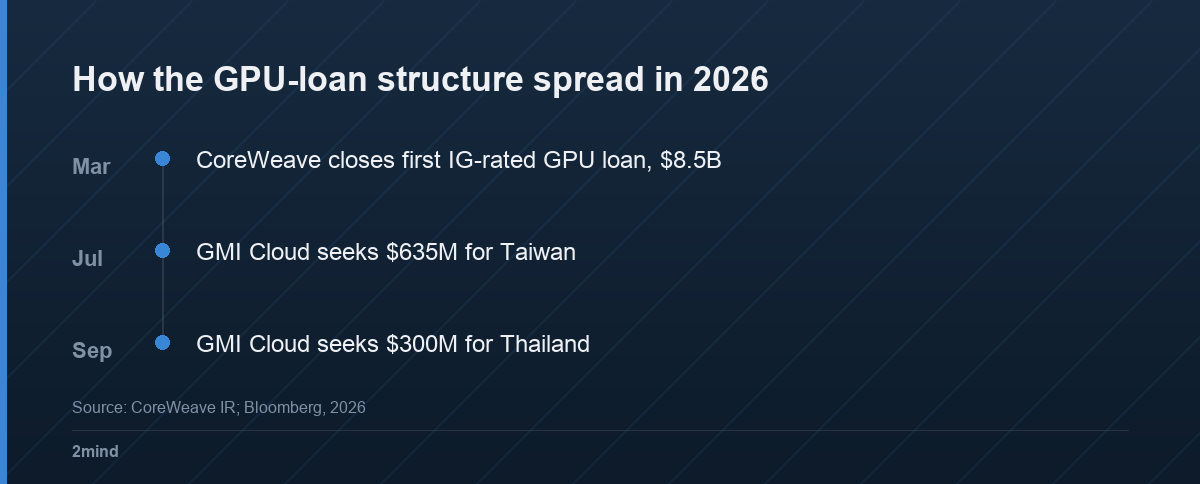
Three deals from 2026 show the same mechanism moving from novel to routine. Lining up the three report dates ourselves, we count one GPU-backed loan surfacing roughly every quarter since March — not proof of a trend, but the pace so far.
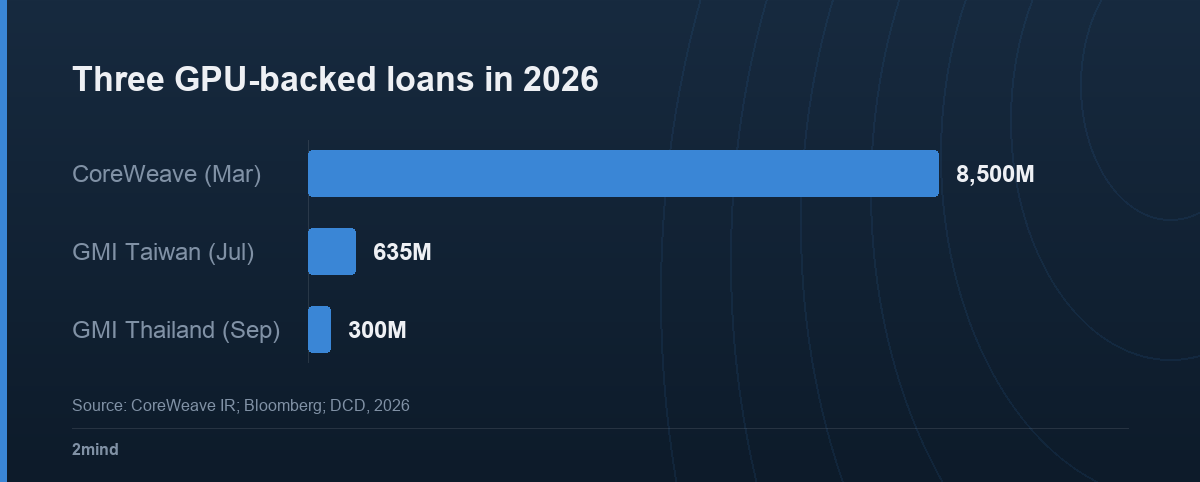
| Deal | Size | When | Backed by |
|---|---|---|---|
| CoreWeave | $8.5B | Mar 2026 | GPUs + Meta customer contract |
| GMI Cloud, Taiwan | $635M | Jul 2026 | GPUs + customer contracts |
| GMI Cloud, Thailand | $300M | Sep 2026 | GPUs + Tencent capacity deal |
CoreWeave’s deal was the first to get a bond rating at all — Moody’s A3, DBRS A (low). Rating agencies treated a GPU plus a Meta contract as a rateable asset for the first time.
GMI Cloud’s two deals since then did not need a first-of-its-kind rating. They just needed banks willing to lend against the same idea again.
Bloomberg reported the Thailand loan is priced at a low-teens yield — well above investment-grade corporate rates. The market still treats it as riskier than CoreWeave’s rated deal, even as the off-book side of AI financing keeps growing alongside it.
Why Would a Bank Rate a GPU Like a Bond?
Because the alternative — funding the AI buildout with pure corporate credit or equity — runs out of capacity faster than hyperscalers are ordering chips. Ring-fencing the loan to one cluster and one contract lets a lender say yes to a company it might not otherwise trust with unsecured debt.
That only works while two assumptions hold. GPU resale markets have to be liquid enough to actually recover value in a default. And the tenant — Meta, Tencent, whoever signed the offtake contract — has to keep needing that specific compute for the life of the loan, not just today.
Two Lenses
The lender who gets AI-boom returns without owning AI-boom equity
A GPU-backed loan pays a fixed yield — low-teens on GMI Cloud’s Thailand deal — for exposure to the same demand curve that is pushing Nvidia’s order book. No equity dilution risk, no waiting on an IPO. For a private-credit fund, that looks like the safer way into the trade.
The lender whose collateral has a shelf life the loan doesn’t match
The loan term runs several years. The chip does not get more valuable over that time — every hyperscaler depreciation schedule assumes the opposite. If a newer Nvidia generation arrives mid-loan and the tenant’s contract lapses, the lender is holding hardware in a resale market that has never been tested at this scale.
What Would Change Our View
We would treat this structure as durable, not experimental, if a GPU-backed loan actually defaulted and the lender recovered close to the collateral’s appraised value. Until that happens once, in public, the resale-value assumption is untested at scale — not proven wrong, just unproven.
FAQ
Q. What is a GPU-backed loan?
A. A loan secured by a pool of GPUs and the customer contract that rents them out, rather than by the borrower’s general credit.
Q. Why did CoreWeave’s deal get an investment-grade rating?
A. Rating agencies treated the GPUs plus a signed Meta contract as a rateable asset for the first time, in March 2026.
Q. What happens if a GPU-backed borrower defaults?
A. The lender’s fallback is seizing and reselling the hardware — a resale market for aging AI chips that has not been tested at this scale.
Sources
- CoreWeave Closes $8.5B GPU-Backed Financing — CoreWeave IR, Mar 2026
- GMI Cloud Seeks Loan to Buy Chips for Thai Site — Bloomberg, Sep 2026
- GMI Cloud Seeks $300M Chip-Backed Loan for Thailand — Investing.com, Sep 2026
- GMI Cloud Seeks $635M Loan Supported by GPU Contracts — DCD, Jul 2026
- GPU Debt Has Gone Investment Grade — Forbes, Jun 2026
Leave a Reply