
Nine months from kickoff to tape-out is fast. Whether it’s fast enough to matter is a different question entirely.
Key Takeaways
- OpenAI and Broadcom unveiled Jalapeño, a custom AI inference chip, completing tape-out in nine months — the fastest ASIC development cycle the companies say has been achieved in high-performance semiconductors.
- The announcement landed the same day Micron reported record quarterly revenue of $41.46 billion, driven largely by AI data center demand for high-bandwidth memory.
- The 2mind read: chip diversification looks real, but a tape-out is a milestone, not proof the chip performs at scale in production.
What happened
| Same-Day Signal | Move |
|---|---|
| Micron quarterly revenue | $41.46B (record), shares jumped after hours |
| Bitcoin | fell below $60,000, touching $58,131 on June 25 |
| Gold | traded at $3,972, below $4,000 |
On June 24, OpenAI and Broadcom unveiled Jalapeño, a custom accelerator built specifically for large language model inference.
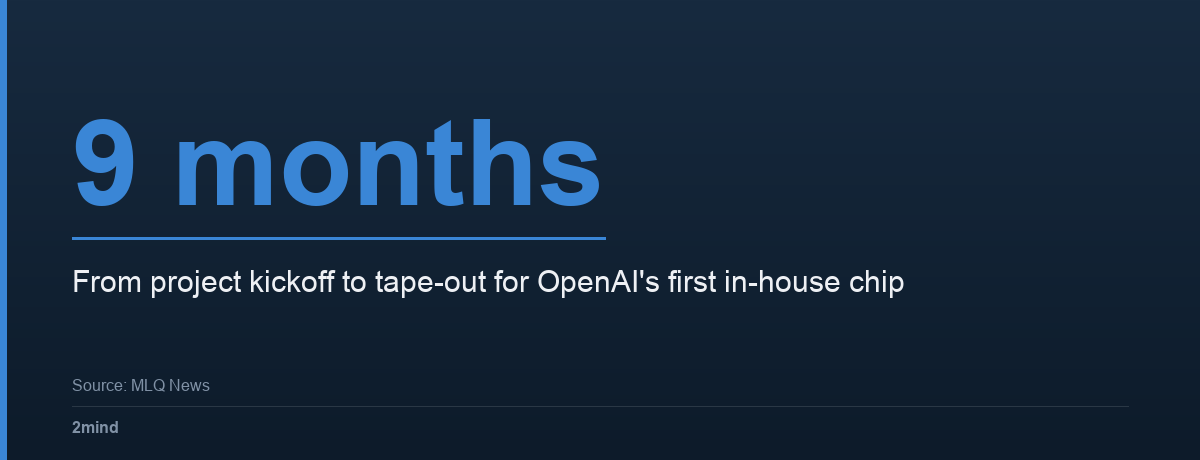
The tape-out — the point where chip design is handed off to manufacturing — was completed just nine months after development began, which the two companies called the fastest ASIC development cycle ever achieved in high-performance semiconductors. It is OpenAI’s first in-house silicon.
The announcement landed the same day Micron reported record quarterly revenue of $41.46 billion for the quarter ended May 28, driven by surging demand for high-bandwidth memory (HBM) from AI data centers, sending its shares higher in after-hours trading.
These two events, arriving within 24 hours of each other, are not coincidental. They represent the same structural shift viewed from two different angles.
Micron’s $41.46 billion quarter is worth sitting with. Memory chips have historically been one of the more cyclical corners of the semiconductor industry, prone to oversupply and price crashes.
A record quarter driven specifically by HBM demand suggests the AI buildout has moved past the GPU headline story. It’s now stressing the memory supply chain directly, which is a different kind of signal than one company’s earnings beat.
The two lenses
A nine-month tape-out buys OpenAI a design that’s ready for manufacturing, not a chip already running production inference traffic. That gap is where custom silicon projects usually prove themselves or quietly stall.
Neither company has published yield rates or benchmark results yet. Until those numbers exist, ‘fastest ASIC cycle ever’ describes a development timeline, not a finished product’s performance.
Lens one: This is a healthy diversification of AI infrastructure.
For years, the AI industry’s compute stack has been uncomfortably concentrated around a single supplier. OpenAI spending nine months to tape out a custom chip signals that the largest AI labs are serious about building their own silicon roadmaps.
Custom inference chips, tuned to a specific model architecture, can deliver meaningfully better performance-per-watt than general-purpose GPUs for deployment workloads.
If OpenAI’s chip performs as intended, it reduces both cost and dependency — and that’s a structural improvement for the broader ecosystem, not just for one company.
Micron’s HBM numbers reinforce this: the memory layer of AI infrastructure is already being stress-tested at scale. Demand is real, not speculative.
Lens two: Vertical integration at this scale concentrates power, not just compute.
When the world’s most influential AI lab controls its own chips, its own models, and its own deployment infrastructure, the competitive moat deepens in ways that are hard to reverse.
Smaller AI companies and researchers who depend on shared cloud infrastructure may find themselves further behind — not because the technology is unavailable, but because the cost and latency advantages increasingly favor those who own the full stack.
There’s also the question of validation. A tape-out is a milestone, not a product.
Nine months is fast, but inference chips live or die on yield rates, thermal performance, and real-world benchmark results against production workloads. We haven’t seen those numbers yet.
Why it matters
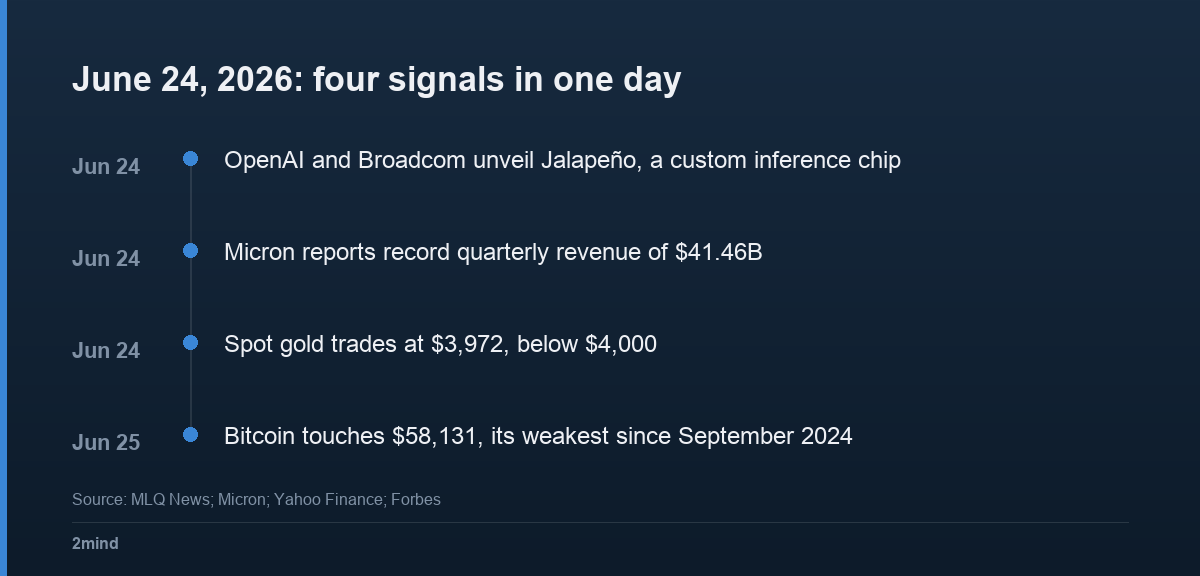
The capital flow story is already visible in the markets. On the same day these AI infrastructure announcements surfaced, gold traded at $3,972, its first sustained move below $4,000 since November 2025 — and the next day Bitcoin touched $58,131, its weakest level since September 2024.
Institutional attention — and money — appears to be rotating toward AI hardware and semiconductor plays. CoinDesk noted in May that the AI and semiconductor boom had significantly outpaced bitcoin, which was down 11% year-to-date at the time.
The people most directly affected are, in order: Nvidia (whose grip on inference now faces a named competitor), cloud hyperscalers (who will face pressure to offer OpenAI-chip-optimized instances), and smaller AI labs (who must decide whether to build their own silicon or accept a widening cost gap).
What to watch: OpenAI’s chip performance benchmarks when they surface, Broadcom’s manufacturing partnership terms, and whether other frontier labs — Anthropic, Google DeepMind — accelerate their own silicon timelines in response.
The race for AI compute is no longer just about who trains the best model. It’s about who controls the hardware it runs on.
The gold and Bitcoin numbers aren’t just background noise to the chip story. Gold slipping under $4,000 for the first time since November 2025 and Bitcoin touching its weakest level since September 2024 arrived in the same 48-hour window as Micron’s record HBM quarter.
Taken together, those three data points describe where risk capital was pointed that week more clearly than any single one does alone.
The order of affected parties matters too. Nvidia is named first because inference is currently one of the more contestable parts of its business — training workloads are stickier.
Cloud hyperscalers come second because they’ll face pressure to offer chip-optimized instances regardless of preference. Smaller AI labs come last simply because they have the least room to respond either way.
What would change our view
If Jalapeño’s first benchmark results land roughly in line with Nvidia’s inference chips rather than meaningfully ahead, the ‘structural improvement for the ecosystem’ reading in Lens one gets harder to defend.
It would look more like a cost play for OpenAI alone than a shift for the industry. We’d also revisit this if Anthropic or Google DeepMind announce comparable custom silicon within two quarters.
FAQ
Q. Is Jalapeño already running in OpenAI’s products?
A. Not based on what’s been disclosed. The companies confirmed the tape-out milestone — the design handoff to manufacturing — but haven’t published performance benchmarks or a deployment timeline.
Q. Does this mean OpenAI is moving away from Nvidia?
A. Not entirely. A custom inference chip narrows OpenAI’s reliance on Nvidia GPUs for specific workloads, but general-purpose GPUs remain central to training, where the economics differ.
Q. Why did OpenAI build its own chip instead of buying more GPUs?
A. The article doesn’t detail OpenAI’s full rationale, but custom silicon tuned to a known model architecture can, in theory, outperform general-purpose hardware on performance-per-watt for inference.
Sources
- MLQ News, OpenAI and Broadcom unveil Jalapeño, a custom inference chip (24 June 2026)
- StockTitan, Micron reports record results for its third quarter (24 June 2026)
- Yahoo Finance, Gold breaks below $4,000 for the first time in 2026 (24 June 2026)
- Forbes, Bitcoin hits 21-month low (25 June 2026)
- CoinDesk, Bitcoin slips to 13th largest asset as the AI semiconductor boom accelerates (27 May 2026)
Leave a Reply