
A BlackRock managing director said the quiet part out loud this week — and it reframes the entire crypto selloff narrative.
Key Takeaways
- Bitcoin fell to a 21-month low of $58,131 amid a broader crypto selloff, while a BlackRock managing director said AI momentum is “sucking the oxygen out of the room” for capital allocation.
- Coatue’s Philippe Laffont said he’d rather bet on space travel quadrupling over 20 years than on Bitcoin, signaling institutional attention shifting toward AI and other growth narratives.
- The 2mind read: this looks like capital rotation for now, but if institutions keep framing AI and Bitcoin as competing bets, the shift could become structural.
What happened
| Asset | Weekly Move |
|---|---|
| Bitcoin | fell to $58,131 (intraday low) |
| Ethereum | -9% |
| XRP | -10.8% |
| Dogecoin | -12.6% |
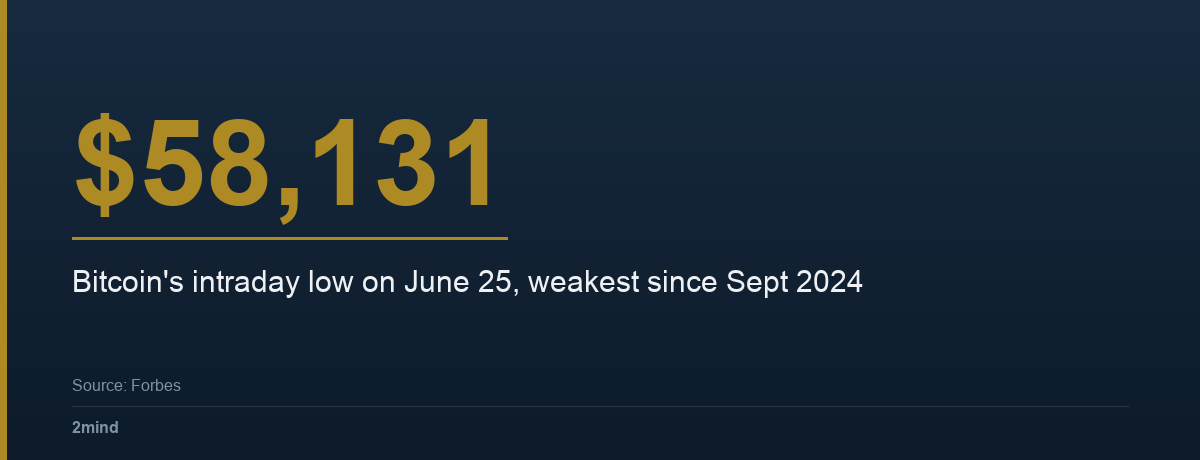
Bitcoin dropped to an intraday low of $58,131 on June 25, its weakest level since September 2024, extending a three-day decline that dragged most major cryptocurrencies down with it. Ethereum fell roughly 9% over the week, XRP dropped 10.8%, and Dogecoin shed 12.6%.
The timing was notable: approximately $10 billion in options were set to expire on Deribit, the world’s largest crypto options venue, adding mechanical pressure to an already stressed market.
But the more revealing moment came from Robert Mitchnick, a managing director at BlackRock, who described the period since Bitcoin’s October peak as a “tough stretch” and pointed directly at AI as the culprit — saying “the AI momentum is certainly sucking a lot of the oxygen out of the room.”
Philippe Laffont, billionaire founder of Coatue Management, echoed the sentiment on CNBC’s Squawk Box on June 23, saying he would “rather bet on space going to quadruple over the next 20 years” — and that he does not “know what to think about Bitcoin anymore.”
These aren’t retail traders venting frustration. These are institutional voices describing how they are actually allocating capital.
The $10 billion Deribit options expiry is a mechanical detail, but it matters for reading the price action correctly.
A chunk of that week’s decline may reflect positioning unwinding around a known calendar event, not a fresh reassessment of Bitcoin’s value.
XRP and Dogecoin falling harder than Bitcoin over the same week is also worth noting. Altcoins typically move with more amplitude than Bitcoin in both directions.
A broad decline led by double-digit altcoin losses looks more like a risk-off unwind across the whole asset class than a Bitcoin-specific story.
The timing also lines up with a documented three-day decline — this wasn’t a single bad day but a sustained slide feeding into the options expiry pressure.
The two lenses
Lens one — this is a rotation, not a verdict. One reading is that this is a temporary rotation — the kind that happens whenever a new technology narrative captures the market’s imagination.
AI’s current moment, driven by the rapid commercialization of large language models and the GPU infrastructure buildout behind them, is absorbing risk capital that might otherwise flow into digital assets.
Under this lens, the pressure on Bitcoin is cyclical. When AI valuations cool or when a macro shock forces a flight to alternative stores of value, the capital could rotate back.
Lens two — the money may not be coming back. The other reading is more structural.
If institutions are genuinely treating AI infrastructure and Bitcoin as competing allocations within the same risk bucket, then the relationship between the two asset classes has fundamentally changed. Mitchnick’s framing suggests this isn’t just about sentiment — it’s about where sophisticated capital sees compounding returns. AI companies have revenue, customers, and government contracts.
Bitcoin has scarcity and decentralization. In a world where institutional mandates increasingly demand growth narratives alongside store-of-value arguments, Bitcoin’s pitch may need to evolve.
What makes this harder to resolve is that both readings can be true simultaneously.
The rotation can be cyclical *and* reflect a deeper structural shift in how institutions think about digital assets. The two aren’t mutually exclusive.
Laffont’s specific framing — betting on space quadrupling over 20 years rather than on Bitcoin — is a useful tell.
Some allocators are now thinking in decades-long growth theses rather than store-of-value arguments, a different mental model than the one that drove institutional Bitcoin adoption in prior cycles.
Mitchnick’s comment is notable partly because of who’s saying it. BlackRock runs the largest spot Bitcoin ETF by assets.
A managing director there describing AI as competing for the same oxygen isn’t a bearish outsider’s take. It’s coming from inside the tent.
Why it matters
The people most directly affected are Bitcoin-focused funds and retail holders who bought into the post-election rally expecting sustained institutional inflows.
The BlackRock and Coatue comments signal that at least some of that institutional enthusiasm has been redirected, not withdrawn from risk assets entirely — just aimed elsewhere.
For the broader market, the more interesting question isn’t whether Bitcoin recovers to a specific price level.
It’s whether the crypto industry can articulate a value proposition that competes with AI’s current momentum on institutional terms.
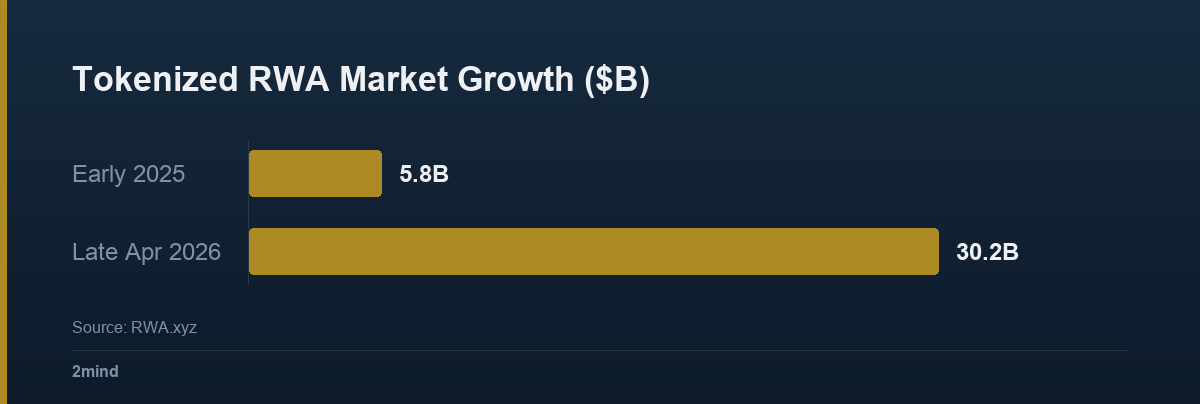
Tokenized real-world assets, which grew from $5.8 billion at the start of 2025 to more than $30.2 billion by late April 2026 on RWA.xyz’s numbers, suggest one path: crypto infrastructure embedding itself into traditional finance rather than competing with it.
The signal worth watching isn’t the next options expiry or the next price candle.
It’s whether institutional language around crypto shifts from “store of value” toward “infrastructure” — and whether that reframing is enough to recapture the capital that AI is currently holding.
The oxygen in the room is finite. Where it flows next is the real story.
The RWA number is the other half of this story that’s easy to miss under the price headlines.
Tokenized real-world assets growing from $5.8 billion to over $30 billion in roughly sixteen months is a five-times increase.
That’s crypto infrastructure attaching itself to traditional finance rather than competing with AI for the same speculative capital.
Framed that way, the ‘oxygen’ Mitchnick describes may be finite specifically for speculative capital chasing price appreciation.
It isn’t necessarily finite for the infrastructure layer, where tokenization is quietly scaling regardless of what Bitcoin’s spot price does that week.
What would change our view
If Bitcoin recovers sharply once AI valuations cool — the classic rotation pattern — Lens one holds up.
If institutional language keeps shifting from ‘store of value’ toward crypto needing to prove itself as ‘infrastructure’ even after AI sentiment settles, that supports Lens two instead.
We’d also revisit this if BlackRock’s own Bitcoin ETF flows turn sharply negative, which would suggest the shift isn’t just rhetorical.
FAQ
Q. Did BlackRock say it’s abandoning Bitcoin?
A. No. Mitchnick’s comment describes where institutional attention and capital are currently flowing, not a change in BlackRock’s own Bitcoin ETF holdings.
Q. Is the AI-versus-Bitcoin capital rotation permanent?
A. That’s the open question the article raises rather than answers. Both a temporary rotation and a more structural reallocation are consistent with what’s been reported.
Sources
- Forbes, Bitcoin Hits 21-Month Low As Expiring Crypto Bets Threaten More Selling (25 June 2026)
- Benzinga, BlackRock: AI is sucking the oxygen out of the room (26 June 2026)
- Yahoo Finance, Billionaire investor reveals he would rather bet on space than Bitcoin (23 June 2026)
- CoinCentral, Tokenized Real-World Assets Hit $30 Billion — citing RWA.xyz data
Leave a Reply