I noticed something familiar in today’s price action: a soft labor report, and bitcoin moves almost on cue.
Key Takeaways
- Bitcoin rose after a weaker-than-expected U.S. jobs report fueled expectations of a Federal Reserve rate cut, per WSJ market coverage.
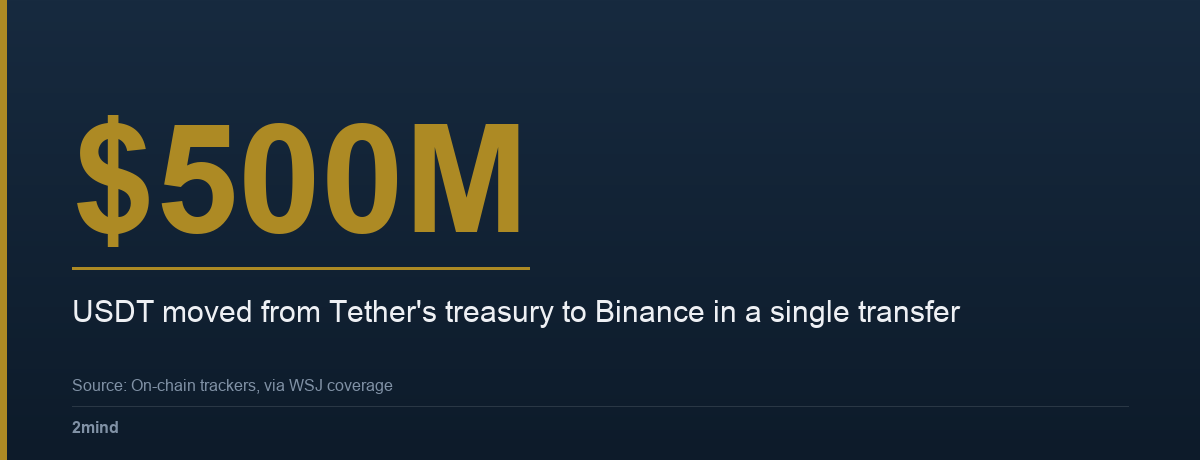
- On the same day, roughly $500 million in USDT moved from Tether’s treasury to Binance, a transfer size large enough to draw market attention.
- The pairing of a macro-driven bitcoin bounce with a large stablecoin inflow suggests traders are positioning for volatility around this week’s FOMC minutes, not confirming a trend yet.
What happened
U.S. jobs data released this week came in softer than economists expected, and markets quickly priced in higher odds of a Fed rate cut.
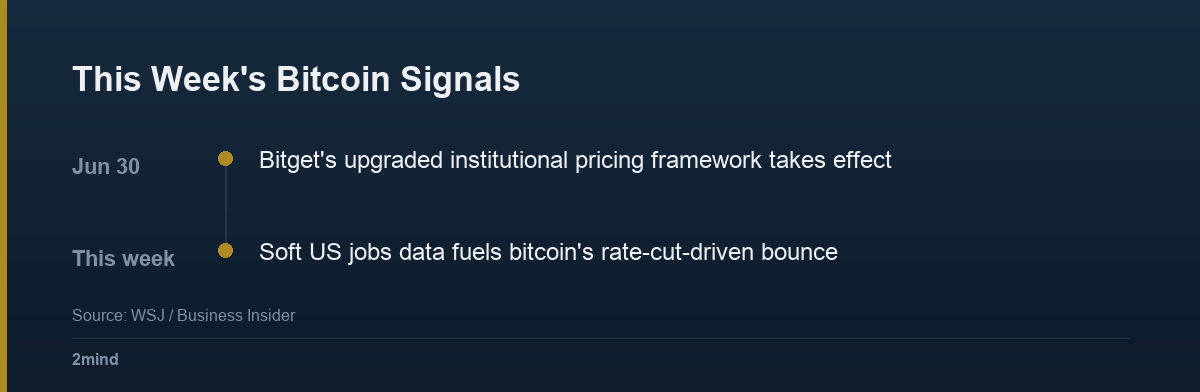
Bitcoin responded with a rise, according to Wall Street Journal market commentary, even as broader risk sentiment stayed mixed — Nasdaq-listed AI chip stocks saw profit-taking the same day, and oil prices climbed on Middle East tensions.
Separately, on-chain trackers noted that Tether moved approximately $500 million in USDT from its treasury wallet to Binance, one of the largest single stablecoin transfers observed recently.
As we noted earlier this week, bitcoin had briefly reclaimed the $64,000 level intraday before giving back some of the gain, settling into a consolidation pattern rather than a decisive breakout.
Meanwhile, exchange infrastructure kept evolving in the background. Bitget announced an upgraded institutional pricing framework, introducing what it calls a more granular fee model for its PRO and Liquidity Incentive Programs, effective June 30. The stated goal is supporting institutional traders and market makers who increasingly move capital between crypto and tokenized traditional assets like stocks, ETFs, and commodities.
The same-day moves that didn’t make the headline
The jobs-driven bitcoin bounce didn’t happen in isolation. The same day saw profit-taking in Nasdaq-listed AI chip stocks and oil prices climbing on Middle East tensions, per the same WSJ coverage.
That’s a mixed risk picture, not a clean ‘risk-on’ day. Money moved into bitcoin and oil at the same time capital rotated out of AI chip names.
That doesn’t fit neatly into either a pure rate-cut trade or a pure flight-to-safety trade, which is part of why I’m treating today’s move as provisional rather than confirmed.
The oil move in particular is worth noting since it’s traditionally read as inflation-sensitive, not rate-cut-sensitive — a detail that doesn’t fully support a single, clean macro narrative for the day.
The two lenses
| Signal | Bullish read (Lens one) | Cautious read (Lens two) |
|---|---|---|
| $500M USDT moved to Binance | Dry powder waiting to deploy | Could be treasury ops, not buying intent |
| Bitcoin rose, then gave back part of the gain | Reflex to rate-cut expectations | Looks like short-covering, not conviction |
| Bitget’s fee overhaul | Institutional demand rising | Routine competitive move among exchanges |
Lens one: A market regaining its macro reflexes. This reading treats bitcoin’s reaction to jobs data as a healthy sign — proof that crypto is once again trading as a liquidity-sensitive asset rather than moving on isolated crypto-native news alone.
Under this view, the Tether-to-Binance transfer is a bullish undertone: large stablecoin balances parked on exchanges are often read as dry powder, capital waiting for a catalyst to deploy into spot or derivatives positions.
Bitget’s institutional upgrade fits the same narrative — exchanges retooling their fee structures specifically because institutional flow between crypto and traditional markets is increasing, which implies real demand rather than speculation.
In this frame, today’s moves are incremental evidence that professional capital treats bitcoin as a macro hedge candidate, reacting to rate expectations the same way gold or long-duration bonds might.
Lens two: A market that still lacks conviction. The counter-reading is more cautious. Bitcoin gave back part of its intraday gain the same day it rose, which is not the behavior of a market with strong directional conviction — it looks more like short-covering or algorithmic response to a single data point.
A $500 million stablecoin transfer, while large in absolute terms, doesn’t confirm buying intent; it could just as easily reflect internal treasury management, exchange liquidity provisioning, or preparation for redemptions.
And Bitget’s fee restructuring, while notable, is a routine competitive move among exchanges rather than a signal of a new capital wave — every major platform adjusts institutional pricing periodically to stay competitive.
Under this lens, the real test hasn’t happened yet: it arrives with the FOMC minutes, which will show whether the Fed’s own internal debate matches what soft jobs data implied.
Bitget’s timing, read against the FOMC calendar
Bitget’s institutional fee overhaul took effect June 30 — before this week’s jobs data and ahead of the FOMC minutes both landed.
That timing makes it hard to read the update as a reaction to this week’s volatility specifically. It looks more like exchanges positioning ahead of a calendar they already knew was coming.
Why it matters
Traders watching bitcoin for macro cues should treat this week’s move as provisional, not confirmed. The FOMC minutes will matter more than today’s price action because they reveal whether policymakers actually share the market’s dovish reading of the jobs report — a mismatch there could reverse today’s gains quickly.
Institutional desk activity, visible through moves like Bitget’s fee overhaul, is worth tracking as a slower-moving but more structural signal of where crypto liquidity is heading. For now, the honest read is that bitcoin is behaving like a rate-sensitive asset again, but one data point and one large transfer don’t yet make a trend.
I’ll be watching whether this reflex reaction holds once the Fed’s minutes are actually digested by the market.
Reading the $500 million transfer on its own terms
A $500 million USDT movement from Tether’s treasury to Binance is large enough to draw attention on its own, separate from what bitcoin’s price did the same day.
Treasury-to-exchange transfers of that size get flagged by on-chain trackers precisely because they’re unusual, but unusual isn’t the same as directional.
What would make this transfer more meaningful is a visible drawdown in Binance’s USDT reserves over the following days, suggesting the stablecoin actually got deployed into buying rather than sitting as available liquidity.
That’s the kind of follow-through this piece doesn’t have yet, which is exactly why I’m not calling this a confirmed signal.
For now, the transfer sits in the same category as other large Tether-to-exchange flows — notable in size, inconclusive in meaning until on-chain data shows what happened next.
FAQ
Q. Does a large stablecoin transfer to an exchange mean a big buy order is coming?
A. Not necessarily. Large USDT transfers to exchanges are often interpreted as available buying capacity, but they can also reflect treasury operations, liquidity provisioning, or preparation for withdrawals — the transfer alone doesn’t confirm trading intent.
Q: Why would a soft jobs report push bitcoin higher?
A: A weaker labor market increases expectations that the Federal Reserve will cut interest rates, which tends to boost risk assets, including bitcoin, because lower rates typically reduce the appeal of holding cash or bonds.
What would change our view
If the FOMC minutes show the Fed’s internal debate lines up with what soft jobs data implied — real openness to a near-term cut — this week’s bounce would look like an early, correct read.
If the minutes instead show more hawkish resistance inside the committee, I’d treat today’s price action as the short-covering Lens two describes, and expect the $64,000 level to get retested from below.
Sources
- [Bitcoin Rises Amid Growing Rate Cut Hopes From Soft U.S. Jobs Report — Market Talk] — Moomoo (WSJ)
- [Bitget Upgrades Institutional Trading Framework to Power the Next Phase of Multi-Asset Markets] — Business Insider
Leave a Reply