Bitcoin ETP vs Self-Custody sounds like a debate about two ways to follow the same asset. I think the more useful question is simpler: after you choose, what do you actually own, and who must act correctly for that ownership to remain useful?
This is an evergreen explainer, current as of August 3, 2026, rather than a breaking-news report. The answer begins with a legal distinction that everyday language tends to blur. A U.S. spot bitcoin product commonly called an ETF is generally an exchange-traded commodity trust, not a traditional fund registered under the Investment Company Act of 1940.
That distinction tells us to examine the trust documents, custody chain, expenses, and share price. Self-custody asks different questions about keys, backups, devices, and human error.
What would change our view
The risk-exchange framing would need revision if a spot bitcoin ETP gave ordinary shareholders direct, routine redemption into bitcoin under their own keys, or if self-custody recovery became reliably reversible without transferring control to an intermediary. Product filings, redemption terms, and independently verified recovery outcomes—not price performance alone—would be the evidence to watch.
Key Takeaways
- A spot bitcoin ETP investor owns shares in a trust, not the private keys controlling the trust’s bitcoin.
- Self-custody gives the owner control through private keys, along with the full burden of protecting and recovering them.
- An ETP moves custody, cyber, and operational duties to institutions, but it does not make those risks disappear.
- The choice is best understood as a risk exchange, not a contest with one universally safer winner.
Bitcoin ETP vs Self-Custody starts with the ownership claim
With a spot bitcoin ETP, the object in the brokerage account is a security: a share representing an interest in a trust. The trust holds bitcoin through its custody arrangements. The shareholder does not receive the private keys and cannot treat a brokerage share as bitcoin that can be sent directly to a blockchain address.
With self-custody, the relevant object is access. A wallet manages the private keys that authorize transactions. The bitcoin remains recorded on the network, while the holder controls the credentials needed to move it. That control enables direct transfer, spending, and onchain use, but it also makes key security the holder’s job.
| Decision point | Spot bitcoin ETP | Self-custody |
|---|---|---|
| What the investor holds | Shares in a commodity trust | Keys that authorize access to bitcoin |
| Who controls the keys | The trust’s appointed custody structure | The wallet owner |
| How value is accessed | Buy or sell shares through a market account | Sign and broadcast a bitcoin transaction |
| Main convenience | Familiar brokerage-market workflow | Direct transfer, spending, and onchain use |
| Responsibility moved elsewhere | Asset custody and much of the operating process | None of the key-management duty |
| Risk retained by the user | Share pricing, product structure, counterparty chain, account access | Seed exposure or loss, device security, transaction mistakes |
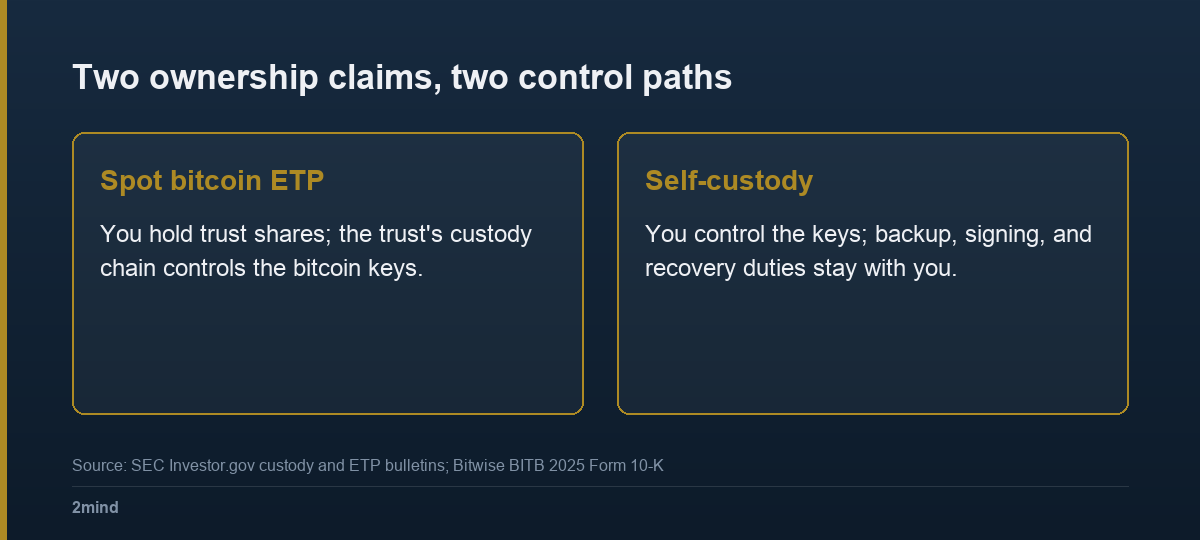
An ETP can offer economic exposure without giving the shareholder transactional control. Self-custody provides that control, but it is only as durable as the owner’s security and recovery practices.
The custody risk moves; it does not vanish
An ETP replaces a personal key-management problem with an institutional chain. The sponsor, trust, custodian, brokerage, exchange, and other service providers each perform a defined role. The SEC warns that crypto ETPs still carry custody, cyber, and operational risks. Product filings describe these dependencies in much greater detail.
Structures differ across products. Bitwise’s BITB filing names Coinbase Custody. Another bitcoin trust filing discloses Coinbase and Anchorage for some assets. The label “spot bitcoin ETP” is not a complete custody review.
This point connects with our earlier look at why crypto hacks can fall while structural risk still feels larger. A quieter incident count does not remove concentration, access, or recovery questions. Here, an ETP can reduce the investor’s operational workload while concentrating reliance on a documented institutional system.
Self-custody shortens that chain, but it does not produce effortless independence. Losing a seed phrase, exposing it, signing the wrong transaction, or mishandling a device can turn direct control into direct loss. There may be no institution capable of reversing the mistake.
Hot and cold wallets make different compromises. A hot wallet is connected and generally easier to use. A cold wallet keeps keys offline and can reduce some online exposure, but adds a handling and recovery process.
Two Lenses
Lens one — A wrapper can remove the hardest personal task
The constructive case for an ETP is not that institutions eliminate risk. It is that many investors may prefer a familiar account, market execution, statements, and a professional custody arrangement to safeguarding a seed phrase themselves. Delegation can be rational when the delegated task is one the investor is unlikely to perform consistently.
Product pages and filings can identify fees, custodians, NAV, closing price, and premium or discount. Those disclosures give the investor a concrete review list, not a guaranteed outcome.
Lens two — Direct control preserves abilities the wrapper cannot
The case for self-custody begins where the share certificate stops. Bitcoin under the owner’s keys can be transferred, spent, or used onchain. A trust share cannot be withdrawn as bitcoin merely because its value is designed to reflect bitcoin.
That difference may matter more than convenience for someone whose purpose is direct use or independence from an intermediary chain. It may matter much less for someone seeking price exposure inside an existing brokerage workflow. The judgment fork is whether transactional control is a requirement or an unnecessary responsibility.
When bitcoin breaks resistance and the mood remains restrained, price tells only part of the story. Ownership architecture determines what the holder can do under stress.
Fees and tracking create a second layer of distance
A spot bitcoin ETP aims to track bitcoin, but its market price can diverge from NAV. BlackRock’s IBIT page publishes NAV, closing price, and premium or discount separately because exchange price and calculated per-share value can differ.
Expenses create another gap. The SEC explains that a commodity trust does not generate income to pay costs, so bitcoin may be sold for expenses. The bitcoin represented by each share can therefore decline over time.
IBIT’s official product page listed a 0.25% sponsor fee when checked on August 3, 2026. That figure belongs to IBIT and should not be generalized to every product. A comparison needs the current fee and governing documents for the specific ETP under consideration.
Self-custody has no trust sponsor fee, but it is not necessarily costless. Hardware, transaction fees, backups, and the owner’s time vary by setup and use, so I have not assigned figures to them.
A decision test built around recoverability
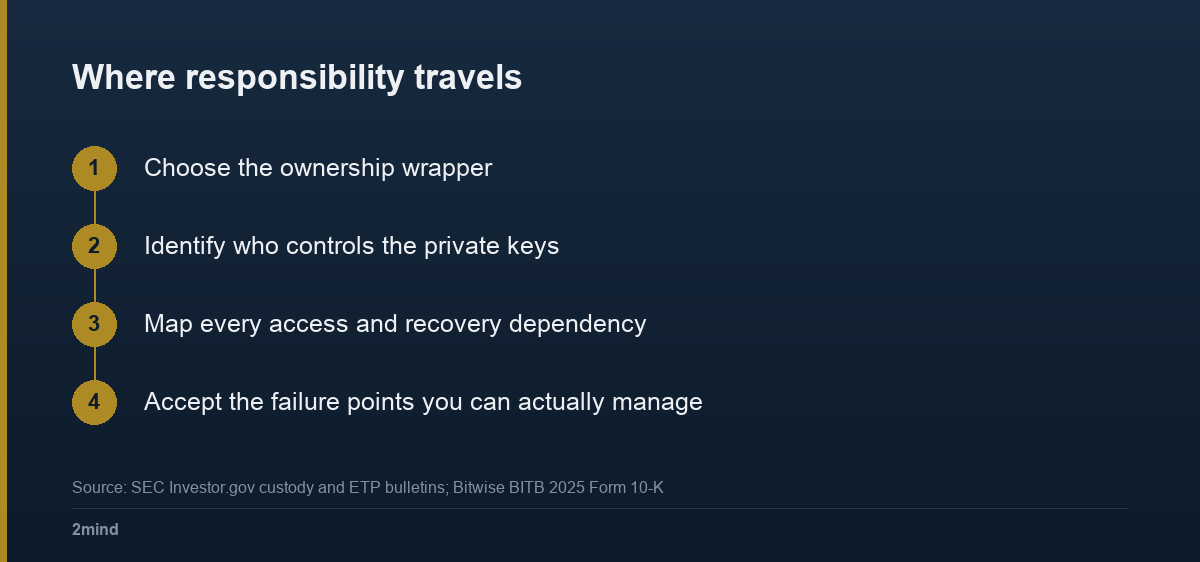
I would start by imagining a failure, not a rally. If brokerage access is interrupted, does the investor understand which institution is responsible? If a wallet device fails, can the owner restore access without exposing the seed? If a custodian arrangement changes, will the investor read the filing? If a transaction is misdirected, is there any recovery path?
The answers reveal the chosen risk more clearly than slogans about “paper bitcoin” or “being your own bank.” An ETP holder accepts legal and operational intermediation. A self-custody holder accepts personal operational finality. Neither statement alone establishes that one route is categorically safer.
Exposure, transferability, recovery, and delegation are separate requirements. They should be named before a product or wallet is chosen.
FAQ
Q. Is a U.S. spot bitcoin ETP the same as owning bitcoin?
A. No. The shareholder owns trust shares designed to provide bitcoin exposure. The trust’s custody arrangement controls the private keys. Direct bitcoin ownership through self-custody gives the wallet owner control of the keys and the ability to authorize onchain transactions.
Q. Is self-custody always safer than a spot bitcoin ETP?
A. No universal ranking follows from the verified sources. Self-custody removes reliance on a trust’s custody chain but places seed protection, device security, transaction accuracy, and recovery on the owner. An ETP delegates key custody while retaining institutional, cyber, operational, pricing, and structural risks.
Q. Why can an ETP share differ from its bitcoin value?
A. Shares trade on an exchange, so market price can differ from the trust’s calculated NAV. Expenses can also reduce the bitcoin represented per share over time. Investors should check the specific product’s current NAV, closing price, premium or discount, fee, and filings.
Sources
- SEC Investor.gov — Exchange-Traded Products Providing Exposure to Bitcoin and Ether
- SEC Investor.gov — Crypto Asset Custody Basics for Retail Investors
- Bitwise Bitcoin ETF — 2025 Form 10-K
- BlackRock iShares — IBIT official product page
- Bitcoin trust — 2025 Form 10-K
The wrapper changes who must protect the keys—but which failure point are you genuinely prepared to own?
Leave a Reply