Is bitcoin mining still profitable? Yes, for some operators—but there is no industry-wide yes or no. A miner is profitable only when the value of the bitcoin it earns exceeds electricity, operating costs, machine depreciation, financing, and overhead. Those inputs differ sharply by site and by company.
Key Takeaways
- Bitcoin mining can still produce an operating margin for efficient miners with low-cost power, but profitability is company-specific and can disappear after depreciation and financing are counted.
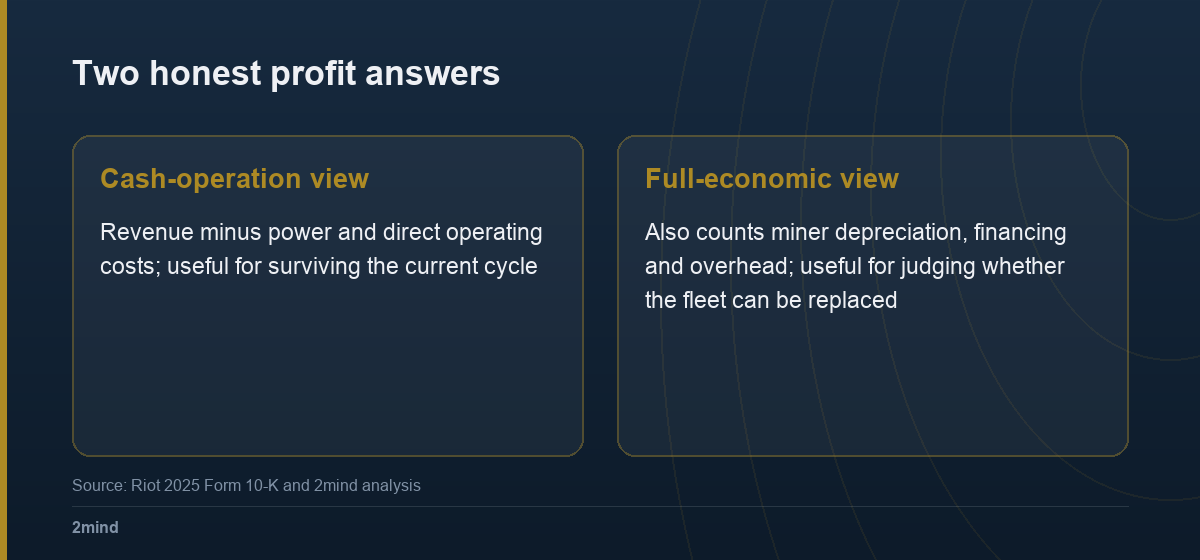
- Riot Platforms reported a 2025 cost per bitcoin of $49,645 excluding miner depreciation and $91,427 including it. The same operation can therefore look comfortably profitable or barely profitable depending on the definition.
- MARA reported $38,956 of purchased energy cost per bitcoin at owned facilities in 2025, but that figure is an energy measure—not a complete cost of production.
- Network difficulty, fleet efficiency, uptime, power prices, curtailment credits, and the bitcoin price all move. A profitability estimate is a dated snapshot, not a permanent answer.
Is bitcoin mining still profitable by published costs?
Public filings show both the number and its definition, revealing why comparisons need care.
| Operator and period | Published measure | Reported figure | What it leaves in or out |
|---|---|---|---|
| Riot, FY2025 | Cost per BTC | $49,645 | Excludes miner depreciation; includes power-curtailment credits |
| Riot, FY2025 | Cost per BTC | $91,427 | Includes miner depreciation and power-curtailment credits |
| MARA, FY2025 | Purchased energy cost per BTC | $38,956 | Power purchased for owned sites; not a full production-cost figure |
| Bitfarms, FY2025 | Average electricity price | $0.049/kWh | Site-level power input, not cost per bitcoin |
Riot also reported an average production value of $101,350 for each bitcoin mined in 2025. Against that figure, its disclosed cost was 49% of production value before miner depreciation and 90.2% after depreciation.
That is a direct demonstration of the two answers hiding inside the word “profitable.” Cash operations had room. The accounting spread after the hardware bill was much thinner.
MARA reported that energy represented 38.5% of owned-mining revenue in 2025. Its purchased energy cost per bitcoin rose from $29,084 in 2024 to $38,956 in 2025, which it attributed to the April 2024 halving and broader energy-cost increases. That is not an all-in cost.
Four variables move the answer
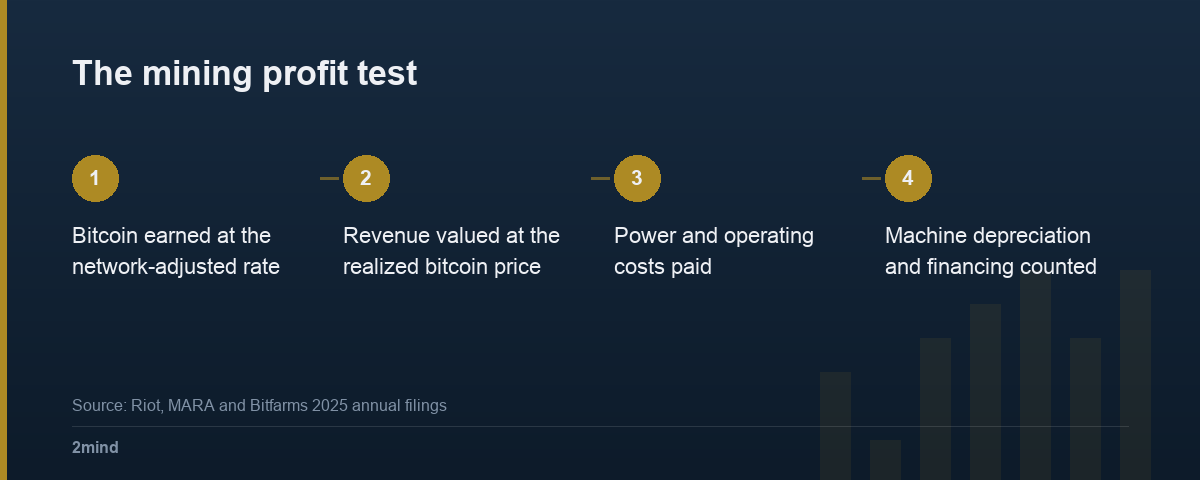
The first variable is the bitcoin price. Revenue arrives in bitcoin while most bills arrive in local currency. A higher price widens the possible spread but cannot rescue an operator with excessive debt, power, or machine costs.
The second is network competition. A miner does not earn a fixed quantity merely because its own machines keep running. Bitfarms said its 2025 average network difficulty was 47% higher than in 2024.
It still increased annual production by 1%, but only after expanding hash rate and installing more efficient machines. More work was required to defend roughly the same output.
The third is machine efficiency and uptime. Bitfarms improved average fleet efficiency from 25 watts per terahash in 2024 to 18 W/TH in 2025. Lower W/TH means less electricity for the same work. Riot notes that deployed and operating hash rate diverge during repairs, maintenance, or power curtailment.
The fourth is the power contract. Riot calls power the largest marginal input and says lower-cost operators can profit across a wider range of bitcoin prices. Curtailment credits reduced its 2025 self-mining costs by $56.7 million. Two identical ASICs can have different economics when one has a flexible grid contract and the other pays a retail tariff.
Two Lenses
Lens one: efficient mining is still a real business
The constructive reading is straightforward. Riot’s 2025 figures show an operating spread before depreciation, and MARA’s filings show that large operators can manage power hourly, curtail when prices rise, and place machines near owned or contracted energy. Bitfarms increased output despite higher network difficulty by expanding and improving its fleet.
Under this lens, mining has become an industrial optimization business. Competitive operators control cheap power, newer machines, reliable sites, and fleet-refresh financing.
American Bitcoin made the same point from another angle in Q1 2026. It reported a cost to mine of about $36,200 per bitcoin, down from about $46,900 in the prior quarter, after production rose and energy discipline improved. That company-supplied non-GAAP measure is one operator’s result, not an industry benchmark.
Selling mined coins does not by itself disprove profitability, either. Our earlier look at Bitdeer selling its weekly output showed why bitcoin can function as inventory that funds expansion rather than as a treasury asset. The follow-up on a miner selling everything made the same distinction: treasury policy and operating margin are separate questions.
Lens two: the apparent margin can vanish after the machine bill
The cautious reading starts with Riot’s $49,645 and $91,427 figures. Excluding depreciation is useful for asking whether today’s machines generate cash. Including it is necessary for asking whether the business replaces the machines it wears out. The gap is not a technical footnote. It is the cost of remaining a miner.
When more efficient fleets join the network, older machines earn a smaller share while consuming the same electricity. A miner can be cash-positive now and uncompetitive over the equipment’s life.
That pressure explains the search for other uses for scarce power connections. We saw assets re-enter the market in Poolin’s bankruptcy auction, then traced the strategic version through Bitdeer’s AI pivot and Hut 8’s AI data-center move. ASICs do not become AI chips; the bridge is the energized land, grid connection, cooling, and operating experience.
The miner matters more than the headline price
For a public mining company, the balance sheet can decide the outcome before the latest bitcoin quote does. Debt service and machine purchases have dates. Bitcoin’s price does not promise to cooperate on those dates.
Our review of American Bitcoin’s balance-sheet pressure is a reminder that a bitcoin treasury is only a cushion if the company is not forced to sell it to fund operations.
Selling into a rally may fund power, machines, or construction rather than express a bearish view. We would not use miners selling while bitcoin rises as a standalone verdict. The sale shows a need for cash; the filing shows whether the operation produced it economically.
For a home miner, electricity, cooling, pool fees, downtime, and machine price matter. Public-company costs do not prove a residential setup works. Use the miner’s own tariff, efficiency, uptime, and full equipment cost.
What would change our view
We would become more constructive if several miners reported falling full costs per bitcoin—including depreciation—while network difficulty continued rising. That would show efficiency gains are outrunning competition rather than merely hiding hardware expense outside a cash-cost measure.
We would become more cautious if operating costs stayed below mining revenue but full costs repeatedly exceeded it across efficient public fleets. That pattern would mean the industry can keep machines running yet cannot replace them without outside capital.
We would also revisit the thesis if AI/HPC conversions consistently failed to secure customers, because the assumed alternative value of mining sites would then be weaker than it appears.
FAQ
Q. Is bitcoin mining still profitable in 2026?
A. It can be. Recent company filings show positive operating spreads for some efficient public miners, but the result changes when depreciation, financing, and overhead are included. There is no single cost that applies to every miner.
Q. What is the biggest cost in bitcoin mining?
A. Electricity is the largest marginal input for major operators, according to Riot, while MARA calls energy its most significant mining cost driver. Hardware depreciation can be equally decisive when judging full economic profit.
Q. Does a miner selling all newly mined bitcoin mean it is losing money?
A. No. A miner may sell production to pay operating bills or fund expansion. To judge profitability, compare realized mining revenue with clearly defined cash and full costs rather than treating treasury policy as an income statement.
Q. Can a bitcoin mining site simply switch to AI?
A. Not simply. ASIC miners cannot perform general AI workloads. A site may reuse power access, land, and some cooling infrastructure, but AI data centers require different chips, networking, reliability, and customer contracts.
Related from 2mind
- Eric Trump’s Bitcoin Miner Lost $600M. Here’s Why It Matters
- Bitdeer Mines Bitcoin Then Sells It All, Every Week
- Why “Never Sell Bitcoin” Keeps Breaking
Sources
- Riot Platforms 2025 Form 10-K — mining costs, depreciation, power and curtailment credits
- MARA Holdings 2025 Form 10-K — energy cost per bitcoin, curtailment and AI/HPC strategy
- Bitfarms 2025 Form 10-K — network difficulty, power price and fleet efficiency
- American Bitcoin Q1 2026 results filed with the SEC — production and company-defined cost to mine
The answer, then, is not “mining is profitable” or “mining is dead.” It is more useful: show me the power contract, the fleet efficiency, the network share, and whether the cost includes the machine.
Leave a Reply