
Ask why “never sell bitcoin” fails and you will usually get an answer about conviction — that the holder got scared, or was never serious. That answer fits almost none of the actual cases.
The companies that broke the promise in public did not lose their nerve. They ran into an obligation denominated in dollars with a date on it. Bitcoin is denominated in bitcoin and has no date on it. When those two meet, the calendar wins.
That is the whole mechanism, and 2026 supplied a clean demonstration.
Key Takeaways
- Strategy sold bitcoin three separate times in 2026 — 32 BTC in May, 3,588 BTC across June 29–July 5, and 1,638 BTC across July 27–August 2.
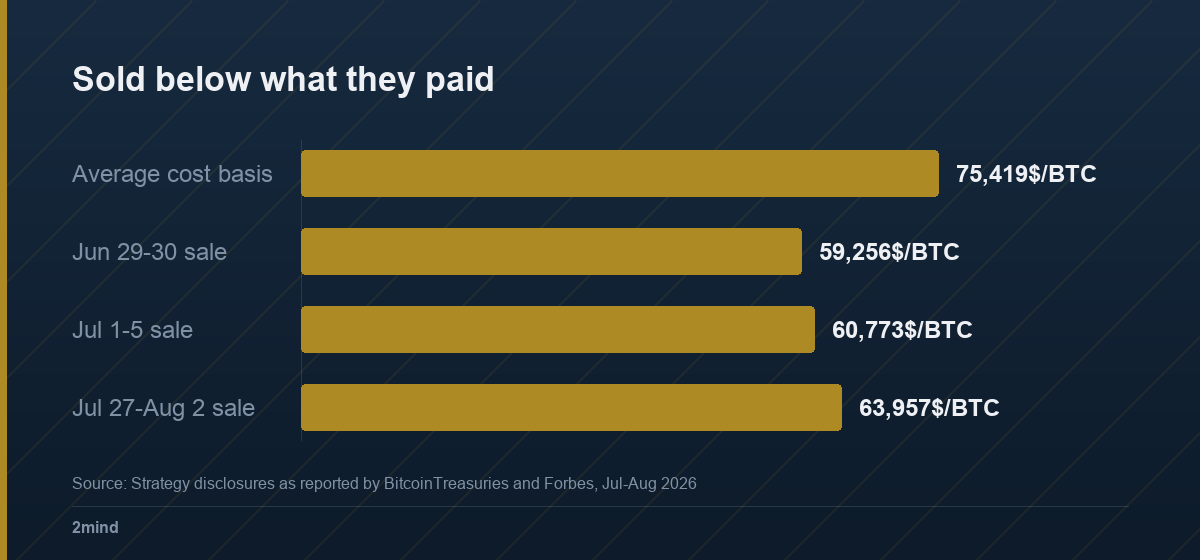
- The last two sales happened below the company’s own average cost of about $75,419 per bitcoin, at averages near $60,000 and $63,957.
- Every sale funded a dollar obligation: preferred stock dividends, now running at a 12.00% annual rate on the STRC series.
- Tesla broke the same promise the same way in 2022, converting approximately 75% of its bitcoin to fiat for $936M — because it wanted cash, not because it changed its mind about bitcoin.
What actually forces a sale
A treasury holding bitcoin is not one thing. It is an asset on one side and a set of promises on the other. The promises are what move.
Strategy’s promises are unusually explicit. The company funds itself partly through perpetual preferred stock, and preferred stock pays a dividend on a schedule.
On June 29, 2026, the board adopted what it called the Digital Credit Capital Framework. It raised the STRC dividend rate by 50 basis points to 12.00%, effective for record dates on or after July 1, 2026 — and, in the same document, authorized management to sell up to $1.25 billion of bitcoin to cover dividends, interest, and buybacks.
We covered that authorization when it landed, in Strategy’s Bitcoin Sale Clause: The End of “Never Sell”. The read then was that it formalized optionality the company always implicitly had, and the real test was whether it would be exercised. It was exercised within days.
| Sale | Dates | BTC sold | Proceeds | Average price |
|---|---|---|---|---|
| First | May 26–31, 2026 | 32 | $2.5M | $77,135 |
| Second | Jun 29–30, 2026 | 1,363 | $80.8M | $59,256 |
| Second (cont.) | Jul 1–5, 2026 | 2,225 | $135.2M | $60,773 |
| Third | Jul 27–Aug 2, 2026 | 1,638 | $104.73M | $63,957 |
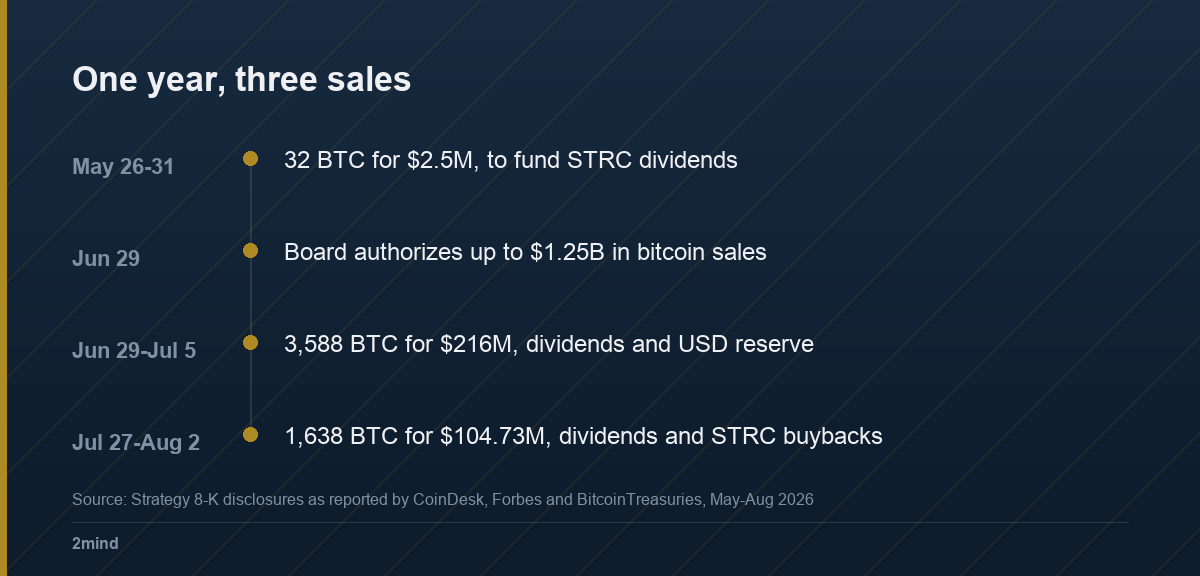
The second sale left holdings at 843,775 BTC against a cost basis of roughly $63.69 billion. The third left 842,138 BTC. Neither is a capitulation, and that is what makes them useful evidence: a seller who still owns 842,138 BTC is not selling on sentiment.
The part that gives the game away
The revealing detail is not that Strategy sold. It is the price.
The July 27–August 2 sale went out at an average of $63,957 per coin against an average purchase price of $75,419 — roughly 15% below cost. The late-June tranche was worse, at $59,256.
Nobody sells below cost while optimistic about the price and free to wait. Selling below cost is what happens when the timing is not yours. The record date arrives whether or not bitcoin has recovered, and bitcoin had not recovered.
A second pressure runs the same way. Forbes reported that $52.3 million of the August proceeds repurchased STRC preferred stock trading around $89 against a $100 stated value.
A preferred issue below par is a financing channel that has stopped working — and a company that funds bitcoin purchases through that channel must repair it before reusing it. The repair was paid for with bitcoin.
Two Lenses
Lens one: this is a treasury behaving correctly
The generous reading is that none of this is a broken promise. It is a company meeting obligations it publicly took on, using the most liquid asset it owns, as a solvent business should.
It disclosed each sale promptly, set a formal reserve policy, and told the market in advance that this could happen. Michael Saylor said as much on the first-quarter earnings call: “We will probably sell some bitcoin to pay a dividend just to inoculate the market and send the message that we did it.”
Under this lens, a treasury that would default on a dividend rather than sell a fraction of a percent of an asset is not showing conviction. It is showing bad management. The digital asset treasury model was always a leveraged structure, and leveraged structures have coupons.
Lens two: the promise was never the company’s to make
The cautious reading is that “never sell” was doing marketing work it could not support, and everyone involved knew the difference.
The clearest evidence is the retreat itself. After the August sale, Saylor wrote on X on August 3: “When I say ‘Never Sell Your Bitcoin,’ I speak as one saver to another. I have never sold mine. Not one satoshi. Strategy is a public company, not my wallet.”
Read literally, that is consistent. Read as an investor who bought exposure to the company on the strength of a slogan, it is a distinction that arrived after the fact. The slogan traveled without the footnote for four years.
The structural point underneath it is real, though. An individual saver can hold indefinitely because nothing bills them. A public company with 12% preferred stock is billed continuously. Those are not two versions of one promise — they are different instruments, and only one can keep it.
Why it matters
For anyone holding a bitcoin treasury company rather than bitcoin, that distinction is the entire investment. You own a claim on an entity servicing dollar obligations from a volatile asset — a structure that forces selling precisely when prices are low, because that is when financing channels close and dividends still come due.
For individual holders, the lesson runs the other way: the reason these sales happened does not apply to you. Nobody sends you a dividend record date.
And for the thesis that institutions are steadily absorbing supply, three forced sales in one year are a reminder that institutional demand arrives with institutional obligations attached — part of the same rotation we traced in The Asset That Ate Bitcoin’s Lunch.
What would change our view
We would revise this if Strategy funded a full dividend cycle from software revenue or fresh equity while bitcoin traded below its cost basis. That would show the mismatch we describe is survivable without touching the treasury.
We would also revise it if the STRC preferred returned to its $100 stated value and held there through a quarter of falling bitcoin prices. That would mean the financing channel works under stress — the specific condition whose absence forced the August repurchase.
FAQ
Q. Has Strategy actually sold bitcoin, or is that a rumor?
A. It sold three times in 2026, each disclosed in a regulatory filing: 32 BTC in late May for $2.5 million, 3,588 BTC between June 29 and July 5 for about $216 million, and 1,638 BTC between July 27 and August 2 for $104.73 million.
Q. Why would a company sell bitcoin below what it paid?
A. Because the obligation had a date and the asset did not. The proceeds funded preferred dividends — $52.4 million of the August sale — plus $52.3 million of STRC repurchases. Record dates do not move to accommodate the price.
Q. Does this mean Michael Saylor sold his own bitcoin?
A. He says he has not. On August 3, 2026 he wrote: “I have never sold mine. Not one satoshi. Strategy is a public company, not my wallet.” We could not independently verify his personal holdings, which are not disclosed in any filing, so we report the statement rather than the fact.
Q. Has any other company broken a “never sell” position?
A. Tesla did, in 2022, converting approximately 75% of its bitcoin purchases to fiat for $936 million and taking digital assets from $1.26 billion to $218 million. Elon Musk’s stated reason was liquidity: “we were uncertain as to when the Covid lockdowns in China would alleviate.”
Sources
- Strategy sold 32 BTC for $2.5 million in late May, filing shows — CoinDesk, June 1, 2026
- Strategy’s Digital Credit Capital Framework, STRC dividend and bitcoin sale authorization — TFTC
- Strategy sells 3,588 bitcoin for $216 million — BitcoinTreasuries
- Strategy sells 1,638 BTC, boosts cash reserves to $4 billion — BitcoinTreasuries, August 3, 2026
- “Not One Satoshi” — Saylor sells $105 million in bitcoin below cost — Forbes, August 5, 2026
- Tesla converted 75% of bitcoin holdings in Q2 2022 — crypto.news
Leave a Reply