I want to walk through something that happened last week and is still being digested. On July 30, the Situational Awareness fund — the AI-focused hedge fund run by former OpenAI researcher Leopold Aschenbrenner — handed its entire public stock portfolio to Citadel at roughly a 10% discount, after three banks issued margin calls in the same week.
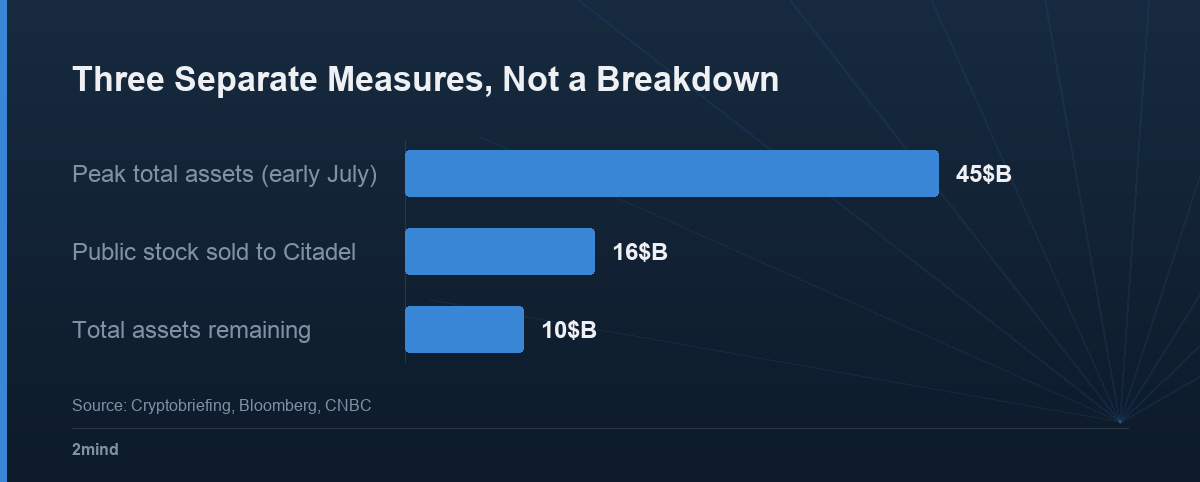
At its early-July peak, the fund held about $45 billion in assets. It now holds around $10 billion. That’s the headline, and on its own it reads like a collapse.
But sitting right next to that headline is a second number that complicates it: even after the July loss, Situational Awareness is still up roughly 80% for the year. Both numbers are true at once, and I think that’s the part worth sitting with rather than picking one and running with it.
Key Takeaways
- Situational Awareness’s assets fell from a peak of ~$45 billion to about $10 billion after a 4x-leveraged bet drew margin calls from Bank of America, Goldman Sachs, and JPMorgan.
- The fund lost roughly 67% in July alone, but is still up about +80% for 2026 and +1,551% since its 2024 launch.
- Citadel bought roughly $16 billion of the liquidated portfolio at about a 10% discount, closing the deal on July 30, 2026.
- The fund’s Anthropic stake — separately valued around $5 billion by Bloomberg — was not part of the sale.
The Situational Awareness Fund, By the Numbers
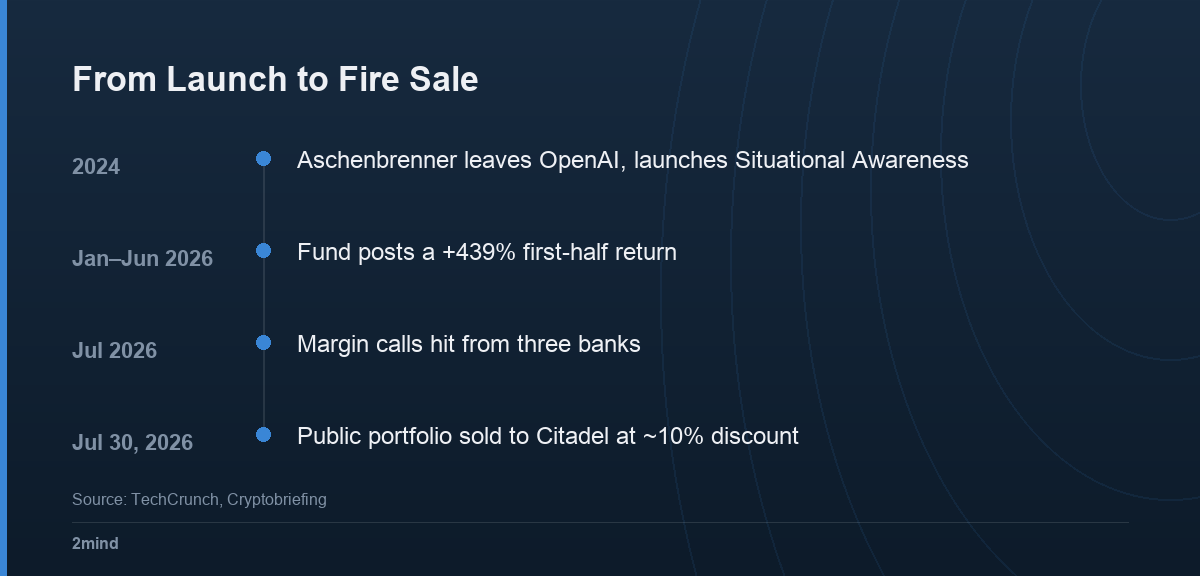
Aschenbrenner left OpenAI in 2024 and started Situational Awareness soon after, betting openly and heavily on AI-related public equities. For a long stretch, that bet worked about as well as a bet can work.
The fund reportedly returned 439% in the first half of 2026 alone, on top of a cumulative gain of roughly 1,551% since its 2024 launch, per reporting carried by Yahoo Finance.
Leverage was part of how that happened. The fund was reportedly running about 4x leverage on its public book — a structure that magnifies gains on the way up and does the same thing, in reverse, on the way down. That’s roughly what showed up in July.
As AI-related stocks pulled back, the roughly 12-person team faced margin calls from three separate banks within the same week.
Rather than meet them piecemeal, the fund sold its entire public portfolio to Citadel — about $16 billion of holdings, at around a 10% discount — and closed the position on July 30, 2026.
Notably, its Anthropic stake, separately estimated by Bloomberg at around $5 billion, was not part of that sale.
| Metric | Figure |
|---|---|
| Peak AUM (early July 2026) | ~$45 billion |
| AUM now | ~$10 billion |
| July 2026 loss | ~67% |
| Year-to-date 2026 return | ~+80% |
| H1 2026 return (Jan–Jun) | +439% |
| Return since 2024 launch | +1,551% |
| Leverage used | ~4x |
| Citadel purchase size | ~$16 billion |
| Discount to Citadel | ~10% |
| Liquidation date | July 30, 2026 |
| Fund team size | ~12 people |
Two Lenses
Lens one: This is a leverage story, not an AI story
The simpler reading is also, I think, mostly the right one.
A fund running 4x leverage on a concentrated set of AI stocks was always going to be fragile to a drawdown, regardless of whether the underlying AI thesis holds up.
Margin calls are a financing-structure problem — they happen because a lender wants collateral back, not because a company’s product roadmap changed overnight.
A fund without leverage would have had a bad month on paper. This fund had three banks calling for collateral in a single week, and a forced sale to settle them.
I made a related point when I wrote about China’s AI-focused funds outperforming human managers — the financing structure underneath a strategy usually matters more than the theme it’s dressed in.
Lens two: The margin call is the tell, not the return
The other reading doesn’t need bigger numbers to make its point — just the fact pattern. Three separate banks issued margin calls in the same week. That’s not one lender getting nervous; that’s several counterparties, independently, deciding the collateral quality had changed enough to act on.
There’s also a wrinkle in that +80% worth naming. Cryptobriefing attributes it largely to the private holdings the fund kept — the Anthropic stake among them. A private mark isn’t the same thing as a liquid gain: it’s a valuation, not a price someone just paid. The liquid part of this book is what got sold at a discount.
I don’t think this proves the AI trade is “over” — the fund’s own since-2024 return argues against reading it that flatly. But it’s a reminder that concentrated, leveraged AI bets can unwind faster than the thesis behind them does.
We’ve seen a version of this tension before on the crypto side of this beat: Bitcoin fell 54% and BlackRock kept building anyway. A sharp drawdown didn’t end that story, but it didn’t happen for no reason either.
Leverage Is the Variable Worth Watching, Not the Sector
For other AI-focused funds running similarly concentrated, leveraged bets, this is a preview of what one bad month can do — margin calls don’t wait for conviction to catch up. For LPs and allocators, the takeaway probably isn’t “avoid AI exposure.” It’s closer to “ask how much leverage sits underneath the exposure before judging the return.”
And for anyone just reading the headlines, this is a useful case study in how one fund can post a 67% monthly loss and an 80% year-to-date gain at the same time, depending only on which window you’re looking through.
I made a related point about who actually captures AI’s returns in Why AI’s Winners Aren’t the Companies Spending the Most — spending the most and being leveraged the most aren’t the same risk, but they rhyme.
What would change our view
A few things would shift how I read this. If the Anthropic stake — the one piece the fund didn’t sell — gets liquidated too, that would suggest the cash need went beyond what the public-equity margin calls alone implied.
If other AI-focused funds report similar margin calls in the coming weeks, that would move this from “one fund’s leverage problem” toward something closer to a sector-wide financing issue.
And if Citadel ends up selling the acquired portfolio at a further loss rather than holding it, that would say something about how mispriced the original 10% discount actually was. As of this writing, none of that has happened.
FAQ
Q. Did Situational Awareness lose money for the year?
A. No. Despite the 67% July loss, the fund is still up roughly 80% for 2026 overall, and about 1,551% since its 2024 launch, according to reporting carried by Yahoo Finance.
Q. Why did the fund sell to Citadel specifically?
A. Cryptobriefing’s reporting describes Citadel buying roughly $16 billion of the liquidated public portfolio at about a 10% discount, after margin calls from Bank of America, Goldman Sachs, and JPMorgan. I haven’t found a fuller account of why Citadel was the counterparty rather than another firm — that’s a detail I’d flag as unconfirmed.
Q. Did the fund sell its Anthropic stake too?
A. No. TechCrunch reported the fund kept its Anthropic shares — separately valued by Bloomberg at around $5 billion — even after selling the rest of its public portfolio.
Sources
- Cryptobriefing — Situational Awareness loses 67% in July, sells $16B public portfolio to Citadel amid margin call chaos
- TechCrunch — AI hedge fund Situational Awareness may have sold its public portfolio, but it still has its Anthropic shares
- Bloomberg — Situational Awareness Assets Drop to $10 Billion After Liquidations
- CNBC — How Leopold Aschenbrenner built a $45 billion AI hedge fund — and lost most of it in days
- Yahoo Finance — Leopold Aschenbrenner was up 439%, then 4x leverage wiped out 67% of his $45B AI hedge fund in one month
Is $10 billion a fund coming back down to earth after outrunning its own leverage, or the first thread pulled on something bigger? My guess is the first — but I’m watching for the second.
Leave a Reply