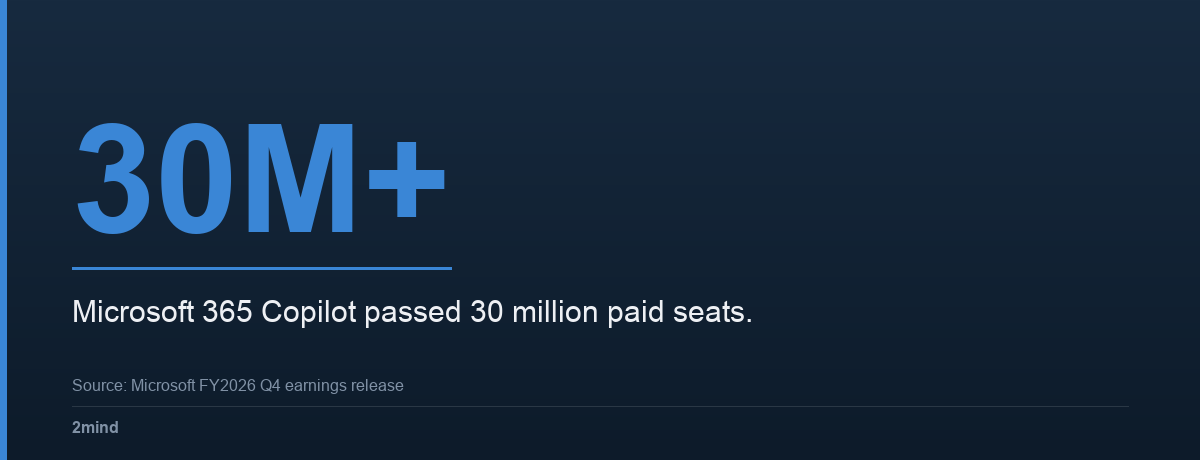
Microsoft AI returns are no longer just a promise attached to a spending plan. Microsoft’s fiscal 2026 fourth-quarter figures give us unusually concrete evidence of demand: Azure’s annual revenue passed $100 billion, while Microsoft 365 Copilot exceeded 30 million paid seats.
I think the more revealing number sits on the other side of the ledger. Quarterly capital expenditure reached $41 billion, and Microsoft said roughly two-thirds of capex went to short-lived assets, mainly CPUs and GPUs. The question now is whether recurring AI demand can outrun a recurring hardware replacement bill.
Key Takeaways
- Fiscal Q4 revenue reached $90.0 billion, up 18% year over year.
- Azure and other cloud services revenue grew 43%, while annual Azure revenue crossed $100 billion for the first time.
- Microsoft 365 Copilot passed 30 million paid seats, making enterprise adoption more visible.
- Quarterly capex was $41 billion, with roughly two-thirds directed to short-lived assets, primarily CPUs and GPUs.
Microsoft AI Returns Now Have Receipts
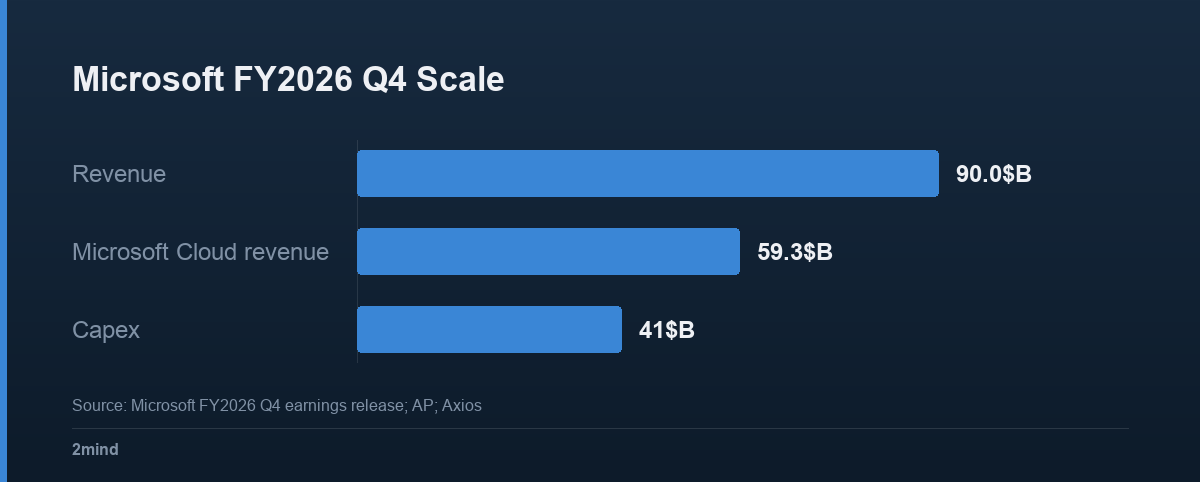
Microsoft reported quarterly revenue of $90.0 billion, operating income of $40.6 billion, and GAAP net income of $35.8 billion. All three moved higher year over year: revenue and operating income rose 18%, while net income increased 31%.
The cloud figures give that growth an AI-relevant shape. Microsoft Cloud quarterly revenue reached $59.3 billion, up 27%. Azure and other cloud services grew 43%, and Azure’s annual revenue exceeded $100 billion for the first time.
| FY2026 Q4 measure | Reported result | Why I am watching it |
|---|---|---|
| Total revenue | $90.0B, +18% YoY | Scale of the overall business funding the buildout |
| Operating income | $40.6B, +18% YoY | Whether growth still reaches operating profit |
| GAAP net income | $35.8B, +31% YoY | Bottom-line capacity behind continued investment |
| Microsoft Cloud revenue | $59.3B, +27% YoY | Recurring commercial base tied to cloud demand |
| Azure and other cloud growth | +43% YoY | Speed of demand expansion |
| Quarterly capex | $41B | Size of the infrastructure commitment |
Copilot adds a different kind of evidence. More than 30 million paid Microsoft 365 Copilot seats do not reveal revenue per seat or usage intensity, so I would not turn that figure into a profit estimate. Still, paid seats are harder evidence than broad claims about interest. Someone is signing contracts.
The $41 Billion Bill Is Not One Kind of Asset
Capital expenditure is easy to discuss as if every dollar buys the same future. It does not. Buildings, land, power equipment, networking gear, CPUs, and GPUs can have very different useful lives and replacement patterns.
Microsoft’s disclosure makes this distinction unusually important. Roughly two-thirds of quarterly capex was allocated to short-lived assets, primarily CPUs and GPUs. Applied only as a rough proportion to the reported total, that tells us the spending mix leans toward equipment that may need to be refreshed sooner than long-lived infrastructure.
I would resist converting “two-thirds” into a precise dollar figure. The company described an approximate share. The important point is the composition: much of the buildout is not a one-time foundation that can simply sit in place for decades.
The pattern also reaches beyond Microsoft. In our look at KLA and the AI chip inspection bottleneck, the less glamorous layers of the semiconductor chain helped explain why scaling compute is not only a model story. Every additional generation depends on physical production, inspection, installation, and operation.
Two Lenses on the GPU Treadmill
Lens one: recurring demand can make recurring replacement rational
The constructive reading begins with growth. Azure and other cloud services expanded 43%, Microsoft Cloud revenue rose 27%, and Copilot moved beyond 30 million paid seats. If customers continue paying for more cloud capacity and workplace AI, replacing processors is not merely maintenance. It can support a larger revenue base.
From this lens, short-lived hardware is not automatically a weakness. A logistics company replaces vehicles; a semiconductor manufacturer replaces tools. The relevant test is whether the assets generate enough incremental cash during their useful economic lives and whether newer equipment improves the service customers will fund.
Lens two: demand growth can coexist with a stubborn cash burden
The cautious reading starts with the same disclosure. When roughly two-thirds of capex goes to CPUs and GPUs, the infrastructure program may require repeated reinvestment. Strong revenue growth can make that affordable without making it cheap.
We also lack several figures needed for a clean return calculation. The verified materials here do not isolate AI revenue, disclose Copilot revenue per seat, or assign operating profit to the reported Azure milestone. Paid adoption and cloud growth are evidence of monetization, but not a complete measure of returns.
This resembles the risk-allocation question in our analysis of the Nvidia–OpenAI backstop. Compute demand can be real while financing determines who absorbs utilization, depreciation, and replacement risk.
Depreciation Is Where the Story Gets Less Photogenic
Investors naturally focus on the $100 billion Azure milestone and 30 million Copilot seats. I am more interested in what happens after the first wave of deployments. Revenue can recur every quarter, but so can depreciation and replacement needs.
That question cannot be answered from one quarter. We would need a sequence of disclosures showing how cloud growth, margins, capital expenditure, and cash generation behave as successive processor generations enter the fleet. A single strong quarter is a starting point, not a full-cycle result.
There is also a utilization issue. Hardware economics improve when expensive processors remain busy with paying workloads. The verified results show demand at a broad level, but they do not disclose fleet utilization. I would therefore treat claims about excess capacity or near-perfect utilization as unproven.
The same discipline applies to software adoption. Our discussion of Kimi K3’s open weights and operating costs made a related point: access to a model and the cost of serving it are different questions. For Microsoft, selling Copilot seats is the visible front end; supplying the compute behind those seats is the economic back end.
What would change our view
I will be watching whether Azure growth stays strong as the revenue base becomes larger. A 43% growth rate is notable, but percentages become harder to sustain at scale. Continued expansion would strengthen the case that infrastructure investment is meeting durable demand rather than a temporary capacity rush.
Finally, paid Copilot seats need context over time. Seat growth is useful, but revenue contribution, retention, usage, and the cost to serve those users would tell us much more. Until Microsoft discloses more, 30 million is a credible demand marker rather than a standalone proof of attractive unit economics.
FAQ
Q. Has Microsoft proved that its AI spending is profitable?
A. Not by itself. Microsoft reported strong companywide profit, rapid Azure growth, an annual Azure revenue milestone, and more than 30 million paid Copilot seats. Those facts show monetization and financial capacity. They do not isolate AI revenue, AI operating profit, or a return on the $41 billion quarterly capex figure.
Q. Why does the short-lived asset mix matter?
A. Microsoft said roughly two-thirds of capex went to short-lived assets, mainly CPUs and GPUs. Those assets may require faster replacement than buildings or other long-lived infrastructure. That can create a recurring cash requirement even when customer demand is growing.
Q. Does $41 billion of capex mean Microsoft overspent?
A. The verified results do not establish that. Capex can support future capacity and revenue, and Azure grew 43%. Whether the level is excessive depends on utilization, margins, asset lives, and future cash generation—details that this quarter’s confirmed figures do not fully resolve.
Sources
- Microsoft Investor Relations — FY2026 Q4 press release and webcast
- Associated Press — Microsoft earnings, cloud growth, and AI spending
- Axios — Microsoft earnings and Azure results
- Axios — Microsoft and Meta capex comparison
Microsoft has shown that AI demand can reach paid seats and cloud revenue. The next proof is harder: can that demand compound faster than the machines beneath it wear out?
Related from 2mind
- KLA AI Chip Inspection: The Quiet Bottleneck Gets Louder
- Kimi K3 Open Weights: Free to Download, Not Free to Run
- Nvidia OpenAI Backstop: Who Actually Carries the Risk?
- When Does AI CapEx Pay Back? Watch Four Clocks
- Microsoft and OpenAI’s Relationship Is No Longer Exclusive. Here’s What Changed
- Why AI Inference Costs Keep Rising While the Price Per Token Falls
Leave a Reply