
I’ve noticed a pattern worth naming plainly: the companies pouring the most cash into AI aren’t the ones getting richer fastest from it.
Key Takeaways
- Platform companies carry the capital cost of the AI buildout, while chipmakers are paid up front — a split visible in two capital events this month.
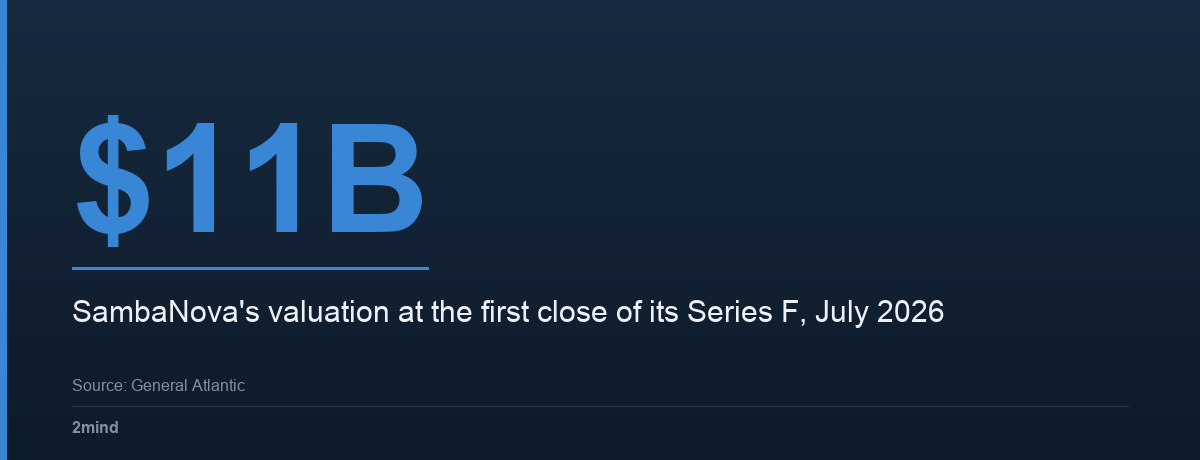
- AI chip startup SambaNova Systems raised roughly $1 billion at an $11 billion valuation, five months after a $350 million round — and months after Intel had been in talks to buy it for about $1.6 billion.
- SK Hynix raised approximately $26.5 billion on Nasdaq, earmarked chiefly for new fabs in Korea plus its first US packaging plant, with part of it expected to be converted into won.
What happened
There is a structural imbalance forming inside the AI buildout, and this week’s market numbers make it legible: big tech platforms are absorbing the capital expenditure of building AI infrastructure — data centers, power contracts, networking — while semiconductor companies are the ones seeing cash reserves grow fastest, since they’re paid up front for the hardware regardless of whether the platform’s AI product eventually turns a profit.
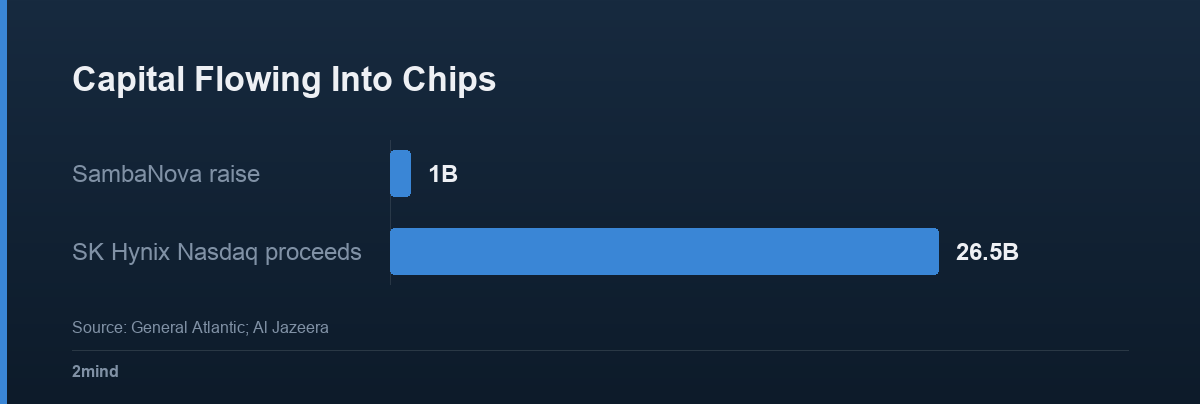
That dynamic showed up concretely this week. SambaNova Systems, an AI inference chip startup, secured a new funding round of roughly $1 billion at an $11 billion valuation — five months after a $350 million round.
Intel had been in talks to acquire the company for about $1.6 billion in December 2025; those talks did not close, and the two now run a multi-year inference partnership instead, with Intel among SambaNova’s backers.
The bet is on the AI inference market, where demand for running trained models (as opposed to training them) is expanding fast.
Separately, SK Hynix raised approximately $26.5 billion selling American depositary shares on Nasdaq. The proceeds are earmarked for new fabrication plants — chiefly a large cluster in Yongin — plus its first US packaging facility in Indiana.
Part of that capital is expected to be converted into Korean won: the won strengthened from about 1,501 per dollar on July 10 to roughly 1,486 shortly afterwards.
| Company | Capital Event | Amount |
|---|---|---|
| SambaNova Systems | New funding round | ~$1 billion at $11B valuation |
| SK Hynix | Nasdaq listing proceeds redirected | ~$26.5 billion |
What Intel’s declined acquisition reveals
The SambaNova timeline is worth slowing down on. Intel was in talks to acquire the company outright for about $1.6 billion in December 2025. Those talks didn’t close.
Seven months later, SambaNova is valued at $11 billion, and Intel is a backer in a multi-year inference partnership instead of an owner.
That’s a specific choice: Intel, a company that makes chips itself and had a clear path to owning a rival inference-chip maker at a fraction of today’s valuation, chose a partnership over consolidation.
One reading is that Intel simply couldn’t justify $1.6 billion at the time and missed the upside.
Another is that Intel judged an inference partnership, buying access to SambaNova’s technology without owning its balance sheet or its execution risk, as the better structure regardless of price.
Either way, the company closest to this deal, with the most information, decided partnership beat ownership.
The two lenses
Lens one: the picks-and-shovels thesis is playing out. For years, analysts have argued that in a gold rush, the safest bet isn’t the miners — it’s whoever sells the shovels. This week’s numbers back that up.
SambaNova’s valuation jump wasn’t driven by consumer hype; it was driven by enterprise demand for inference compute, a less glamorous but more durable revenue stream than chatbot subscriptions. SK Hynix’s decision to direct $26.5 billion into new fabrication capacity signals confidence that memory and AI-adjacent chip demand will remain structurally elevated, not just cyclically hot.
Under this lens, the chip layer of the AI stack is where durable value is accruing, while application-layer companies fight for margin in a crowded, commoditizing market. This pattern isn’t new — it’s just intensifying.
Lens two: it’s a warning sign, not a victory lap. The less comfortable reading is that this capital flow reflects a market that hasn’t figured out where AI’s actual profit will land.
If platform companies are burning cash to build infrastructure without commensurate revenue growth, that’s a bet on a future payoff that hasn’t arrived yet — and the chipmakers benefiting today are essentially getting paid regardless of whether that bet succeeds.
A private company moving from $1.6 billion in acquisition talks to an $11 billion valuation inside seven months is also a classic marker of a financing environment where capital is chasing narrative as much as fundamentals.
If inference demand growth slows, or if custom silicon from hyperscalers (Google’s TPUs, Amazon’s Trainium) erodes third-party chip demand, valuations like SambaNova’s could look overextended in hindsight.
Why it matters
This matters most to investors and policymakers tracking where AI capital actually concentrates, since it reshapes assumptions about who holds pricing power in the AI supply chain. It matters to Korea specifically, given SK Hynix’s scale and its FX market impact.
What to watch next: whether inference-chip demand growth (SambaNova’s bet) continues at its current pace, and whether platform companies start showing revenue growth that justifies their infrastructure spend — because right now, the money is flowing toward hardware faster than it’s flowing back from AI products themselves.
It’s not a dramatic story, but it’s the kind of quiet capital shift that tends to matter more in hindsight than it does in the moment.
What the won’s move says about the size of this listing
The currency detail is a useful scale check on its own.
The Korean won moved from about 1,501 per dollar to roughly 1,486 in the window around SK Hynix’s listing, a shift reported as tied to anticipated dollar-to-won conversion from the $26.5 billion raised.
Currency markets don’t typically move on ordinary corporate financing; they move when a single flow is large enough, or concentrated enough in timing, to shift supply and demand for a currency pair on its own.
That a single company’s capital raise showed up in the won-dollar rate is itself a data point about how large this listing was relative to the flows the market usually absorbs.
FAQ
Q. Why are chip companies benefiting more than AI platform companies right now?
A. Chipmakers are typically paid upfront for hardware and infrastructure components, while platform companies bear the ongoing capital cost of building and running AI services before those services generate proportional revenue.
Q. What does SambaNova Systems actually make?
A. SambaNova builds AI chips focused on inference workloads — running already-trained AI models efficiently — rather than the chips used primarily for training new models from scratch.
What would change our view
This reading would change if SambaNova’s next funding round comes in flat or down, since that would suggest the $11 billion valuation reflected a financing window rather than durable inference demand.
It would also change if platform companies start reporting AI revenue that clearly outpaces their infrastructure spend, which would undercut Lens two’s reading that this capital flow reflects unresolved uncertainty about where AI profit actually lands.
Sources
- General Atlantic, SambaNova completes first close of $1 billion financing at $11 billion valuation (8 July 2026)
- TechCrunch, SambaNova draws $1B at $11B valuation in Series F first close (8 July 2026)
- Al Jazeera, South Korea’s SK Hynix raises $26.5bn in record-breaking US listing (10 July 2026)
- Euronews, SK hynix: from near-collapse to a $1 trillion valuation and a Nasdaq listing (9 July 2026)
- Crypto Briefing, SK Hynix’s Nasdaq listing and the South Korean won (10 July 2026)
Leave a Reply