Something clicked when I noticed both companies moved on the exact same feature within days of each other.
Key Takeaways
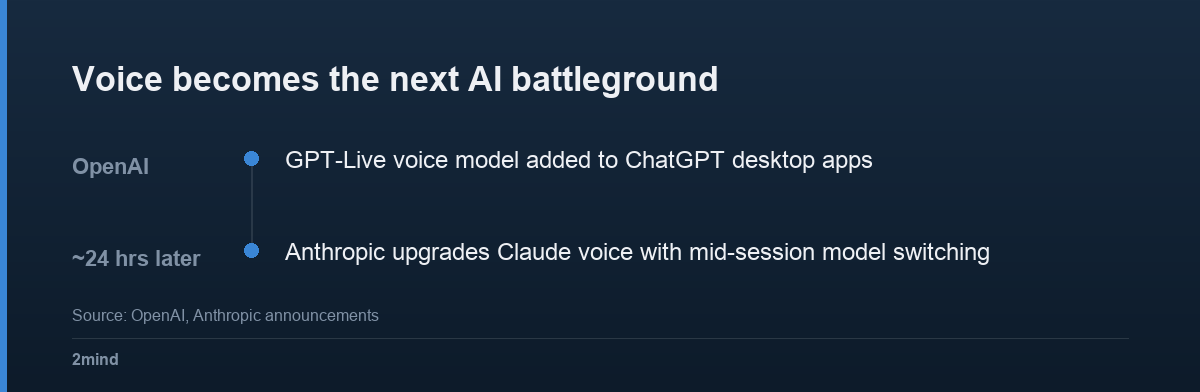
- OpenAI integrated its “GPT-Live” natural voice conversation model into the ChatGPT desktop app for Mac and Windows, enabling voice control of coding agent Codex and ChatGPT Work.
- Anthropic separately upgraded Claude’s voice mode, adding model-switching between Haiku, Sonnet, and Opus mid-conversation plus external tool integrations.
- The 2mind read: both companies converging on voice control in the same week signals the interface layer — not just model capability — is becoming the next competitive battleground.
What happened
OpenAI rolled out GPT-Live, a natural-sounding voice conversation model, directly into its desktop ChatGPT apps. The integration goes beyond simple dictation — users can now voice-control Codex, OpenAI’s coding agent, and ChatGPT Work, meaning tasks that previously required typing commands can now be spoken instead.
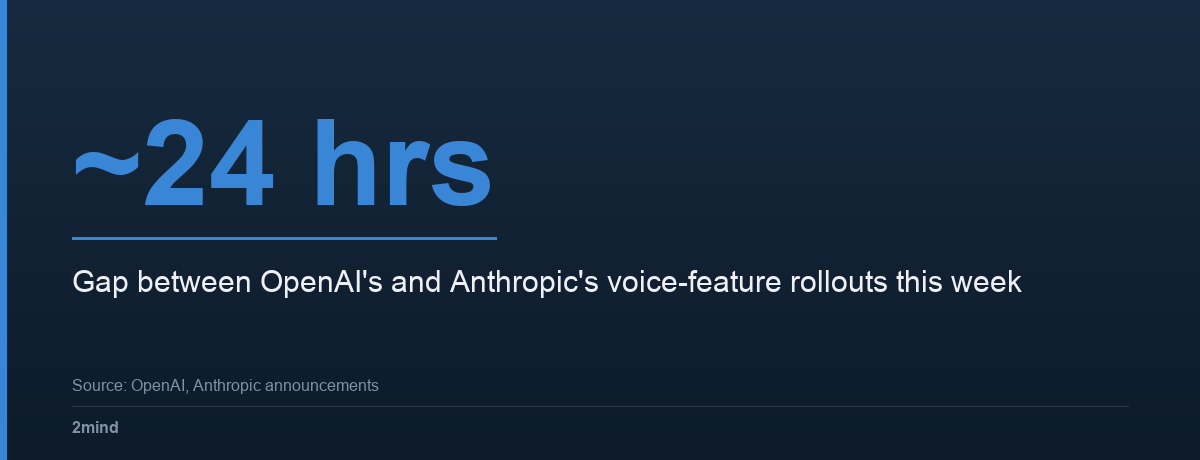
Almost simultaneously, Anthropic announced a significant upgrade to Claude’s voice mode. Users can switch between Haiku, Sonnet, and Opus models mid-conversation without breaking the voice session, and the update adds integration with external work tools. Both companies published these updates on the same day — July 23, though neither referenced the other directly.
| Feature | OpenAI (GPT-Live) | Anthropic (Claude Voice) |
|---|---|---|
| Model switching mid-voice-session | Not specified | Yes (Haiku/Sonnet/Opus) |
| Agent/tool control via voice | Yes (Codex, ChatGPT Work) | Yes (external work tools) |
| Platform | Mac, Windows desktop app | Not fully specified |
The overlap in timing is worth sitting with. Model releases get staggered for a reason — nobody wants their headline buried under a rival’s. When two frontier labs ship comparable features the same day without acknowledging each other, it usually means both were already deep in development independently.
That matters more than the features themselves. It tells you voice-controlled agents weren’t a response to a competitor’s move — both companies apparently concluded, on their own timelines, that spoken delegation to an AI agent was worth shipping now rather than waiting for the next model release cycle.
The feature comparison above also undersells how much is still unconfirmed. Anthropic’s own materials didn’t fully specify platform availability, which the FAQ addresses directly — a reminder that ‘both companies shipped voice control’ is accurate, but the exact reach of each rollout isn’t yet fully documented publicly.
The two lenses
Lens one: voice is simply the next incremental UX feature. Voice assistants aren’t new — Siri, Alexa, and Google Assistant have existed for over a decade, and neither OpenAI nor Anthropic invented natural voice interaction this week.
Under this reading, these updates are just catch-up features, bringing frontier LLM providers to parity with capabilities that voice-first products already had. The novelty isn’t the voice itself, it’s that it’s attached to a more capable underlying model.
Users who wanted voice control of AI tools could already get partial versions of this through third-party wrappers and APIs; this lens sees the announcements as consolidation rather than innovation.
The pattern of frontier labs absorbing previously third-party functionality directly into their core products has been consistent throughout 2025 and into this year.
Lens two: this is the interface war for agentic AI. The more consequential reading focuses on *what* is being voice-controlled — not general chat, but coding agents and work tools.
If GPT-Live lets someone direct Codex verbally while walking away from a keyboard, and Claude lets someone switch reasoning models mid-task by voice, both companies are betting that the next major AI use case isn’t typed prompts, it’s spoken delegation to autonomous agents. That’s a meaningfully different product bet than voice-as-convenience.
It suggests both labs see agentic workflows — where AI executes multi-step tasks with minimal human typing — as the near-term product frontier, and voice as the natural control layer for that shift, rather than a novelty feature bolted onto chat.
The two lenses aren’t mutually exclusive, and that’s part of what makes this week interesting. A feature can be catch-up relative to consumer voice assistants and still represent a genuine strategic bet for these two companies, since neither had shipped serious voice-to-agent control before this week.
What tips it toward Lens two, for me, is what’s being controlled. Siri directing you to a weather app is a convenience feature. A voice command that hands off a multi-step coding task to an autonomous agent is a delegation decision — a different kind of trust than typed interfaces earned by default.
Neither lens requires the other to be wrong. It’s entirely possible this is simultaneously overdue parity with existing voice assistants and a genuine strategic bet on agentic delegation — the two readings operate at different altitudes, one about the feature category and one about what it’s attached to.
Why it matters
For developers, voice-controlled coding agents could change how much time is spent at a keyboard versus reviewing and directing AI output verbally — a genuine workflow shift, not just a convenience.
For enterprise buyers evaluating OpenAI versus Anthropic, feature parity on voice removes one differentiator and pushes the competition back toward underlying model quality and tool ecosystem breadth.
For everyday users, the near-simultaneous timing is a reminder that these companies watch each other’s release cadence closely, and matching feature launches within a day or two isn’t coincidence — it’s competitive signaling.
What to watch: whether third-party developers build meaningfully new workflows around voice-controlled agents, or whether this remains a marginal feature most users ignore in favor of typing, the way many predicted (incorrectly, and correctly, at different times) about earlier voice assistant waves.
There’s also a quieter angle here for accessibility. Voice-controlled coding agents lower the barrier for developers who can’t or don’t want to type extensively — a use case that tends to get treated as a side benefit of consumer voice features but is a primary benefit for some users.
The FAQ below flags an honest gap: neither company has published independent, large-scale reliability data for voice-directed multi-step tasks. Until that exists, how useful these features are for serious work remains something individual developers will have to test rather than take on faith.
That caveat means this remains a story about strategic intent for now, not proven usefulness at scale — which is worth keeping in mind before treating either launch as a settled win for either company.
FAQ
Q. Can I actually control coding tasks entirely by voice now with these updates?
A. Yes, to a degree — OpenAI’s GPT-Live lets users voice-control its Codex coding agent within the desktop app, though how reliably it handles complex multi-step coding tasks by voice alone hasn’t been independently tested at scale yet.
Q. Is Anthropic’s voice mode only available on paid Claude plans?
A. The update applies to Claude’s higher-tier models (Sonnet and Opus) in addition to Haiku, but specific plan-tier restrictions weren’t detailed in the announcement; this is worth checking directly on Anthropic’s site for current availability.
What would change our view
If third-party developers build genuinely new workflows around voice-controlled agents over the next few months, the interface-war reading in Lens two would hold up.
If usage data instead shows most users reverting to typing once the novelty fades, that would favor the incremental-feature reading in Lens one.
Sources
- TechCrunch — 2026-07-23. OpenAI integrated GPT-Live voice into ChatGPT desktop app enabling voice control of Codex
- TechCrunch — 2026-07-23. Anthropic upgraded Claude voice with model switching between Haiku, Sonnet, Opus mid-conversation
- SQ Magazine — 2026-07-23. Anthropic update adds external tool integrations to voice mode
Leave a Reply