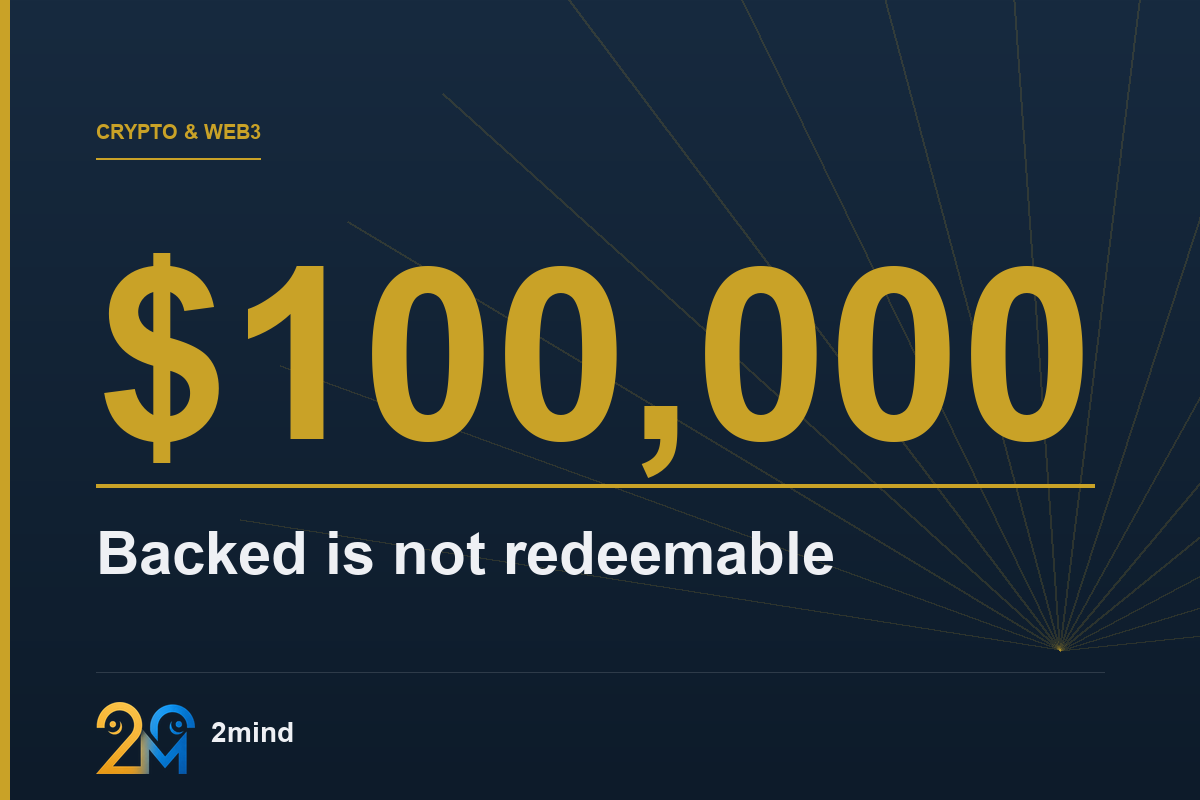
What backs stablecoins, for the largest dollar tokens, is cash and short-dated U.S. Treasury paper held by a custodian bank. That answers the reserve question and only half of what a holder needs. Backing describes what the issuer owns. Redemption describes who may hand a token back for a dollar — at what minimum, on which days, for what fee.
Those two answers now point in different directions. The reserve side has moved on-chain and settles almost continuously. The redemption side still runs on account approvals, business-day calendars and minimums most holders will never meet.
Key Takeaways
- The GENIUS Act requires reserves at least 1-to-1 from eight named categories, including Treasury bills maturing in 93 days or less.
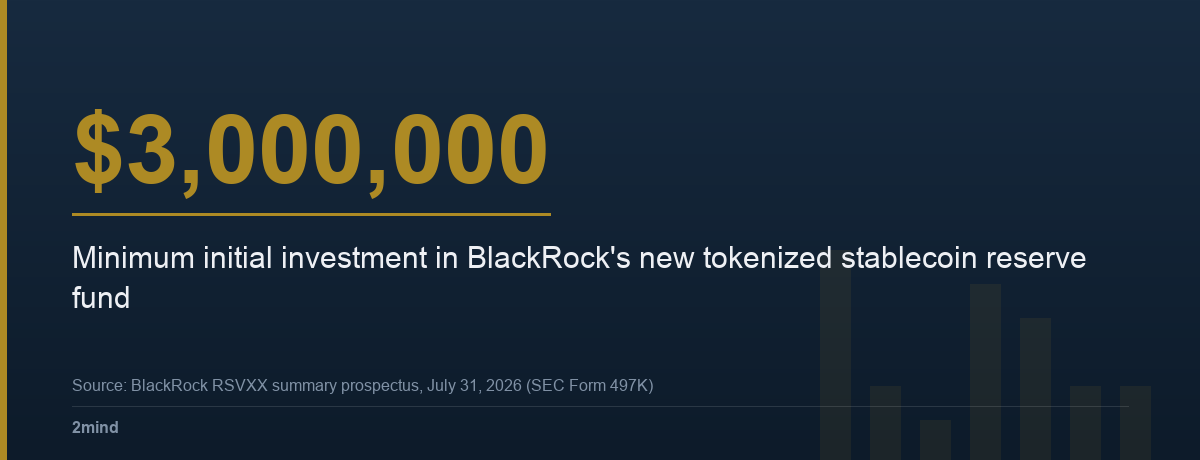
- BlackRock’s new tokenized reserve fund is engineered to that line — with a $3 million minimum, transacted only on business days.
- Tether’s fee schedule sets a $100,000 minimum redemption and a fee of the greater of $1,000 or 0.1%, so the smallest permitted redemption costs 1.0%.
- Below those thresholds your exit is the order book, making market depth — not the monthly attestation — the thing protecting your dollar.
What happened
The rulebook came first. The GENIUS Act, enacted July 18, 2025 as Public Law 119-27, requires a permitted payment stablecoin issuer to “maintain identifiable reserves backing the outstanding payment stablecoins … on an at least 1 to 1 basis.”
Eight asset categories qualify: currency, insured bank deposits, Treasury bills, notes or bonds maturing in 93 days or less, overnight repo and reverse repo against them, government money market funds holding only those assets, other approved federal assets — and, in clause (viii), any of the above “in tokenized form.”
Clause (viii) is the one asset managers read closely, and the products have arrived. In a summary prospectus dated July 31, 2026, BlackRock registered the Daily Reinvestment Stablecoin Reserve Vehicle, OnChain Shares ticker RSVXX.
The fund “invests 100% of its total assets in cash, U.S. Treasury bills, notes and other obligations issued or guaranteed … by the U.S. Treasury … with a maturity of 93 days or less, and overnight repurchase agreements that are secured by Treasury Instruments.” The match is no coincidence: the filing says the shares are meant to be eligible reserve assets under the Act.
Ownership is recorded by Securitize Transfer Agent, LLC across Ethereum, Tempo and Solana, at 0.17% annual expenses. Issuer disclosure moved the same way: Circle’s annual report puts roughly 88% of USDC reserves in the BlackRock-managed Circle Reserve Fund at December 31, 2025, the rest cash at globally systemic banks.
Two Lenses
Lens one: the reserve really has hardened
On reserve quality alone, this is a different asset class from the one that produced the old arguments about commercial paper. A statute names the permitted assets. A 93-day ceiling caps duration risk. Monthly publication of reserve composition, including average tenor and custody location, is now law.
The tokenized fund extends that. An issuer holding RSVXX holds a Rule 2a-7 government money market fund whose ownership record lives on public chains, so reserves can move between allow-listed wallets without waiting on a wire. Reserves in a named fund with a named custodian are also easier to verify than reserves described in prose — the point our look at Circle under siege returned to.
Tether moved the same way. Its Q2 2026 attestation, prepared by BDO, puts total assets at $187.75 billion against $183.64 billion of liabilities — a buffer of $4.11 billion, about 2.2% by our calculation.
Lens two: the door has not moved with the reserve
Now read the other document. Tether’s fee page sets a minimum acquisition or redemption of 100,000 USD, a redemption fee of “the greater of $1,000 or 0.1%,” and a $150 verification fee. Its terms add that to have tokens redeemed “you must be a verified customer of Tether.”
Circle Mint applies KYC, sanctions screening and suitability checks; basic redemption is “initiated within two business days” and free, standard redemption nearly instant for a nominal fee. Eligible non-Mint users redeem through Circle’s European entity.
The reserve fund has a door too. RSVXX shareholders transact when both the NYSE and the Federal Reserve Bank of Philadelphia are open, at a $3 million minimum. The asset settles on a public chain around the clock; every primary exit runs on a business-day calendar. As we argued about what an ETP holder actually owns, the instrument and the claim on it are separate things.
| Exit door | Who may use it | Published minimum | When it opens | Cost |
|---|---|---|---|---|
| BlackRock RSVXX (reserve layer) | Allow-listed institutions | $3,000,000 initial | NYSE and Philadelphia Fed business days | 0.17% annual expenses |
| Tether redemption desk | Verified Tether customers | $100,000 | Per Tether’s terms and approval | Greater of $1,000 or 0.1%, plus $150 verification |
| Circle Mint | Screened institutional customers | Not stated in the 10-K | Basic: within two business days | Basic free; standard instant for a nominal fee |
| Secondary market | Anyone with a venue account | None | Whenever the venue trades | The spread under stress |
Why it matters
The fee floor inverts the assumption that small trades are cheap. Tether’s fee is the greater of a flat $1,000 or 0.1%, so the flat amount governs every redemption below $1,000,000 — making the smallest permitted redemption the most expensive.
| Redemption size | Fee charged | Effective cost |
|---|---|---|
| $100,000 (minimum) | $1,000 | 1.00% |
| $250,000 | $1,000 | 0.40% |
| $500,000 | $1,000 | 0.20% |
| $1,000,000 | $1,000 | 0.10% |
| $5,000,000 | $5,000 | 0.10% |
Read that against a token designed to hold a dollar. A holder redeeming the minimum receives about $0.99 per unit before banking fees, and the headline rate only becomes real at ten times the minimum. If your position is under $100,000 — nearly every individual — the primary door is shut, and the attestation describes collateral you cannot call.
March 2023 shows why. Circle disclosed $3.3 billion of USDC cash reserves at Silicon Valley Bank, “about 8% of the USDC total reserve,” and the token traded below a dollar until regulators confirmed depositors would be made whole. Reserves were never 8% gone. Access to them was uncertain over a weekend, and the price moved on access.
Supply events read the same way. In a $750 million USDC mint on Solana, what mattered was where the liquidity landed. In Tether’s Q2 attestation, the buffer halved while the backing claim stayed true.
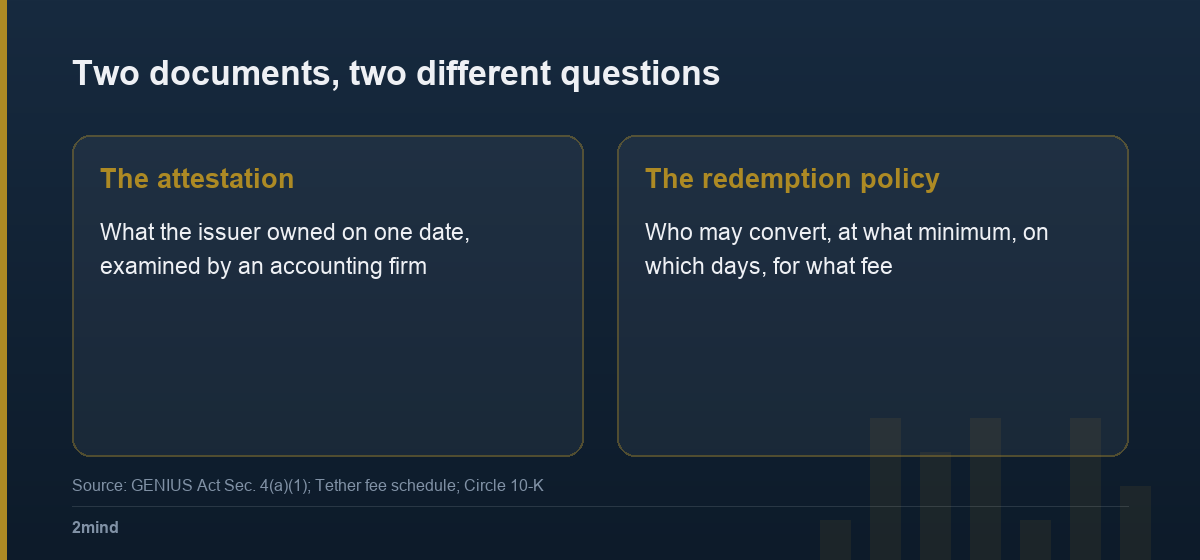
So the practical check is two documents. Read the reserve report for asset quality and tenor. Then read the fee schedule for the minimum, the calendar and the approval requirement — and if you fall below the minimum, price the venue you would actually sell into.
What would change our view
We would treat the gap as closing if a major issuer published a retail redemption path with a minimum near zero, a same-day settlement commitment, and fees that scale proportionally rather than from a flat floor. A tokenized reserve fund redeeming on weekends would be the stronger signal, because the money market layer underneath would have left the business-day calendar behind.
We would grow more cautious if issuers kept improving reserve disclosure while quietly raising minimums, lengthening approval queues, or adding discretionary suspension language. Under the Act only a named regulator may limit timely redemption, so limits widening by contract instead is the thing to watch.
The Act takes effect on the earlier of eighteen months after enactment or 120 days after final implementing regulations. What the first published redemption policies say — not what the reserve tables show — is where the answer will be.
FAQ
Q. Are stablecoins fully backed?
A. For the two largest dollar tokens, disclosed reserves exceed tokens outstanding. Tether’s Q2 2026 attestation reports $187.75 billion in assets against $183.64 billion in liabilities. “Fully backed” describes the issuer’s balance sheet, not your ability to convert.
Q. Can an individual redeem USDT or USDC directly with the issuer?
A. Generally not. Tether’s published minimum is $100,000 and requires verified-customer status. Circle Mint is institutional and screened, though eligible users may redeem through Circle’s European entity. Most individuals exit through an exchange at the market price.
Q. Does a tokenized reserve fund make a stablecoin safer?
A. It improves transparency and transferability of the collateral, and the Act permits eligible reserves “in tokenized form.” It does not change who may redeem the stablecoin, or on what days.
Sources
- GENIUS Act, Public Law 119-27 — Sec. 4(a)(1) reserves; Sec. 20 effective date
- BlackRock RSVXX summary prospectus, SEC Form 497K (July 31, 2026) — investment policy, minimum, business days, expenses
- Circle Internet Group 2025 Form 10-K — USDC reserve composition, Circle Mint terms
- Tether Q2 2026 attestation release (July 31, 2026) — assets, liabilities, buffer
- Tether fee schedule — minimum and fees
- Tether Token Terms of Sale and Service — verified-customer requirement
- Circle, “$3.3 Billion of USDC Reserve Risk Removed” (March 2023) — SVB deposit and de-peg
- Circle transparency — cadence
Leave a Reply