Tether’s Q2 2026 earnings landed on July 31 with two numbers that pull in opposite directions. Net operating profit came in at $1.5 billion. At the same time, the excess reserve buffer backing every USDT in circulation was cut roughly in half, from $8.23 billion to $4.11 billion.
Both figures come from Tether’s own attestation report, reported in detail by CoinDesk. Decrypt independently confirms the profit figure, the current reserve surplus, and rising gold holdings from the same filing.
That combination is the story. A stablecoin issuer made more money and became, on paper, less over-collateralized in the same three months.
Key Takeaways
- Tether reported $1.5 billion in net operating profit for Q2 2026.
- Excess reserves — assets minus liabilities — fell from $8.23 billion to $4.11 billion, per CoinDesk.
- Reserve assets stood at $187.75 billion against $183.64 billion in liabilities.
- Gold holdings rose to 146.2 tons, up from 132.2 tons in Q1.
- USDT circulation grew by roughly $446 million during the quarter.
Tether’s Q2, in three numbers
An attestation report is not the same thing as a full independent audit. It’s a point-in-time snapshot, prepared with an outside accounting firm, confirming that reserve assets matched liabilities on a given date. Tether has published these quarterly for years, and both outlets covering this one describe it the same way — useful, but narrower than a full audit.
The quarter-over-quarter figures below, as reported by CoinDesk, are specific enough to compare directly.
| Metric | Q1 2026 | Q2 2026 |
|---|---|---|
| Excess reserves | $8.23B | $4.11B |
| Gold holdings | 132.2 tons | 146.2 tons |
| Reserve assets | — | $187.75B |
| Reserve liabilities (USDT outstanding) | — | $183.64B |
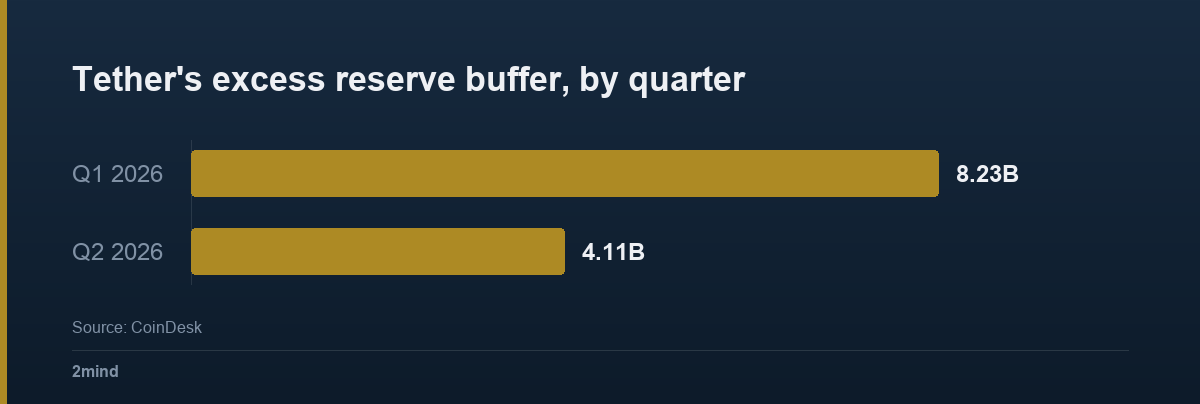
The buffer is still positive. $4.11 billion in assets beyond what’s owed to USDT holders is not a shortfall.
But it’s half of what it was three months ago. Tether’s own disclosures point to the reason: mark-to-market losses on gold and bitcoin held in reserve. Prices moved against Tether’s holdings during the quarter. Because those assets are counted at current market value, the paper loss shows up directly in the buffer line — even though nothing was sold.

The profit number moved the opposite way. $1.5 billion in net operating profit is Tether making money largely the way it always has — holding short-term Treasuries and other reserve assets that pay interest, while USDT itself pays holders nothing. Growing circulation, up about $446 million on the quarter, means more reserve assets earning that yield.
Two Lenses
Lens one: the buffer shrank because collateral did its job
A reserve buffer isn’t supposed to be a fixed number. It’s supposed to absorb exactly this kind of shock.
Gold and bitcoin lost value on paper. The buffer absorbed that loss. USDT holders were never at risk of Tether falling short — reserve assets still cleared liabilities by over $4 billion.
Read this way, a shrinking buffer during a rough quarter for gold and crypto prices is the collateral cushion doing precisely what it exists to do, not a warning sign.
Lens two: half a buffer is still half
The other reading doesn’t dispute the math. It questions the trend.
A buffer that can lose half its size in one quarter from price moves alone is a buffer whose safety margin is more exposed to market volatility than a “well-capitalized” headline suggests.
If gold and bitcoin move against Tether again next quarter by a similar magnitude, the conversation shifts from how large the cushion is to how close the line is getting.
Nothing in this report says that’s happening yet. But the size of one quarter’s swing is itself new information worth tracking into Q3 — not because the current number is alarming, but because the rate of change is larger than the headline profit figure would suggest on its own.
Why regulators watch the buffer, not just the profit
Stablecoin oversight in most major markets has been moving in one direction: toward requiring issuers to hold reserves that fully back tokens in circulation, and to disclose that backing on a regular schedule.
None of that regulatory attention is aimed at whether an issuer is profitable. It’s aimed at exactly the number that moved the most this quarter — the buffer.
That’s the part of this report that outlasts the headline. A profitable quarter is good news for Tether as a company. A reserve buffer that’s more sensitive to gold and bitcoin prices than it looked three months ago is the number a regulator, a competitor, or a large USDT holder would actually reread twice.
For exchanges and market makers that hold USDT as working capital, the profit line is close to irrelevant.
What matters to them is the same thing regulators track: whether reserves clear liabilities by a comfortable margin, and how much that margin moves when markets are volatile.
This quarter answers the first question clearly and the second one less reassuringly than the profit headline implies.
What the profit number doesn’t settle
$1.5 billion in profit is Tether’s business model working. It says nothing about how exposed the reserve backing that profit is to further gold or bitcoin price swings. Those are two separate questions, and this report answers only one of them with real precision — the profit figure is a clean number from operations.
The buffer figure is a snapshot of an amount that moves with markets Tether doesn’t control. A company can be highly profitable and still be carrying more market-price risk in its reserves than it was a quarter earlier. Both things are true here at once, and neither one cancels the other out.
The next attestation, likely due in the fall, is what actually settles which reading holds up. If the buffer stabilizes or recovers as gold and bitcoin prices move, this quarter reads as ordinary market noise. If it keeps shrinking even as profit stays strong, that’s a different story — and one this report alone can’t yet tell.
What would change our view
The profit line is not the number that would change our reading. A reserve buffer that moved this much in one quarter is, and there are two ways that resolves.
If Q3 shows the buffer rebuilding while gold and bitcoin are roughly flat, that supports the first lens: the cushion absorbed a price shock and recovered, which is what a cushion is for. If the buffer falls again by a similar magnitude on similar moves, the question stops being how large the cushion is and becomes how quickly it changes.
A structural answer would settle it faster than either quarter. If Tether shifts reserve composition toward assets that do not reprice like gold and bitcoin, or discloses composition on a tighter schedule, the sensitivity question is answered by design rather than by waiting for the next print. Absent that, we would keep reading the buffer and not the profit.
FAQ
Q. Is Tether’s stablecoin still fully backed?
A. Yes — based on this attestation, reserve assets ($187.75 billion) exceed liabilities ($183.64 billion) by $4.11 billion. “Fully backed” and “less buffer than last quarter” are not contradictory statements.
Q. Why did the buffer fall if Tether made a profit?
A. Profit and the reserve buffer are measured differently. Profit comes from operating income like interest on Treasuries. The buffer is reserve assets minus liabilities, and it moves with the market value of holdings like gold and bitcoin — both of which lost value during the quarter.
Q. Is this the same thing as an independent audit?
A. No. This is an attestation report, a narrower review than a full audit. Both CoinDesk and Decrypt describe it that way in their coverage.
Q. Has Tether’s reserve backing faced scrutiny before?
A. Yes. Questions about what backs the world’s largest stablecoin have been a recurring theme for years. This report doesn’t resolve that history — it adds one more data point, in Tether’s favor on profit and against it on buffer size, to a debate that was already ongoing.
Sources
- CoinDesk — Tether posts $1.5 billion operating profit in Q2 as reserve buffer falls by half
- Decrypt — Tether Reports $1.5B Q2 Profit as USDT Supply Grows, Gold Holdings Rise
Does a reserve buffer that halves in one quarter change how “fully backed” should be read going forward?
Leave a Reply