Key Takeaways
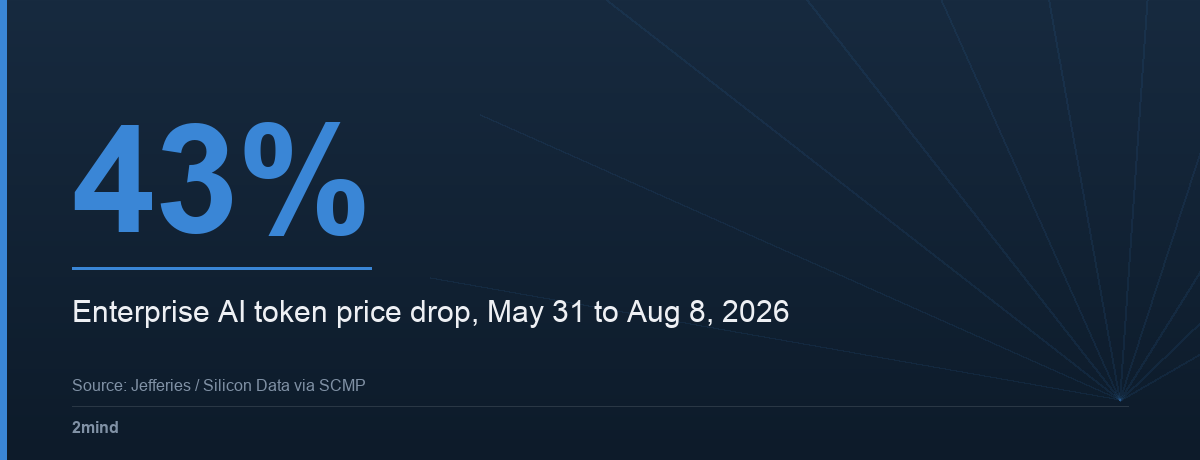
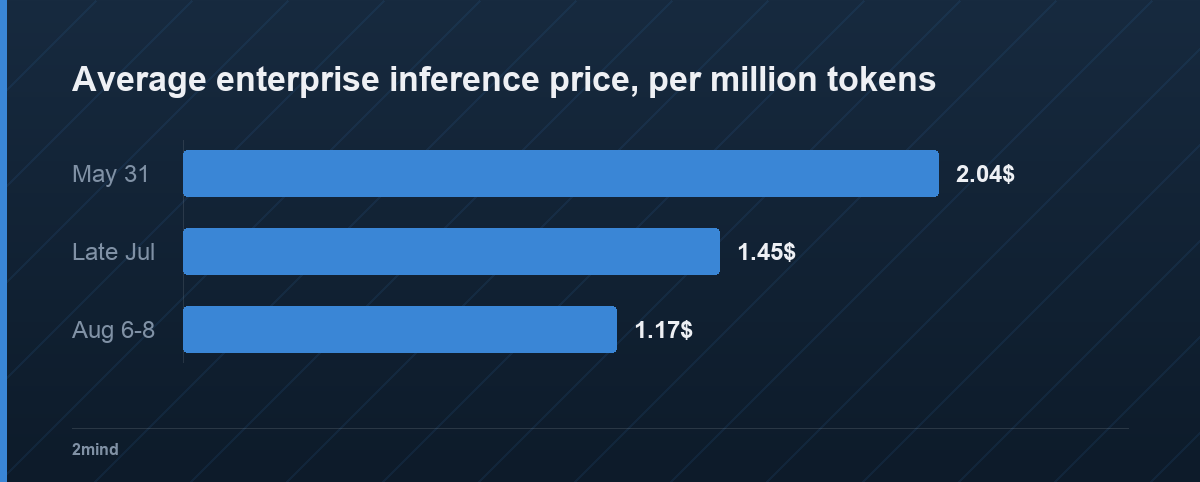
- The blended enterprise inference price fell 43% in about ten weeks: $2.04 per million tokens on May 31 → $1.45 in late July → $1.16–$1.18 on Aug 6–8, 2026 (Jefferies research, citing Silicon Data’s pricing index, via SCMP).
- The cuts are uneven. OpenAI cut GPT-5.6 pricing by up to 80%; Anthropic’s Claude Opus 5 comes within 0.5% of its flagship Fable 5’s peak score at roughly half the cost per task, according to Anthropic; DeepSeek’s V4-Flash-0731 runs some tasks at $0.03.
- Silicon Data publishes separate open-weight and proprietary token-price indexes, so a single blended average can hide very different prices for different workloads.
- A falling average says nothing about your bill unless you know which side of that gap your workload sits on.
Enterprise AI inference got a lot cheaper on paper this month. The average price of a million tokens dropped from $2.04 in late May to $1.16–$1.18 in the first week of August — a 43% decline in about ten weeks.
That figure comes from Jefferies research built on Silicon Data’s pricing index, reported by the South China Morning Post on August 12. It was the lowest reading the index had recorded this year at the time.
It’s also a blended average across 400+ models and more than 20 pricing sources. Averages compress. Before assuming your own AI bill is about to shrink by the same 43%, it helps to know what the compression hides — and how that compares with the total-spend pattern we tracked in when AI capex actually pays back.
What Actually Fell, and What Didn’t
Three separate things happened at once this summer, and headlines usually merge them into one number.
| What | Price point | Source |
|---|---|---|
| Blended index (all models) | $1.16–$1.18 / M tokens, Aug 6–8 | Silicon Data via SCMP |
| Blended index (all models), later reading | $0.98 / M tokens, Sep 30 | Silicon Data index page |
Silicon Data publishes separate open-weight and proprietary indexes, but their values sit in its portal rather than on the public page, so we do not quote them.
The logic still holds. A company that mostly calls GPT-5.6-class or Claude Opus-class models for accuracy-sensitive work should expect to sit above the blended figure. One running high-volume, lower-stakes tasks on open-weight models should sit below it.
The $1.16–$1.18 blended figure describes neither company’s actual bill. It describes the market’s shifting mix between the two — the same shift we saw play out in decentralized AI inference pricing, where a cheaper quote didn’t always survive contact with real workloads.
Individual vendor cuts widen the confusion further. OpenAI’s up-to-80% cut on GPT-5.6 pricing doesn’t mean every GPT-5.6 call got 80% cheaper. “Up to” language typically covers the single largest cut — here, GPT-5.6 Luna at 80% while Terra got 20% — not the median call.
Anthropic’s Claude Opus 5 pricing move is a like-for-like comparison against Fable 5, not against Opus 5’s own prior price. DeepSeek’s $0.03-per-task figure for V4-Flash-0731 is a per-task cost for a specific lightweight model, not a per-million-token rate comparable to the other three. Three different kinds of “cheaper,” reported as one trend.
What Does a Falling Average Price Hide?
- The tier you’re actually billed on. A blended average moving down doesn’t move your invoice unless your workload’s tier moved down with it. Check your provider’s price sheet for your specific model, not the index headline.
- “Up to” is a ceiling, not a median. Vendor-announced cuts describe their best case. Ask what discount applies to your actual usage pattern — batch, cached, or standard-rate calls each price differently.
- Volume can grow faster than price falls. Our earlier reporting on AI capex found that spending keeps climbing even as unit costs drop, because usage volume outpaces the price decline. A 43% price cut paired with a 90% usage increase is still a bigger bill.
- New premium tiers launch alongside the cuts. Reasoning and agentic modes are frequently billed as separate, higher-priced tiers even while a provider’s headline model gets cheaper. A falling average can coexist with a rising bill for the features you’ve just started using.
None of this means the price war is fake. Real cuts are happening, and they compound. A team that can shift eligible workloads from frontier to open-weight models captures a real, large saving.
But that saving comes from making a deliberate tier decision, not from the market average moving on its own. The index tells you the market is getting cheaper. It doesn’t tell you whether you are.
A practical version of this checklist takes five minutes. Pull your provider’s invoice for the model you actually call, and compare that line item’s price today against 90 days ago — before comparing it with the index headline.
If your line item didn’t move, the market average moving doesn’t matter to you yet. It’s still worth checking again next quarter, since providers tend to pass frontier-tier cuts through with a lag.
Two Lenses
Why Buying More AI Feels Rational Right Now
Falling average prices are the reason teams keep approving new AI use cases — the math looks easier every quarter. That’s a legitimate read of the data: unit economics for the same task, on the same model tier, genuinely improved through 2026.
Why the Invoice Won’t Match the Headline
The same team that approved three new use cases because “AI got 43% cheaper” can end this quarter with a larger bill than last quarter. Three new use cases at a higher tier cost more than one use case at a lower tier ever did, even after the discount.
Both things are true at once. That’s exactly why the index number and the invoice number diverge, and why finance teams keep asking for a bill that a market-wide average can’t produce.
What would change our view
If Silicon Data or a comparable tracker starts publishing a volume-weighted total-spend figure — not just a per-token price average — and that total falls in step with the per-token price, that would be a real signal the price war is reaching total enterprise AI budgets, not just unit prices.
Until a spend-weighted index exists publicly, a falling average price index tells us about pricing pressure between vendors. It does not tell us what any specific company will pay next quarter.
FAQ
Q. Is AI actually getting cheaper in 2026?
A. The per-token price is falling — down 43% since May 2026 by Jefferies’ measure. Whether your bill falls depends on which model tier you use and how much your usage grows in the same period.
Q. Why doesn’t a lower average token price show up on my invoice?
A. The average blends frontier and open-weight models, which can be priced very differently. If your workload’s mix between the two didn’t shift, the market average moving doesn’t move your specific rate.
Q. Which AI model had the biggest price cut in 2026?
A. OpenAI cut GPT-5.6 pricing by up to 80%, the largest single-vendor cut reported in this round, though the size of the discount applied to any specific customer’s usage will vary by tier.
Sources
- Enterprise AI costs hit 2026 low — SCMP, Aug 12, 2026
- LLM Token Expenditure Index — Silicon Data
- AI token prices are cooling — but why? — CIO
- When Does AI Capex Pay Back? — 2mind
Correction, October 2, 2026. An earlier version said a 43% price cut paired with a 60% usage increase gives a bigger bill; that combination lowers the bill by about 9%, and the break-even is near 75% more usage.
It also explained OpenAI’s “up to 80%” cut as a batch or cached tier; OpenAI announced model-level cuts of 80% for Luna and 20% for Terra. We removed segment prices we could not verify publicly.
Leave a Reply