Key Takeaways
- A trust bank charter governs who is legally accountable for reserves and who can examine them. It does not change what those reserves are invested in.
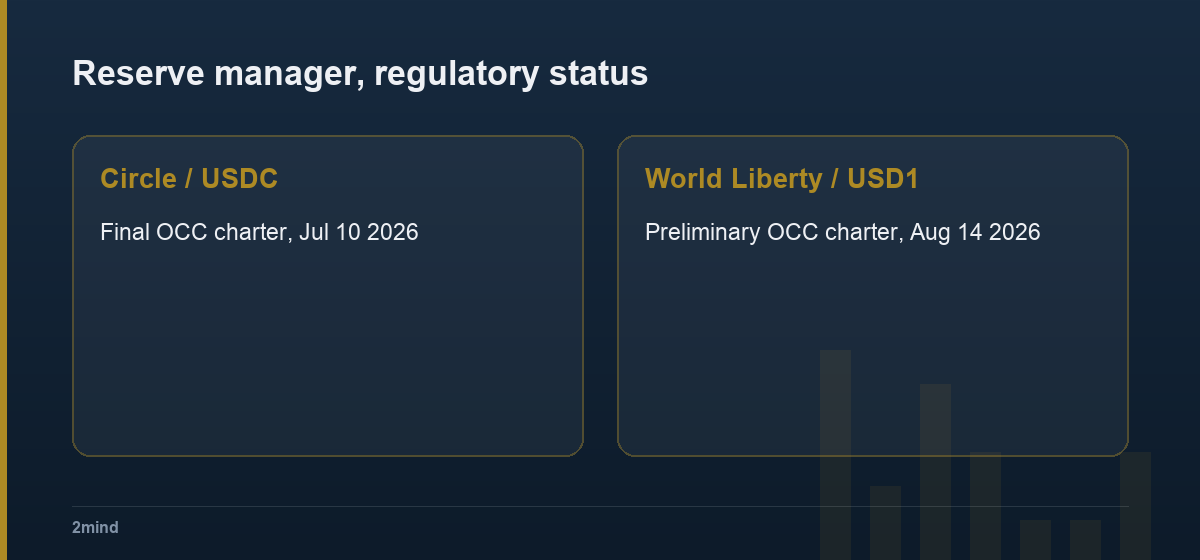
- August 14, 2026: the OCC gave World Liberty Trust Company preliminary conditional approval to become USD1’s reserve manager, custodian and issuer.
- July 10, 2026: Circle received final approval for its own national trust bank, five weeks earlier.
- Tether has no US federal bank charter and has not applied for one.
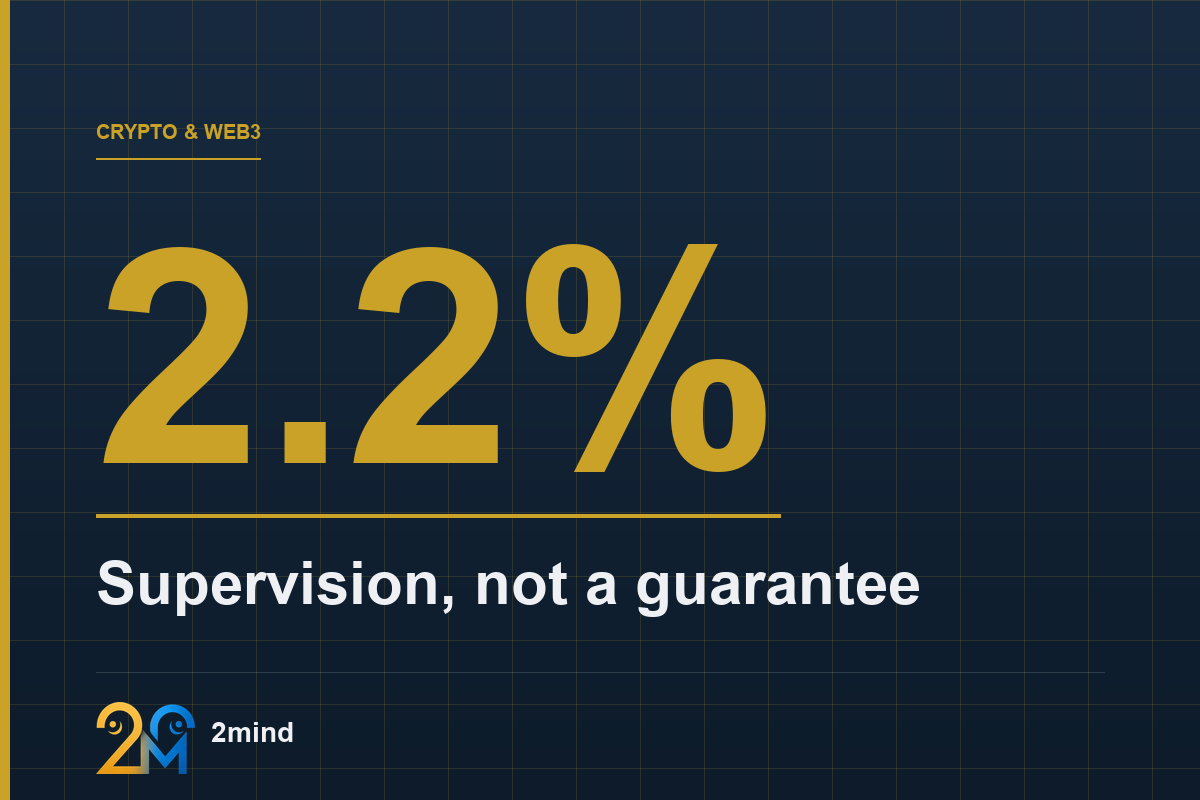
- Tether’s Q2 2026 attestation shows a buffer equal to about 2.2% of what it owes USDT holders.
A national trust bank charter is not a deposit-taking bank license. The OCC’s own letter is explicit that these entities cannot take deposits or make loans.
So the honest answer to “does the charter make it safe” is narrower than the headlines suggest. It changes who answers for the reserves — not what the reserves are.
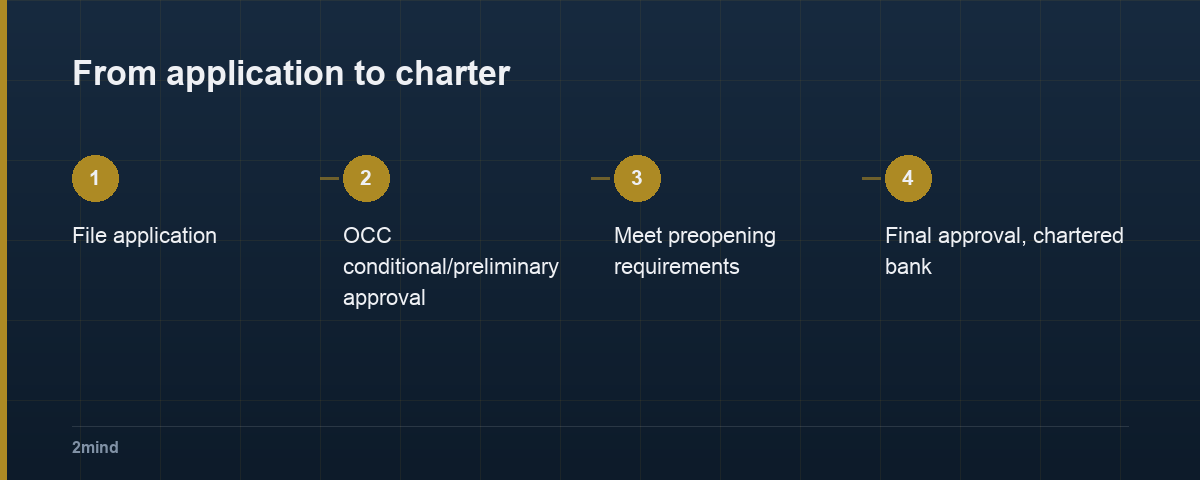
On August 14, 2026, the OCC gave World Liberty Trust Company preliminary conditional approval to organize as a national trust bank. Once it clears final approval it takes over issuing, custody and reserve management for USD1, a job BitGo Trust Company does today.
That approval does two things at once.
It puts USD1’s reserve manager on the same regulatory track Circle finished five weeks earlier. And it leaves Tether — still the largest issuer by market value — as the only one of the three without a US federal bank charter behind it.
Which Stablecoin Issuers Actually Have a Bank Charter?
Federal charters for stablecoin reserve managers are new enough that no issuer has held one for long. Circle is furthest along. USD1 is the newest entrant. Tether has not applied.
| Issuer | Charter status | Approved | Custodian / auditor |
|---|---|---|---|
| USDC (Circle) | National trust bank — final | Jul 10, 2026 | Circle Reserve Fund (BlackRock); Grant Thornton, monthly |
| USD1 (World Liberty) | National trust bank — preliminary | Aug 14, 2026 | BitGo Trust (South Dakota), moving to World Liberty Trust; Crowe LLP, monthly |
| USDT (Tether) | None | — | Tether International (El Salvador DASP); BDO Italia, quarterly |
What a charter authorizes is narrow: direct issuance and redemption, fiduciary custody of the backing reserves, and reserve management — all under OCC examination.
The OCC also keeps the right to “modify, suspend, or rescind” the charter if the bank misses ongoing conditions.
That supervisory leash is the actual product being sold to holders. It is not a guarantee about asset quality.
Two Lenses
Wanting a regulator’s seal that outlasts any one issuer
A trust charter moves stablecoin reserves out of a private custody agreement and into a structure examiners can walk into.
Circle’s own filings describe the goal plainly — bringing USDC Reserve management “under federal regulatory oversight,” rather than leaving it to a state-chartered custodian and a monthly PDF.
For someone deciding whether to route payments through a stablecoin, “an OCC-chartered bank is answerable for this” is a different sentence than “an accounting firm confirmed the numbers matched last month.”
Watching the seal go first to the president’s own venture
That desire runs into an uncomfortable fact.
The first issuer to reach this stage after Circle is World Liberty Financial, a venture in which the Trump family holds a financial stake. The approval came from a federal agency whose leadership the president appoints.
Nothing in the OCC’s letter suggests different standards were applied, and the approval is still only preliminary.
But a reader who wants bank-grade oversight because they don’t trust private actors to police themselves should notice who walked through this new federal door first.
What Does a Trust Charter Actually Authorize?
The GENIUS Act, enacted July 18, 2025, sets reserve rules every issuer will eventually meet regardless of charter type. Reserves must be cash or short-term Treasuries, held separately from operating funds, and not rehypothecated.
The FDIC’s April 2026 proposed rule adds a redemption backstop — issuers would generally have to honor redemptions within two business days.
None of that is finalized. Regulators missed the law’s own July 18, 2026 deadline for final rules. The backstop date is now January 18, 2027, or 120 days after final rules ship.
A national trust charter doesn’t wait for that deadline. It is a separate, voluntary step an issuer can take now.
It puts the reserve manager inside a structure the OCC already knows how to supervise: tailored capital standards, examiner access, and the power to shut the charter down.
What it does not do is certify that the underlying assets are risk-free.
Reserves invested in Treasuries can still lose value if rates move. A chartered custodian can still hold assets worth less than the tokens outstanding on any given day. That is exactly what showed up in Tether’s own numbers this quarter — and it is a separate question from whether you can actually redeem.
How Thin Is the Buffer Behind Each Charter?
Tether’s Q2 2026 attestation, which we covered when it landed on July 31, put reserve assets at $187.75 billion against $183.64 billion in liabilities.
That is a buffer of roughly $4.11 billion. We calculated it as a share of what Tether owes USDT holders:
$4.11B ÷ $183.64B ≈ 2.2%
That 2.2% is the cushion between “fully backed” and “backed with room for prices to move before holders are at risk.” Tether discloses it as a standalone line each quarter, independent of any US charter.
We checked whether the other two disclose the same line. Circle and USD1 don’t publish a comparable figure.
Their monthly attestations confirm reserve assets meet or exceed circulating supply on the reporting date, without stating the margin as a headline number. That is a real difference in disclosure format, not just charter status.
Reading the Next Charter Announcement
Three more issuers have applications pending. When the next approval lands, these are the three lines that decide what it means for holders.
- Preliminary or final? Preliminary approval means the applicant still has to clear preopening requirements. Nothing about the reserves changes on the day the headline runs.
- Who holds the assets today, and does the charter change that? USD1’s reserves sit with BitGo Trust until World Liberty Trust actually takes over. The charter and the custody transfer are separate events.
- Is a reserve buffer disclosed as a number? Tether publishes one. Circle and USD1 confirm coverage without stating the margin. A charter does not create that disclosure.
What would change our view
We cannot verify what World Liberty Trust Company will actually custody once it clears final approval. The preliminary letter does not disclose reserve composition, and BitGo’s current mix is what USD1 holders have today.
What breaks if we are wrong is specific. A reader who treats “charter granted” as “reserves upgraded” would be pricing in a change that has not happened yet.
Two things would change this reading.
If World Liberty clears final approval and then discloses a materially different reserve composition than BitGo currently holds, the charter did move something real.
If Circle or Tether publishes a buffer that falls below the point where one bad quarter for Treasuries or gold leaves liabilities exceeding assets, the charter question becomes secondary to the arithmetic. Tether’s 2.2% cushion is thin enough that a repeat of this quarter’s mark-to-market hit would matter.
FAQ
Q. Does a bank charter mean a stablecoin can’t lose its peg?
A. No. It changes who supervises the reserve manager and what regulators can do about it — not the market risk of the assets the reserves hold.
Q. Does USD1 now have the same regulatory status as USDC?
A. Not yet. Circle’s charter is final. World Liberty’s is preliminary and still has to satisfy the OCC’s preopening requirements before it can take over USD1’s reserves from BitGo Trust.
Q. Why doesn’t Tether just apply for a US bank charter too?
A. Tether hasn’t said it plans to. It relocated its headquarters to El Salvador under a Digital Asset Service Provider license in 2025 and has disclosed work on a separate US-domiciled stablecoin instead.
Sources
- OCC preliminary approval for World Liberty — Business Wire, Aug 14, 2026
- World Liberty wins conditional charter — CoinDesk, Aug 14, 2026
- Tether Q2 2026 attestation — Tether.io, Jul 31, 2026
- GENIUS Act rulemaking — OCC Bulletin 2026-3, Feb 25, 2026
- FDIC redemption backstop proposal — FDIC, Apr 7, 2026
Charter approvals and custodian details for each issuer are linked directly in the comparison table above.
Leave a Reply