Key Takeaways
- Nvidia’s gross margin was 75.0% last quarter; management guided it to 72–73% next year, pointing to memory costs.
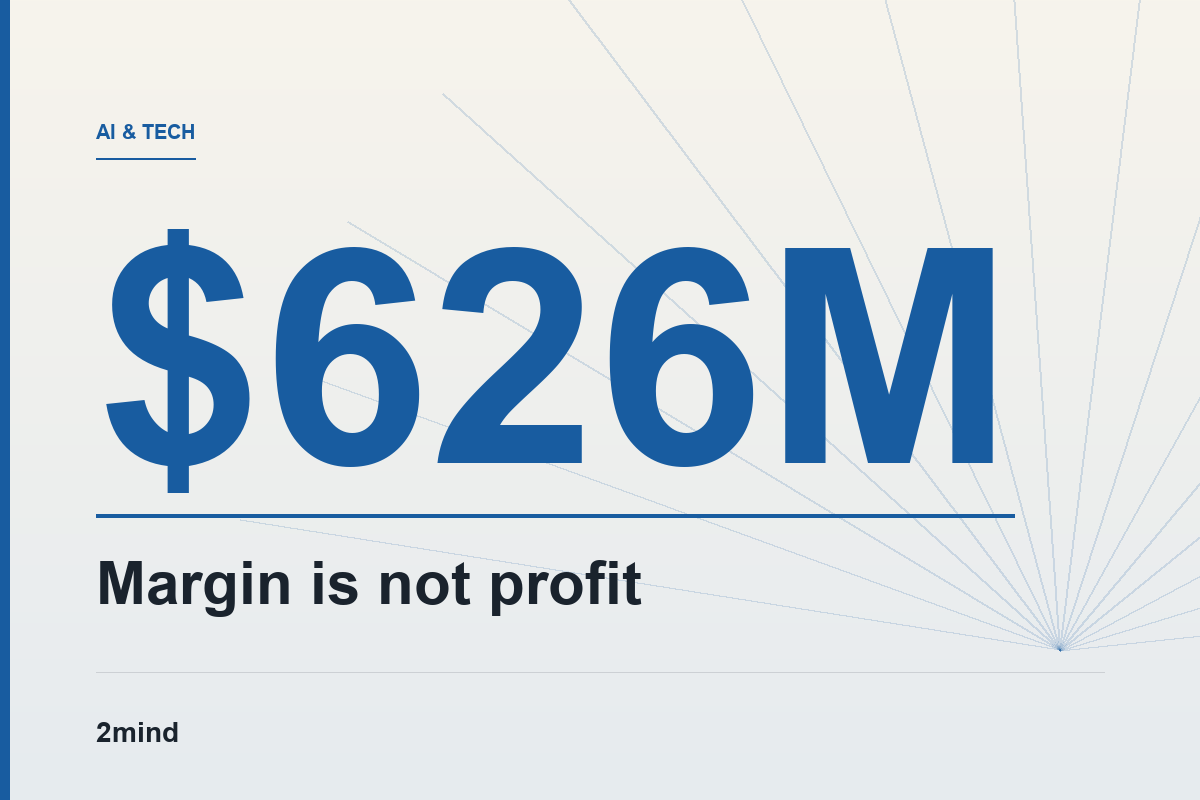
- CoreWeave rents Nvidia chips. Same season: a 66% gross margin, a $626 million net loss, $640 million of interest expense.
- Depreciation and debt interest sit below the gross line. A high gross margin is not profit.
An AI infrastructure company can report a high gross margin and still lose money, because its two largest costs sit below the gross line: depreciation on fast-aging hardware, and interest on the debt that bought it.
What the Two Filings Show
Two sets of results from this earnings season make the point. CoreWeave reported its Q2 numbers on August 11; Nvidia reported on August 26. One rents compute, the other sells the chips, and both describe the same squeeze from different seats.
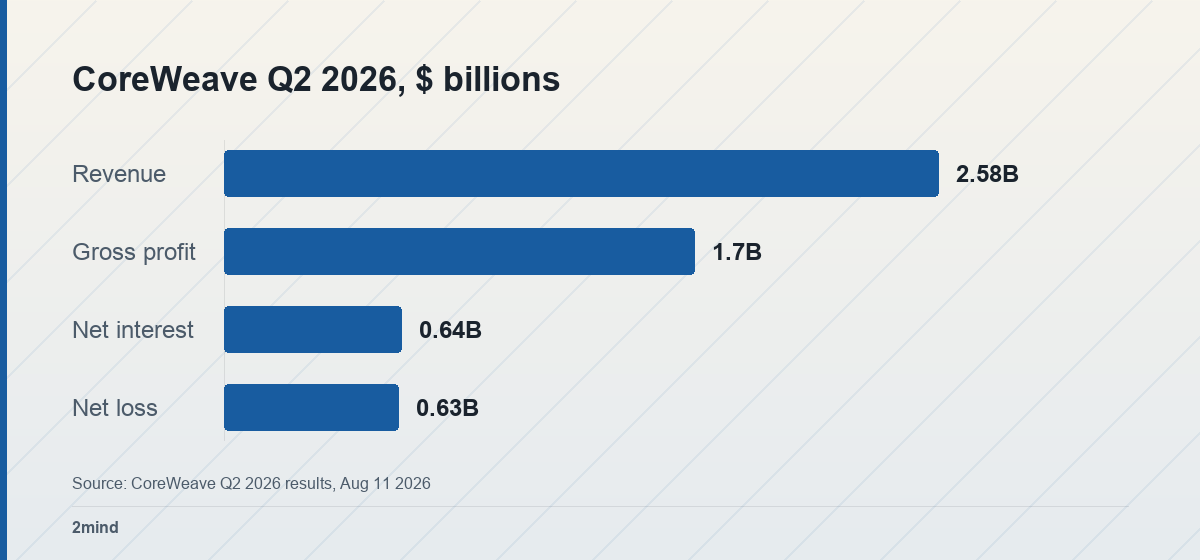
CoreWeave’s revenue reached $2.58 billion in the quarter that ended June 30, up about 112% from a year earlier. Its gross profit was $1.70 billion, a gross margin near 66%.
Below that line, the picture changes. The operating result was a $49 million loss. Net interest expense was $640 million, up from $267 million a year earlier, on roughly $35 billion of debt. The net loss was $626 million, or $1.14 per share.
Adjusted EBITDA was $1.51 billion, a 59% margin. That figure removes depreciation and interest, the exact part that turned a healthy gross margin into a loss.
The stock still rose about 11% after hours, because the revenue backlog stood near $104 billion. Whether that backlog becomes cash depends on when the build-out actually pays back.
CEO Michael Intrator said CoreWeave “reached an important inflection point this quarter as our scale began to translate into expanding operating leverage.”
Nvidia sits one layer up and is more profitable, but its margin is moving the same direction. Revenue was $96.2 billion, up 106% from a year earlier. GAAP and non-GAAP gross margin were both 75.0%. Guidance for the next quarter is 74.0%, give or take half a point.
The Margin Map: Where a Dollar of AI Spend Goes
Here is where a dollar of AI compute spending lands as it moves down the stack, using the most recent figures disclosed at each layer as of August 31, 2026.
| Layer | Recent margin signal | What sits below the gross line |
|---|---|---|
| Memory makers | HBM sold out through 2026 | Little; they are setting the price |
| Nvidia (chips) | 75.0% gross margin, guided to 72–73% | Rising memory and packaging cost |
| CoreWeave (GPU cloud) | 66% gross margin, $626M net loss | Depreciation plus $640M quarterly interest |
| Model labs and apps | Not separately disclosed | Long compute contracts, training runs |
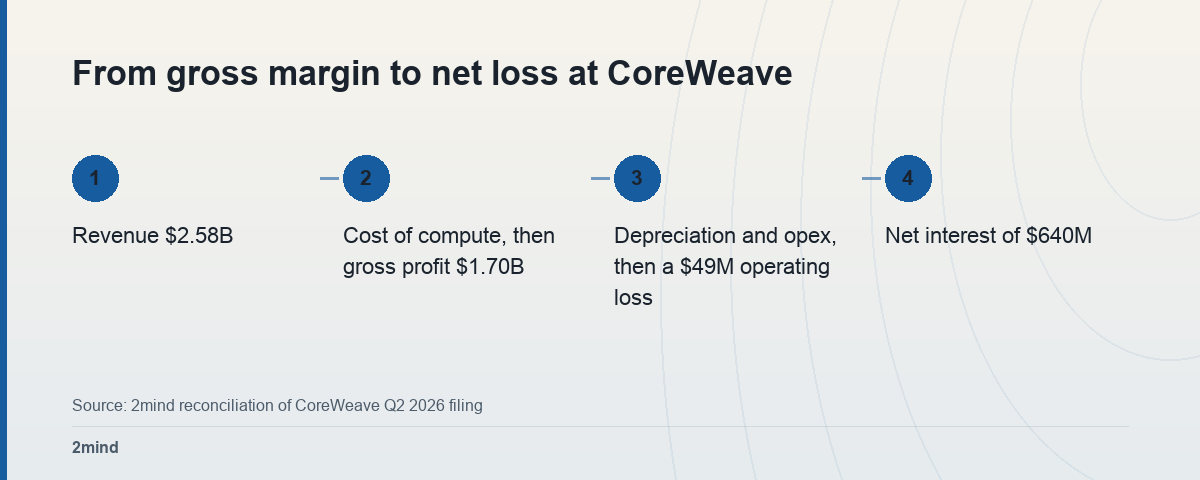
We worked the arithmetic below ourselves from CoreWeave’s Q2 filing. The company did not report the step from its 66% gross margin to its net loss as a single figure. Follow the line items in order:
- Start with revenue of $2.58 billion.
- Subtract cost of revenue of about $0.88 billion. Gross profit is $1.70 billion, a 66% gross margin.
- Subtract depreciation, amortization and operating expenses. The operating result is a $49 million loss.
- Subtract $640 million of net interest on roughly $35 billion of debt.
- After tax and other items, the net loss is $626 million, a negative 24% net margin.
The gross margin and the net margin describe the same quarter and disagree by 90 points. Steps 3 and 4 are the reason, and neither improves just because revenue grows.
Why Did Nvidia Cut Its Own Margin Target?
Nvidia’s margin pressure comes from the same boom that fills its order book. CFO Colette Kress said the company’s commitments for critical components rose from $119 billion in the prior quarter to $279 billion, “primarily related to the procurement of memory.”
Memory is scarce because the AI build-out is consuming it. Micron’s high-bandwidth memory was sold out through 2026 as of early in the year. SK Hynix has described its capacity as essentially sold out for the same period. Samsung has warned customers to expect industry-wide price increases.
CEO Jensen Huang framed the guidance cut as a deliberate reset. “This quarter we decided that we would rip the Band-Aid off, reset expectations about our gross margins,” he said, adding that margins would settle “between 72% and 73% next year” after the company absorbed and repriced around the higher costs.
Two Lenses
The case that the losses are a build-out lag
CoreWeave books depreciation and interest on a data center the moment it is energized. Revenue from that same capacity arrives slowly, as contracts activate over months. A company doubling its footprint every year will always show the cost before the matching revenue.
On this reading the $104 billion backlog is the real number, and the net loss is an accounting shadow of growth. If contract revenue catches up to the installed base, the gap in steps 3 and 4 closes on its own.
The case that the cost line now moves faster than the contracts
The other reading is that the inputs are repricing faster than the deals signed against them. Memory costs pushed Nvidia to cut its own margin guidance. Interest expense at CoreWeave more than doubled in a year. Power and land are also tightening.
We would weight this side more heavily right now. A backlog is a promise priced at yesterday’s cost assumptions. Depreciation schedules and debt coupons are contractual today.
What breaks if the optimistic reading is wrong is the belief that scale alone fixes the margin. That is also why the heaviest AI spender is not automatically the winner.
What Would Change Our View
We would grow more confident in the build-out-lag reading if CoreWeave and its peers show operating income turning clearly positive as older sites fill, with interest expense growing slower than revenue for two or more quarters.
We would grow more cautious if memory and power costs keep rising into 2027, if more AI cloud debt is refinanced at higher rates, or if hardware is written down faster because chips are replaced sooner than planned. Any of those widens the gap below the gross line.
FAQ
Q. How can a company with a 66% gross margin post a net loss?
A. Gross margin only subtracts the direct cost of delivering the service. Depreciation on equipment, operating expenses and interest on debt are all subtracted after that. For CoreWeave in Q2, interest expense alone was $640 million against a $626 million net loss.
Q. Is adjusted EBITDA a better measure here?
A. It is a different measure, not a better one. Adjusted EBITDA removes depreciation and interest, which are the real cash and balance-sheet costs of an infrastructure business built on borrowed money and fast-aging hardware. It is useful for comparing operations, not for judging whether the company earns a profit.
Q. Why is Nvidia’s margin falling if demand is this strong?
A. The same build-out that drives Nvidia’s revenue has made memory scarce, and memory is a large part of the cost of an AI chip. Management chose to reset margin guidance to 72–73% rather than signal that the higher costs were temporary.
Sources
- Nvidia Q2 FY2027 results — revenue and gross margin, Aug. 2026
- Nvidia CEO on resetting gross margins — Fox Business, Aug. 2026
- Nvidia CFO on memory costs — The Motley Fool, Aug. 29, 2026
- CoreWeave Q2 2026 results — revenue, margin, backlog, Aug. 11, 2026
- CoreWeave losses and interest expense — Yahoo Finance, Aug. 11, 2026
- AI memory shortage and pricing — CNBC, Jan. 2026
- Samsung warns of memory price surge — Network World, 2026
Leave a Reply