
Key Takeaways
- A new PJM site drawing 50 MW or more can be cut first during a shortage from June 1, 2027.
- Staying exempt means buying capacity: about $6.0 million a year for 50 MW, our calculation.
- Texas can directly disconnect new loads of 75 MW and up during grid emergencies.
- Google has put 1 GW of data-center demand under utility curtailment contracts.
Under rules taking effect now, a grid operator can order a large AI data center to cut power before it touches homes or existing customers. Whether a given site is exposed comes down to its size, its region, and its connection date.
What the Three Rules Actually Say
The comparison people are drawing this week is to Bitcoin mining. Miners spent years selling their ability to switch off on demand. AI data centers are now being asked to do the same, except the switch-off is harder and the rules are turning mandatory. Three separate regimes now decide when a large computing load loses power first.
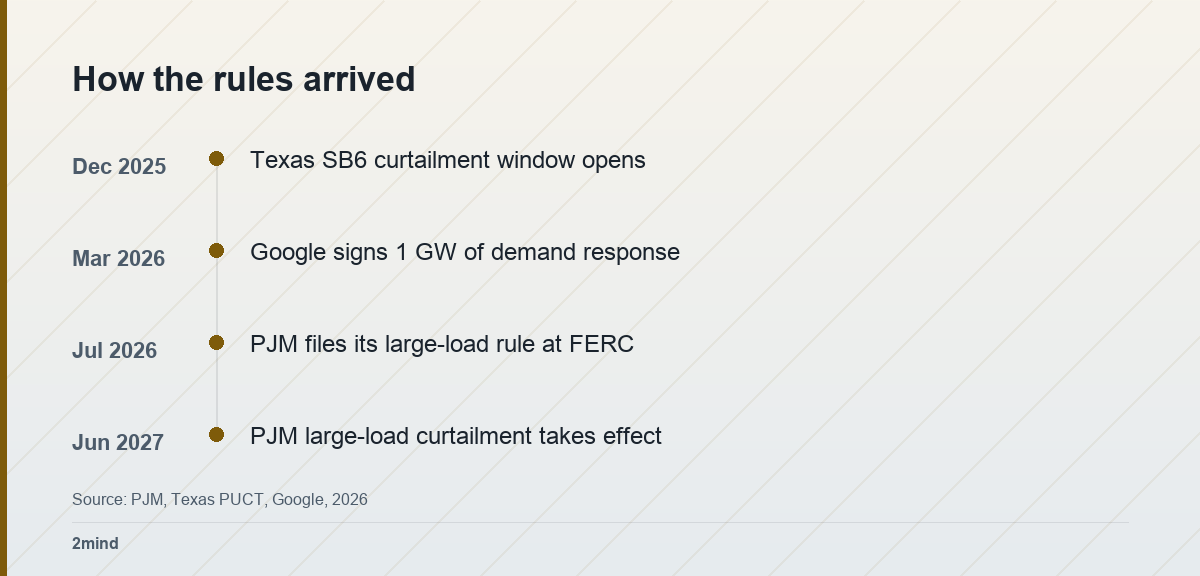
- PJM’s large-load rule. On July 27, 2026, PJM’s board directed a FERC filing for an Interim Resource Adequacy Service. It defines a “large load” as 50 MW or more at one site. New large loads without secured capacity by June 1, 2027 face load reduction “prior to deployment of Pre-Emergency Load Management,” ahead of steps that affect other customers. The way out is “Bring Your Own Capacity”: on-site generation, a long-term supply contract, or capacity bought in PJM’s market.
- Texas Senate Bill 6. Signed in 2025, it directs regulators to require that large loads connecting after December 31, 2025 install equipment letting ERCOT curtail them directly during firm load-shed events. The threshold is 75 MW unless regulators set it lower. A separate voluntary program pays loads of 75 MW or more to ramp down or switch to backup generation when asked.
- Voluntary demand response. This is the path Google took. In March 2026 it said it had put 1 GW of data-center demand under long-term contracts with five US utilities, agreeing to limit or shift machine-learning work during peak hours. In return it gets faster connections. Nothing forces a company onto this path, but it is becoming the price of a quick hookup.
What Each Rule Can Cut, and What Buys You Out
The three regimes differ in who they touch, what sets off a cut, and how a site avoids one.
| Regime | Exposed | Trigger | Way out |
|---|---|---|---|
| PJM large-load | New 50 MW+ sites, from Jun 2027 | Capacity shortage | Bring or buy capacity |
| Texas SB6 | New 75 MW+ sites, after Dec 2025 | Firm load-shed | Backup generation |
| Voluntary DR | Opt-in only | Peak-demand call | Paid, by contract |
Existing sites are largely untouched in all three. The pressure lands on new and expanding capacity, which is most of what is being built.
The Cost of Buying Your Way Out
We worked out what a PJM site pays to stay off the cut list by buying capacity. PJM does not publish this as a per-site figure.
- PJM’s capacity price for the 2026/27 delivery year is capped at $329.17 per MW-day, under FERC Docket ER25-1325.
- A 50 MW large load must cover a capacity obligation of at least 50 MW each day. The real obligation is somewhat higher once a reserve margin is added.
- 50 × $329.17 × 365 works out to about $6.0 million a year, for capacity alone, on top of energy, transmission and interconnection costs.
The cap can change in later years, and self-supplied generation or a bilateral contract may cost more or less. But the order of magnitude is clear: staying firm is a multi-million-dollar line item, and it scales with size.
Why the Miners Are the Comparison
Bitcoin miners are the reference because they proved a flexible load can be a grid asset. A mining rig stops in well under a second and loses no work. That let miners sell curtailment to grid operators and get paid for it.
An AI training run is different. It can pause, but a large job has to checkpoint its state and later reload it, which costs time and coordination. Inference traffic can sometimes be routed to a data center on a calmer grid, but only if the company has that capacity elsewhere.
The Phoenix demonstration in May 2025 showed the gap is closable. Researchers using Emerald AI’s software cut a 256-GPU cluster’s power by 25% for three hours during a grid stress event while holding service quality, with no hardware changes. That result is why regulators now feel able to treat large AI loads as at least partly flexible.
The economics still sit downstream of the same squeeze we have tracked before: why a high gross margin still ends in a loss for AI cloud firms, and when the build-out is supposed to pay back. A curtailment obligation is one more cost the boom is adding to its own inputs, alongside the swings in mining economics.

Two Lenses
Flexibility buys a place in line
For an operator, agreeing to be curtailed is how you connect where the queue is years long. A cut of a few hours a year is a cheap trade for power now.
On this reading the rules are a market clearing itself. The grid is short, so the marginal new load pays for its own reliability or accepts interruption.
Flexibility means someone else holds the switch
The other reading is that “flexible” is a downgrade sold as a feature. An AI company’s promise is that the service is there when a user asks.
A forced cut at a training cluster, or rerouted inference during a heat wave, is a service you sold but cannot fully deliver. And the utility, not you, decides when to pull the switch.
We lean toward the second reading for now. The flexibility case rests on cuts being rare, and no operator has published how often a real curtailment has been called.
What Would Change Our View
We would treat large AI loads as genuinely firm again if PJM’s rule is rejected or heavily softened at FERC, or if operators routinely secure their own capacity so the curtailment tier stays empty in practice.
We would move further toward the downgrade reading if a major grid publishes its first forced multi-hour cut of a training cluster, or if voluntary programs like Google’s start being called often enough that customers notice slower jobs.
FAQ
Q. Does this apply to data centers that are already running?
A. Mostly no. PJM’s rule targets new large loads that connect without their own capacity after June 1, 2027, and Texas SB6 targets loads connecting after December 31, 2025. Existing sites keep their current status, though a large expansion can pull a site into the new rules.
Q. How often would a cut actually happen?
A. We could not verify a frequency. These are emergency tools meant to be used rarely, and Google’s contracts are not public in detail. No operator has published a track record, which is the main reason the risk is hard to price.
Q. Can a data center just run diesel generators instead?
A. Backup generation counts as bringing your own capacity in PJM and helps satisfy parts of SB6. But air-permit limits, emissions rules and fuel logistics cap how many hours a year that is allowed, so it is a bridge, not a full substitute for firm grid supply.
Sources
- Google: 1 GW of data center demand response — Google, March 19, 2026
- PJM board directs FERC filing on large loads — PJM Inside Lines, July 27, 2026
- Turning AI Data Centers into Grid-Interactive Assets — Colangelo et al., field demonstration, 2025
- How AI factories can help relieve grid stress — NVIDIA, July 1, 2025
- Texas law lets ERCOT disconnect data centers in a crisis — Utility Dive, 2025
- PJM capacity price hits the $329.17/MW-day cap — RTO Insider, 2025
- AI data centers learn the power trick Bitcoin miners mastered — CryptoSlate, August 31, 2026
Leave a Reply