Key Takeaways
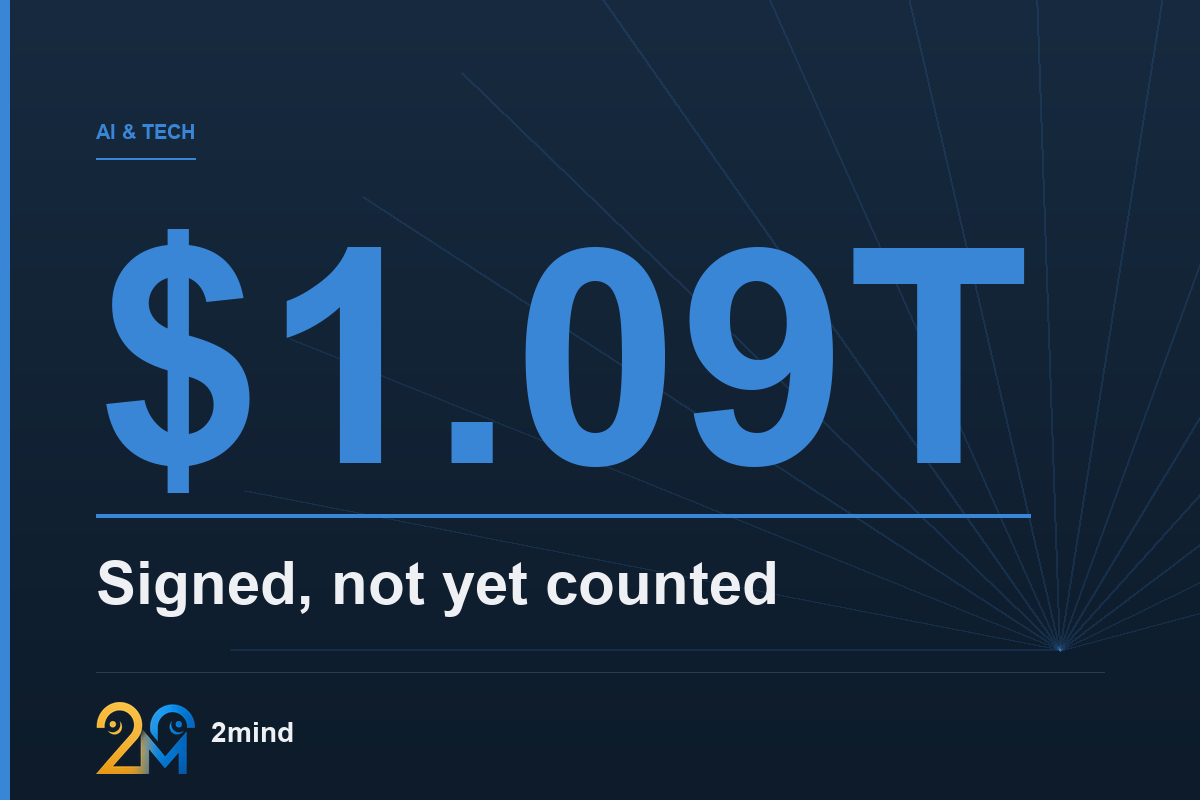
- Five hyperscalers have signed ~$1.09 trillion in data-center leases not yet started.
- That is ~4x the $285 billion of lease debt already on their books.
- A lease is not booked as debt until the building is ready to use.
- Meta’s off-book leases are close to 10x its recognized operating lease debt.
Most of Big Tech’s AI data-center bill is a commitment, not yet a liability. The leases are signed, but the payments stay in a footnote until each site is handed over.
That gap now exceeds everything these companies have borrowed. The rent runs 15 to 30 years once it starts, whether or not the AI demand shows up.
What the Filings Actually Disclose
Each hyperscaler reports a figure for leases it has signed but not yet started paying on. The numbers are in the notes to the financial statements, under a line usually called “leases that have not yet commenced.”
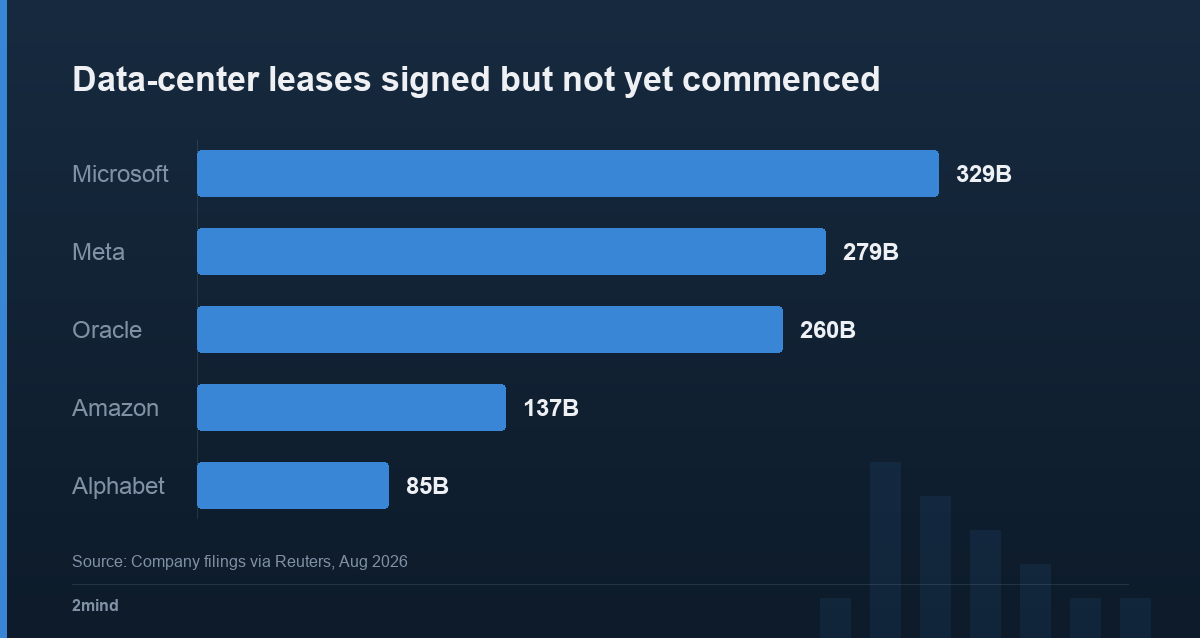
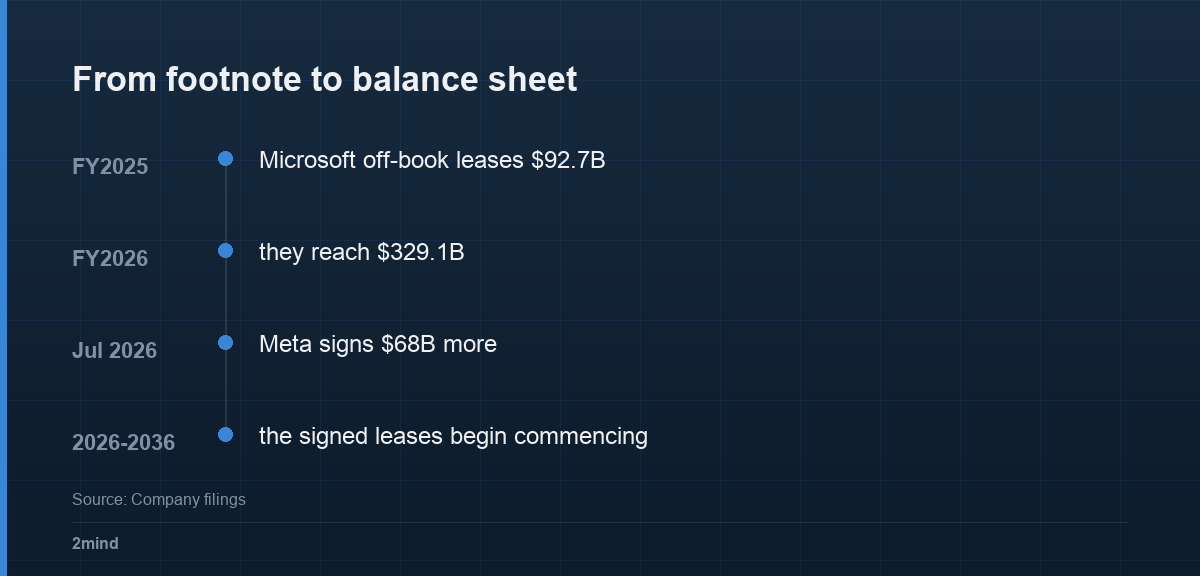
Meta disclosed about $278.99 billion of such leases as of June 30, 2026, for “data centers, colocations, and certain network infrastructure.” They begin between the rest of 2026 and 2036, with terms of up to 30 years. In July 2026, after the quarter closed, Meta signed a further $68 billion.
Microsoft’s FY2026 annual report showed $329.1 billion not yet commenced, up from $92.7 billion a year earlier. Oracle disclosed about $260 billion, with typical terms of 15 to 19 years. Amazon reported $137.21 billion and Alphabet $85.2 billion.
Add the five and the pipeline is near $1.09 trillion, or about $1.16 trillion counting Meta’s July deals.
The Off-Book Pile, Three Companies Added Up
The disclosed pipeline only means something next to what is already on the books. Here is that comparison for the three companies where both sides are clearly stated.
| Company | Off-book leases | On-book leases | Off ÷ on |
|---|---|---|---|
| Microsoft | $329B | $89B | 3.7x |
| Meta | $279B | $29B | ~10x |
| Oracle | $260B | $38B | 6.9x |
| Five-company total | ~$1.09T | ~$285B | 3.8x |
The ratios in the last column are our calculation from the disclosed figures. Meta’s on-book number is its operating lease liabilities; the pile it has signed for is close to ten times that.
One more way to see the pace. Meta’s single month of July signings, $68 billion, is more than twice its $28.7 billion of operating lease liabilities. Microsoft’s off-book figure grew 3.55 times in one fiscal year, from $92.7 billion to $329.1 billion.
We could not line up Amazon’s and Alphabet’s recognized lease liabilities against their filings in time for this piece, so the table stops at three names.
Why Doesn’t a Signed Lease Count as Debt?
Under US accounting rules, a lease becomes a balance-sheet liability at “commencement,” the point when the tenant can actually use the asset. A data center under construction has been signed for but not handed over, so it is not there yet.
Until commencement, the company discloses the future payments in a footnote instead. This is a normal application of the standard, not a workaround.
Moody’s Ratings counted $662 billion of these commitments across the five companies at the end of 2025. Analyst David Gonzales made the same point: it is “not as if they have avoided a liability through structuring,” only that it has “yet to be on the balance sheet.”
The firm was not fully reassured. It called the practice one that can “mask the true economic risk facing the tech industry,” and said it may change how it measures these companies’ debt.
What Happens When the Leases Commence?
As each site opens over the next several years, its lease moves onto the balance sheet as a liability, and the rent starts hitting the income statement as an expense.
So the reported debt of these companies is set to rise for reasons already locked in, regardless of new deals. S&P Global Ratings has already built Oracle’s $260 billion into its forecasts and expects the company’s leverage near 4.4 times in fiscal 2027.
The wider context is a buildout that is not slowing. PwC’s Global Data Centre Outlook, published September 2, 2026, projects data-center capital spending rising from roughly $800 billion a year now toward $1.8 trillion by 2050. That is a projection, not a commitment, and PwC calls power “the binding constraint” on all of it.
How to Read a Hyperscaler’s Lease Footnote
- In the 10-Q or 10-K, open the note titled “Leases.” Skip the tables of recognized right-of-use assets and liabilities for a moment.
- Find the sentence about leases “that have not yet commenced.” Note the dollar figure, the description, and the years the leases will start.
- Divide that figure by the total operating and finance lease liabilities on the balance sheet. A ratio above two means most of the committed rent is not yet booked.
- Check the “subsequent events” note for leases signed after the quarter closed. Meta’s largest recent commitment showed up there, not in the main figure.
Two Lenses
The buildout looks disciplined because the debt is not on the page
Read the balance sheet alone and these companies look like they are funding AI mostly from cash flow. Recognized lease debt is modest against their earnings. The commitment to spend is real, but it reads as ambition rather than leverage, because the accounting has not caught up to the contracts.
The rent bill arrives whether or not the demand does
A 20-year lease on a data center is a fixed cost for 20 years. If AI revenue grows into it, the capacity was cheap to lock in early. If it does not, the payments continue on buildings that are hard to sublet and hard to exit.
That rent lands on top of the other fixed costs we mapped in why AI cloud companies lose money at high margins. The signature already happened; the choice is no longer open.
What Would Change Our View
We would revisit this if the first full year of commenced-lease costs lands without a visible jump in these companies’ reported lease liabilities. That would suggest the pipeline figures overstated what actually gets built.
We would also revisit it if a rating agency cut a hyperscaler’s outlook specifically on lease commitments rather than on total capex. What matters is the year the footnote becomes a balance-sheet line, not the size of the pipeline today.
FAQ
Q. Is this hidden debt?
A. No. Every figure here comes from the companies’ own filings. The point is timing: the payments are disclosed now and become recorded liabilities later, when each site opens.
Q. Does this mean Big Tech is overstating profit?
A. Not through the leases themselves, since the rent is not yet an expense either. The profit debate is more about how server costs are depreciated, a separate estimate.
Q. What if AI demand keeps growing?
A. Then locking in 15-to-30-year capacity now looks cheap in hindsight. The risk is asymmetric: the upside needs demand to keep rising, the downside only needs it to stall.
Sources
- Meta Form 10-Q, quarter ended June 30, 2026 — SEC, Jul 2026
- AI data-center race builds $1 trillion lease burden — Reuters, Aug 2026
- Moody’s flags $662 billion off-balance-sheet risk — Fortune, Feb 2026
- Microsoft’s $329.1bn uncommenced datacentre leases — BTW Media, 2026
- PwC maps $31.6 trillion data-center buildout through 2050 — Data Center Frontier, Sep 2026
Leave a Reply