Key Takeaways
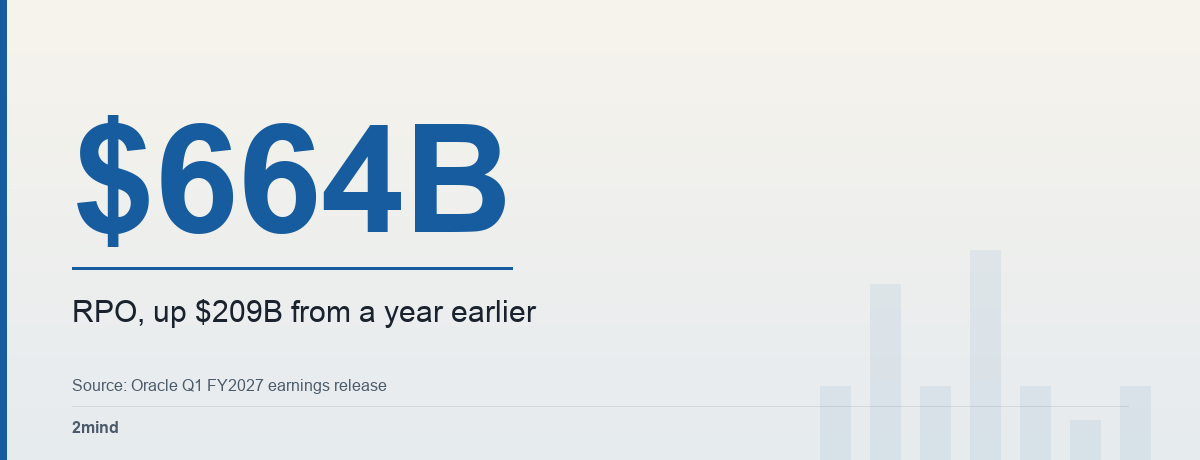
- Oracle’s revenue backlog (RPO) hit $664 billion on Sept 10, 2026, up $209 billion from a year earlier.
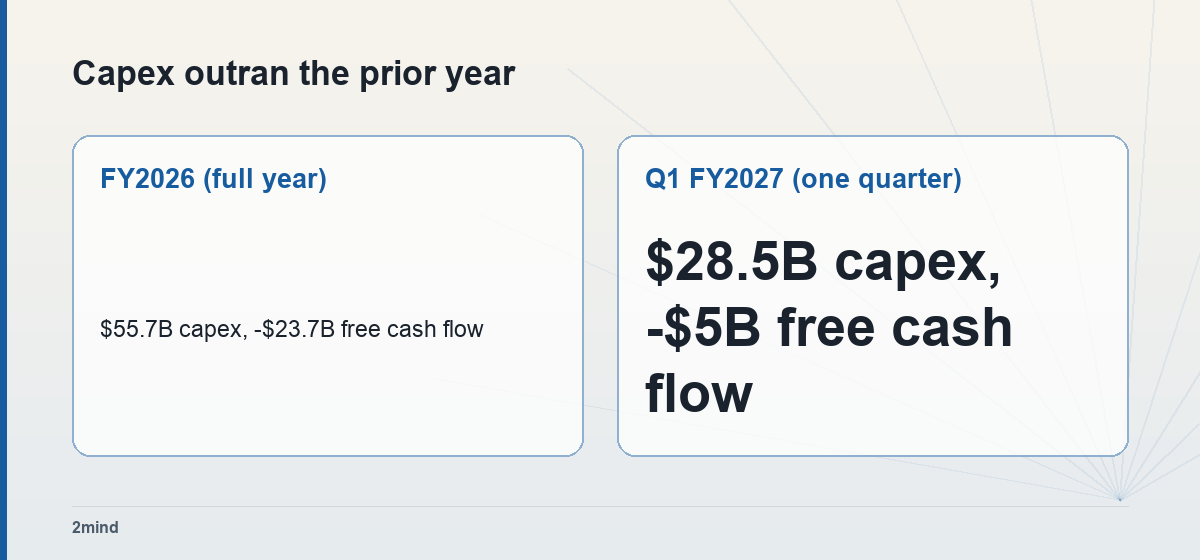
- The same quarter, Oracle spent $28.5 billion on capex — more than half of last fiscal year’s $55.7 billion — and free cash flow remains -$5 billion.
- Full fiscal 2026 free cash flow was -$23.7 billion, even after operating cash flow grew 54% to $32 billion.
- At Q1’s spending pace, the backlog covers about 6 years of capex; at Oracle’s guided pace, closer to 9-10 years — our calculation.
Oracle’s record backlog does not settle the cash question. Cloud revenue rose 62% last quarter; free cash flow was still negative $5 billion. Both numbers are true.
What Oracle Actually Reported
Oracle’s fiscal Q1 2027 (ended Aug. 31, 2026) results, filed with the SEC on Sept. 10, showed total revenue of $19.3 billion, up 30%. OCI revenue jumped 121% to $7.4 billion. The company delivered 850 megawatts of new datacenter capacity and shipped more than 300,000 GPUs to AI cloud customers — nearly triple the prior quarter.
The number that moved the stock was the backlog. RPO — contracted future revenue not yet billed — reached $664 billion, above the $639.89 billion analysts expected. Oracle booked more than $30 billion in new AI cloud contracts in the quarter, and shares rose about 5.5% the next morning.
Our ai capex payback framework asks a simple question of any hyperscaler: does spending outrun the cash coming back? Here is Oracle’s own math.
| Period | Capex | Free cash flow | RPO |
|---|---|---|---|
| FY2026 (full year) | $55.7B | -$23.7B | $638B |
| Q1 FY2027 (one quarter) | $28.5B | -$5B | $664B |
| Q1 pace, annualized (our calc) | ~$114B | ~-$20B | — |
Oracle doesn’t publish a “Q1 annualized” line — we built it by multiplying the quarter’s capex by four. It’s a pace, not a forecast. Oracle has guided to roughly $70 billion in net capex for FY2027, with reported capex $20-25 billion higher on prepayments and timing.
How Do You Read an RPO Headline? 3 Questions
- How much of it is prepaid? Oracle disclosed $75 billion of FY2026’s RPO as prepaid or customer-supplied hardware. That portion needs no new Oracle capital. The rest does.
- What’s the capex run rate against it? Divide the backlog by the latest quarter’s capex, annualized. We calculated $664B ÷ ~$114B ≈ 5.8 years for Oracle — or ÷ the $70B guided pace ≈ 9.5 years, our estimate. Neither proves the backlog is fake; both show a multi-year bet, not a same-quarter payoff.
- Is free cash flow moving toward zero, or away? FCF went from -$23.7B for all of FY2026 to -$5B in one quarter of FY2027 — a worse quarterly pace than last year’s average. That’s the number to watch next, not the backlog.
Two Lenses
Does the backlog prove the demand is real?
$75 billion of the RPO Oracle reported at fiscal year-end was tied to prepaid or customer-supplied GPU hardware — arrangements where the customer’s cash, not Oracle’s, funds the equipment. That structure is why Oracle can grow a $664 billion backlog without needing $664 billion of its own capital. GPU deliveries nearly tripling quarter over quarter is a real, countable thing customers are receiving, not a projection.
Or does the cash say otherwise?
Lale Akoner, senior market analyst at eToro, put it plainly: “Oracle’s problem has not been finding customers, but proving that its enormous data centre build-out can eventually generate enough cash to justify the cost.” J.P. Morgan’s note framed the same question — whether backlog growth “can be sustained” and convert amid “data center delays.”
RPO is a contract, not a receipt. It becomes cash only once Oracle finishes building capacity and the customer starts using — and paying for — it.
What Would Change Our View
If free cash flow narrows each quarter while RPO keeps growing, that shows capacity coming online and customers paying — not just signing. That would be the backlog converting into cash.
If RPO growth slows while capex keeps accelerating, that’s closer to the scenario Michael Burry’s short thesis describes for the sector overall (see our depreciation piece).
Oracle’s stock is down about 21% year-to-date, at a forward P/E near 17x — below Microsoft’s 24x and Amazon’s 23x. That gap is the market pricing the uncertainty, not resolving it.
FAQ
Q. What is RPO and why does it matter for Oracle specifically?
A. RPO (remaining performance obligation) is contracted revenue a company expects to recognize later but hasn’t billed yet. It matters more for Oracle than most cloud companies because its OCI backlog is now roughly 34 times its trailing quarterly cloud infrastructure revenue — a longer conversion runway than AWS or Azure disclose.
Q. Why is Oracle’s free cash flow negative even though revenue is growing?
A. Oracle is spending on datacenter construction and GPUs faster than it collects cash from customers, even with $11.4 billion in customer prepayments last quarter. Building capacity ahead of contracted revenue is standard for hyperscalers mid-buildout, but it means cash goes out now for revenue promised later.
Q. Does Oracle’s $300 billion OpenAI cloud deal explain these numbers?
A. It’s part of the backlog, but capacity for that deal isn’t scheduled to come online until 2027, so it doesn’t explain this quarter’s cash burn. It does explain why Oracle is building years ahead of when most of the backlog gets billed.
Sources
- Oracle Q1 FY2027 earnings release — SEC, Sept 10, 2026
- Oracle Q4/FY2026 earnings release — PR Newswire, Jun 10, 2026
- Oracle shares rise as AI cloud backlog beats estimates — Reuters via Lufkin Daily News, Sept 11, 2026
- Oracle stock price swing before earnings — 24/7 Wall St., Sept 10, 2026
Leave a Reply