Nvidia doesn’t usually show up on the financing side of a data center deal. This time it reportedly might be the thing holding the whole structure up, and that’s a different role than the one it’s used to playing.
Key Takeaways
- Nvidia is reportedly in talks to guarantee roughly $250 billion in lease and construction debt for a data center campus OpenAI would occupy in Piketon, Ohio.
- The campus belongs to SB Energy, SoftBank’s energy arm. Total build cost is put at a minimum of $500 billion, with a separate package of up to $350 billion discussed just for the chips.
- Nothing is signed. Talks are described as early-stage, and Nvidia, OpenAI, and the Commerce Department all declined to comment.
- The land and the electricity are federally owned — which makes this partly a political allocation, not only a financing one.
The $250 billion number, and the three numbers around it
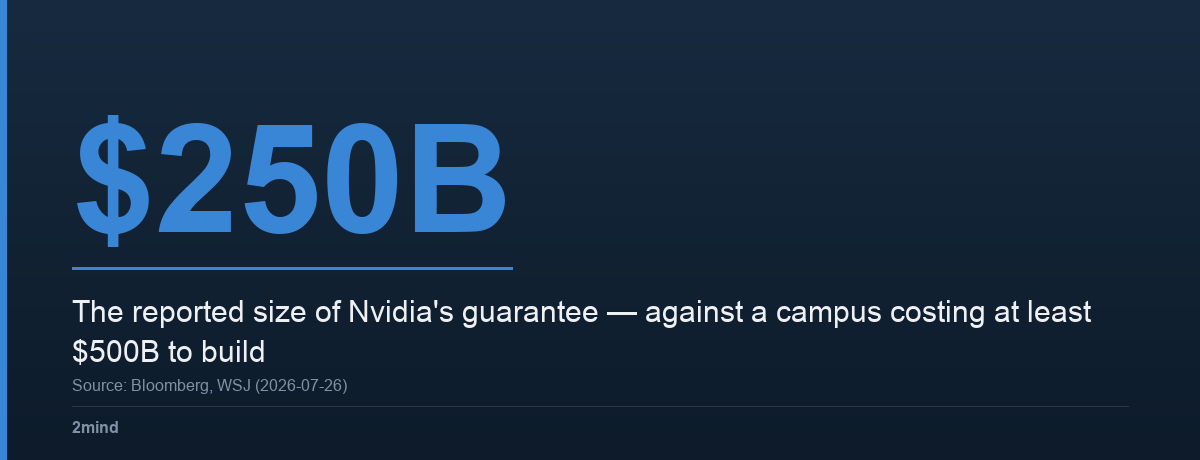
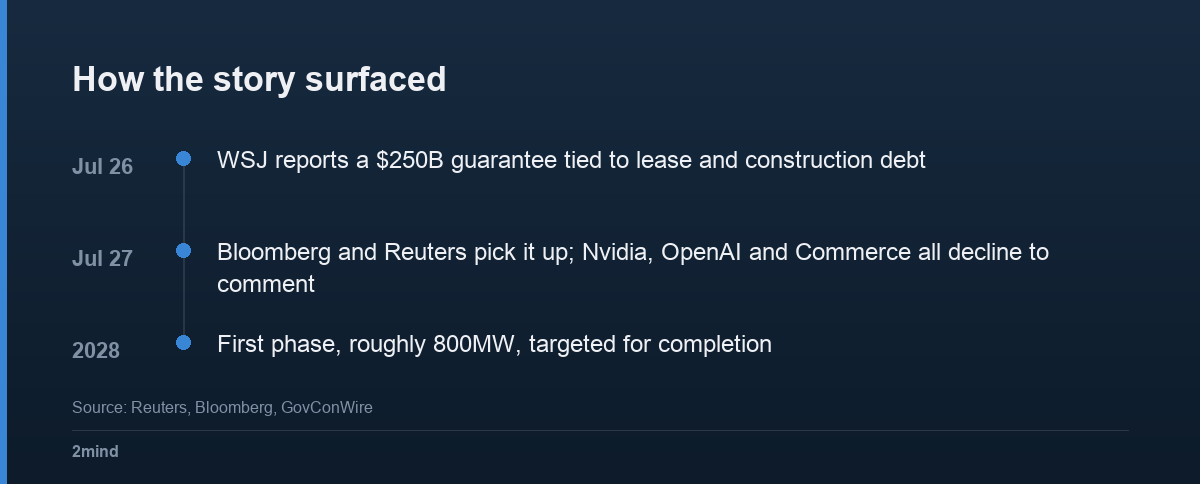
The Wall Street Journal reported on July 26 that Nvidia is in talks to provide roughly $250 billion in financing guarantees tied to lease and construction debt for a data center campus OpenAI wants to occupy. Bloomberg and Reuters picked up the story within a day, and by Monday it was circulating widely.
The campus in question belongs to SB Energy, SoftBank’s energy arm, and is being developed in Piketon, Ohio — a planned 10-gigawatt AI facility that OpenAI would lease rather than own outright. The first phase, roughly 800 megawatts, is targeted for completion in 2028.
The guarantee is the number getting attention, but it is not the largest number in the story.
| Piece | Reported size | What it covers |
|---|---|---|
| Campus construction | at least $500B | Building the 10GW facility |
| Chip financing | up to $350B | A separate package, for the hardware |
| Nvidia guarantee | ~$250B | Lease and construction debt |
| Nvidia’s existing stake | $30B | Already invested directly in OpenAI |
None of this is signed. The talks are described as early-stage, and people close to them say terms could shift or the whole thing could fall apart before anything is finalized.
Two ways to read a chipmaker backstopping its own customer
Lens one: this is how capital-intensive infrastructure has always gotten built. The company with the balance sheet backs the company with the demand but not yet the credit rating, and the guarantee lowers the cost of borrowing for everyone.
Railroads, telecom, and power generation were all financed on some version of this structure. OpenAI has never turned a profit and, as a private company, has no investment-grade rating of its own — which is precisely why a guarantee from someone else is the mechanism being reached for.
If this closes, it is also OpenAI’s first real step away from renting compute inside Microsoft’s, Amazon’s, or Oracle’s infrastructure and toward having a campus of its own. That shift has been building for a while; we traced an earlier stage of it in Microsoft Trimmed OpenAI Ties, Then Deepened Them.
Lens two: Nvidia would be guaranteeing debt that exists largely to buy Nvidia chips. The revenue leaves Nvidia and comes back to Nvidia, backed by Nvidia’s own promise.
Michael Burry put it bluntly on X on July 27: “Around and around we go.
Nvidia to guarantee $200 billion of ChatGPT’s spending on $NVDA chips.” His figure differs from the $250 billion reported elsewhere, but his point doesn’t depend on which number is right — and he reportedly added to a Nvidia short position around the same time, at $210.28. Nvidia closed Friday down 0.92% at $206.84.
Nvidia isn’t a stranger to this bet either; it has already put $30 billion directly into OpenAI. If OpenAI can’t service the debt, the risk doesn’t disappear. It moves onto Nvidia’s books.
Both of these can be true at once. A guarantee can unlock necessary infrastructure and also concentrate risk in the one company that would rather not be holding it. What decides which reading ages better is not the structure itself but whether the demand underneath it shows up.
Nobody in this story owns the electricity
Here is the part that gets least attention and may matter most.
The Piketon site sits on the former Portsmouth Gaseous Diffusion Plant, a facility that spent decades enriching uranium for nuclear weapons and power. The land and the power supply belong to the federal government.
Deciding which company gets access to that power isn’t happening through a market. It’s a decision Commerce Secretary Howard Lutnick is reportedly involved in making directly, and other AI companies have apparently already inquired about the same site.
The generation plan calls for up to 10 gigawatts total, with 9.2 gigawatts from new natural gas plants that SB Energy is building alongside utility AEP Ohio, plus a reported $4.2 billion in grid upgrades.
None of that changes based on who wins the financing argument between Nvidia and OpenAI. It changes based on who a single federal official decides should have it.
That is a different kind of risk than a credit risk, and it doesn’t show up on anyone’s balance sheet.
The same question is showing up elsewhere in the buildout — see Meta May Rent Its AI Data Centers to Rival Anthropic.
What would change our view
For lens one to be the right reading, three things have to hold. Demand for inference has to keep growing fast enough to fill 10 gigawatts.
OpenAI has to reach a point where it can service debt on its own credit rather than someone else’s.
And the gas generation has to actually get built on schedule, which is a construction and permitting question more than a technology one.
None of those are obviously wrong. None of them are settled either.
FAQ
Q. Is this deal actually happening?
A. Not yet. It’s described as early-stage, and Nvidia, OpenAI, and the Commerce Department all declined to comment when Reuters asked. Terms reported this week could look different — or vanish — by the time anything is signed.
Q. Why does OpenAI need someone else’s guarantee at all?
A. Because it isn’t profitable yet and isn’t public, so it has no investment-grade credit rating of its own. Without one, borrowing at reasonable rates for a $500 billion campus isn’t realistic. We looked at a related version of this problem in Why AI’s Winners Aren’t the Companies Spending the Most.
Q. What happens to Nvidia if OpenAI can’t pay?
A. That is the whole question behind lens two. A guarantee means the obligation doesn’t disappear when the borrower struggles — it transfers. The exact terms haven’t been reported, so how much of the $250 billion Nvidia would actually be on the hook for, and under what conditions, is not yet public.
Q. Is Nvidia already exposed to OpenAI?
A. Yes. It has $30 billion invested directly, separate from anything discussed here. Jensen Huang’s broader posture toward the AI market is worth reading alongside this — see Nvidia’s Jensen Huang Wants China’s AI Models Free.
Sources
- Nvidia in Talks on $250 Billion Backing for OpenAI Hub, WSJ Says — Bloomberg, 2026-07-26. Original WSJ report: the $250B guarantee, $500B campus cost, $350B chip financing.
- Nvidia in talks with OpenAI to guarantee $250 billion financing for data center — Reuters via Yahoo Finance, 2026-07-27. 10GW lease, 2028 first phase at ~800MW, no comment from Nvidia/OpenAI/Commerce.
- NVIDIA Eyes $250B Guarantee for OpenAI Lease at Federally Owned Ohio Data Center — GovConWire, 2026-07-27. Federal land and power, Lutnick’s role, OpenAI’s lack of an investment-grade rating, Nvidia’s existing $30B stake.
- Nvidia Reportedly Moves to Backstop $250 Billion in OpenAI Data Center Financing, Michael Burry Says, “Around and Around We Go” — Yahoo Finance, 2026-07-27. Source for the Burry quote and his short position.
- Trump officials announce 10-gigawatt data center, gas plants for former Ohio uranium site — The Reporting Project. Portsmouth site history, 9.2GW of gas generation, $4.2B in grid upgrades.
So whose balance sheet is actually carrying the AI buildout right now — and is that concentration a flaw in the deal, or the only way something this size ever gets built?
Leave a Reply