Moonshot AI put the Kimi K3 open weights on Hugging Face on July 27, free for anyone to download and use commercially. Every time a lab does this, the headline writes itself: bigger model, open license, another point for the “AI is democratizing” column.
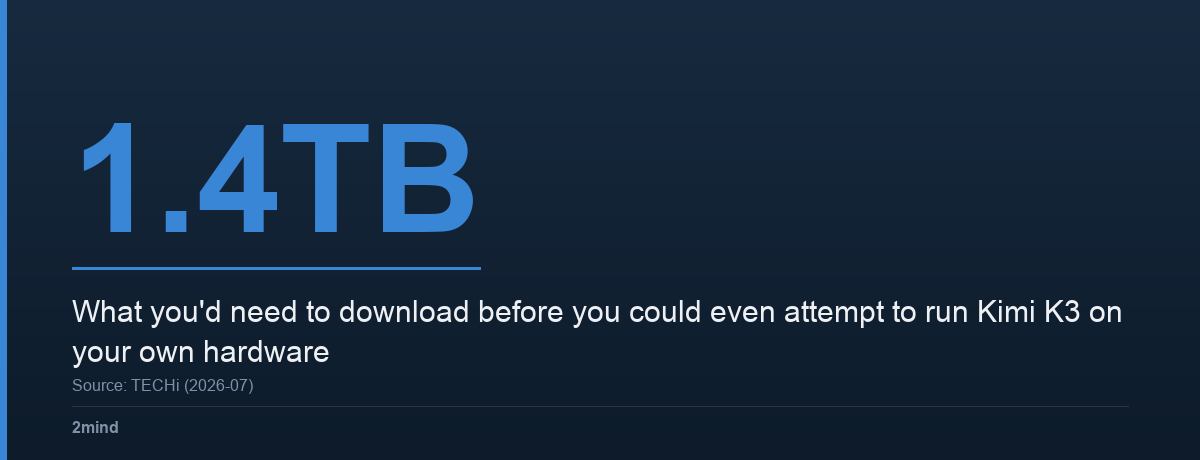
I went looking for who actually benefits from that, and the answer wasn’t as simple as “open beats closed.” The file itself is 1.4 terabytes, and running it well is not something a laptop — or most companies — can do.
Key Takeaways
- Moonshot AI released Kimi K3, a 2.8-trillion-parameter mixture-of-experts model, as open weights on July 27 under a modified MIT license that allows commercial use.
- Only 16 of its 896 experts activate per token — about 104 billion active parameters — but the full download is still roughly 1.4TB.
- On Artificial Analysis’s Intelligence Index, K3 scores 57, putting it third overall, roughly even with Claude Opus 4.8 and GPT-5.5, but behind Claude Fable 5 and GPT-5.6 Sol.
- Just loading those weights takes roughly eighteen 80GB accelerators, and a full eight-card node of the newest 192GB silicon (~1.5TB) barely fits them with almost nothing left for serving — hardware most individuals and small teams simply don’t own.
Kimi K3 open weights, by the actual specs
Kimi K3 is a mixture-of-experts model: 2.8 trillion parameters in total, but only 16 of 896 experts fire for any given token, which works out to roughly 104 billion parameters doing the actual computing at any moment. That’s the trick that makes a model this large usable at all — most of it stays dormant for any single request.
It also supports a 1-million-token context window and takes text, images, and video as native inputs — video goes into the same model rather than a separate vision system, so a prompt can address footage directly instead of a transcript. That puts it among frontier multimodal models rather than a narrow, text-only release.
The license matters as much as the architecture here. Moonshot published K3 under a modified MIT license, which permits commercial use without a royalty or a request for permission — a meaningfully more open stance than the research-only or non-commercial terms some other large open releases have carried.
Where K3 actually lands depends on which number you look at.
| Model | Intelligence Index | Cost per task |
|---|---|---|
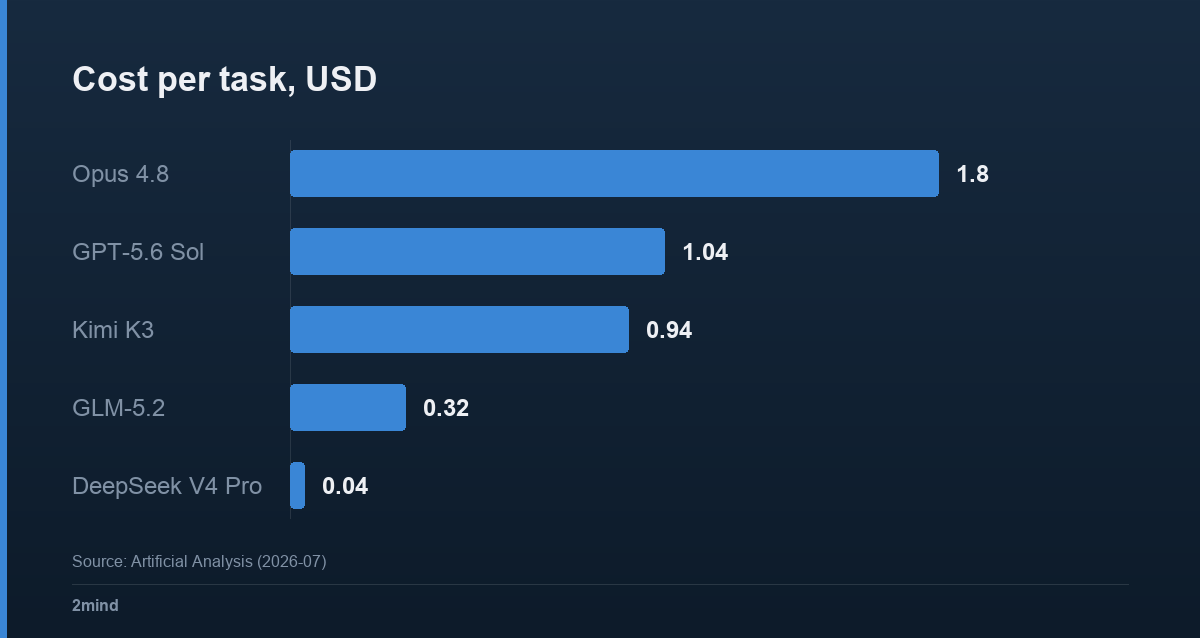
| Kimi K3 | 57 (3rd overall) | $0.94 |
| Claude Opus 4.8 | 56 | $1.80 |
| GLM-5.2 | 51 | $0.32 |
| DeepSeek V4 Pro | 44 | $0.04 |
| GPT-5.6 Sol | not published | $1.04 |
I’ll say plainly what I could and couldn’t confirm: Artificial Analysis reports K3 sits third on its Intelligence Index at 57 points, “on par with” Opus 4.8 and GPT-5.5, and behind Claude Fable 5 and GPT-5.6 Sol.
Its head-to-head page puts Opus 4.8 at 56, one point back. The exact point totals for Fable 5 and GPT-5.6 Sol weren’t in any source I could verify, so I’m not printing numbers I can’t stand behind.
What is verifiable is the cost line — K3 runs about $0.94 per task, cheaper than GPT-5.6 Sol’s $1.04 and well under Opus 4.8’s $1.80.
Free to license, expensive to run — two ways to see it
Lens one — this genuinely lowers the floor. A modified-MIT license means startups and researchers can fine-tune, redistribute, and build products on K3 without asking anyone’s permission or paying a licensing fee.
Compared to K2.6, Moonshot’s own prior release, K3 gained roughly 13 index points — a real jump in a single generation, and one Nathan Lambert of Interconnects argues closes the US-China frontier gap from six-to-nine months down to something closer to three-to-five.
Lens two — “free” quietly assumes you already own the hardware. Downloading 1.4TB is the easy part.
Holding those weights in memory implies something on the order of eighteen 80GB accelerators before you reserve a single byte for context or a second concurrent request. Even a full node of the newest Blackwell-class silicon — eight cards at 192GB each, about 1.5TB — can barely fit the model with almost nothing to spare.
That is not a hobbyist project. It’s a data-center-scale commitment. The people who can actually run K3 at production quality are cloud providers, well-funded labs, and companies that already have GPU fleets — which is a much smaller group than “anyone with an internet connection.”
Both readings are true of the same release. The license removes a legal barrier; the hardware requirement replaces it with a capital one.
Who the free license actually serves
I keep coming back to this: open weights and open access aren’t the same thing.
A company that already runs a GPU cluster gets a genuinely capable model for the price of electricity and engineering time.
A student, a two-person startup, or a researcher without institutional compute gets a 1.4TB file they likely can’t run beyond a small, quantized, degraded version of it — if that. I don’t think that makes the release cynical.
It just means “open” describes the license, not the barrier to entry — and those two get conflated constantly.
That doesn’t make the release meaningless. API pricing for K3 is listed on OpenRouter at $3 per million input tokens and $15 per million output tokens, which is accessible to almost anyone who doesn’t need to self-host. But that’s a different story than “open weights democratize AI,” which is the framing Moonshot’s release invited and which I think oversimplifies things.
The democratization happens at the API layer, where Moonshot or a reseller is still the one paying for the GPUs. The self-hosting freedom is mostly theoretical for anyone outside a data center.
What this means for the US-China race, and what it doesn’t
Lambert’s framing — that Chinese labs are reaching competitive results with what he calls a fraction of the capital US frontier labs spend — is worth taking seriously, and it lines up with K3’s cost-per-task numbers.
But cheaper training and inference costs cut against proprietary labs’ margins more than they hand China outright leadership. Third place on a widely-cited index isn’t first place, and I’d rather say that plainly than round it up.
The more durable effect, I think, is on pricing pressure. If a third-place open model can be run for roughly half of what a leading proprietary model costs, that pressure shows up in every lab’s margin calculations regardless of who tops the leaderboard next month.
What would change our view
Our reading is that the licence removes a legal barrier and the hardware requirement replaces it with a capital one. The clearest thing that would change it is the memory footprint.
If quantised or distilled versions of K3 preserve most of the benchmark standing on hardware a small team can actually afford, then "open weights" starts to mean open access, and the gap we describe narrows.
The second is serving cost. API pricing makes K3 reachable without self-hosting, so if independent providers converge well below the listed rates, the practical barrier moves again — this time in favour of the people the licence was supposed to serve.
The frontier-gap claim is the part we would hold most loosely. It rests on one analyst’s read of a single generation. A second release that repeats the jump would support it; a plateau, or a benchmark set that does not reproduce outside the publisher’s own numbers, would not.
FAQ
Q. Can I actually run Kimi K3 myself?
A. Technically yes, since the weights and license allow it.
Practically, you’d need to download about 1.4TB and have enough accelerator memory to hold it — on the order of eighteen 80GB cards, or a full eight-card node of 192GB Blackwell-class silicon that barely fits the weights alone.
For most individuals and small teams, using it through an API is the realistic option.
Q. Is Kimi K3 better than Claude or GPT models?
A. On Artificial Analysis’s Intelligence Index, it ranks third at 57 points — about even with Claude Opus 4.8 and GPT-5.5, but behind Claude Fable 5 and GPT-5.6 Sol. It is not the top model overall, though it’s notably cheaper per task than several models near its tier.
Q. Why release something this expensive to run for free?
A. The license removes legal and cost barriers, but Moonshot still benefits — wider adoption, ecosystem lock-in, and API revenue from everyone who can’t self-host. Open weights and easy access aren’t the same thing, which is the core tension this release exposes.
Sources
- moonshotai/Kimi-K3 model card — Hugging Face. Released weights, architecture, and license terms.
- Moonshot AI releases Kimi K3 open weights, largest free AI model ever at 2.8 trillion parameters — Tech Startups, 2026-07-27. Parameter count, modified MIT license, 00:00 UTC release timing, 1M-token context, native visual understanding.
- Moonshot’s Kimi K3 Makes Video a Native Input in a 2.8-Trillion-Parameter Open-Weights Model — VP Land, 2026-07. Native video input alongside text and images, without a separate vision model.
- Kimi K3 — API pricing and specifications — OpenRouter. Listed API pricing of $3 per million input tokens and $15 per million output tokens, 1M context window.
- Kimi K3: The Open-Weights Escalation — Interconnects (Nathan Lambert), 2026-07. US-China gap analysis, capital-efficiency argument.
- Kimi K3 vs Claude Opus 4.8 — Artificial Analysis. Head-to-head Intelligence Index scores: K3 at 57, Opus 4.8 at 56.
- Kimi K3 achieves #3 in the Artificial Analysis Intelligence Index — Artificial Analysis, 2026-07. K3’s third-place ranking, per-task cost comparisons against Opus 4.8, GPT-5.6 Sol, GLM-5.2, and DeepSeek V4 Pro. Exact Fable 5 / GPT-5.6 Sol point totals are not given in this source and are not reported above for that reason.
- Kimi K3’s open weights arrive July 27. The catch is 1.4TB — TECHi, 2026-07. MXFP4 quantization, 1.4TB weight file, and the accelerator-memory math for self-hosting.
The license turned out to be the cheapest part of this release. When the rest of the price is paid in hardware most of us will never touch, how much of “open” is actually ours?
Leave a Reply