I want to be precise about a word before I say anything else, because the word is doing a lot of work here. “Banned” is the version of this story that travels fastest.
What’s actually been reported, first by The Information and picked up by outlets including The Decoder, is narrower and, I think, more interesting: Meta has restricted its engineers’ use of Claude Code and Codex, not switched them off entirely.
The restriction itself isn’t the strange part. Companies limit tool access all the time. What caught my attention is the reason an internal memo reportedly gave — and the fact that Meta is building its own alternative at the same time it’s pulling back from everyone else’s.
Key Takeaways
- Meta has restricted engineers’ use of Claude Code (Anthropic) and Codex (OpenAI) inside the company, according to The Information’s reporting.
- The stated reason is distillation risk — an internal memo reportedly warned that outputs from rival AI models could leak into Meta’s own training data and trigger serious disputes with partner companies.
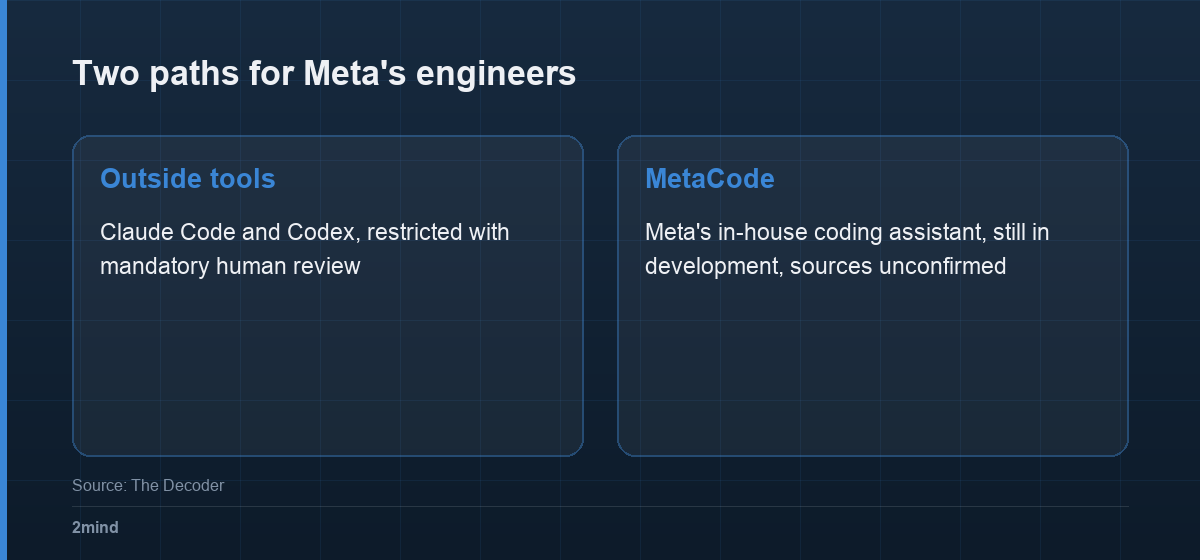
- Meta is developing its own in-house coding assistant, reportedly called MetaCode.
- Under the internal policy, engineers reportedly cannot use outside AI outputs for testing tasks or code analysis without human review.
- The Decoder’s report is dated June 29, 2026.
What The Information’s reporting says happened
The core claim, as multiple outlets summarized it from The Information’s original reporting: Meta engineers can no longer freely run Claude Code or Codex against the company’s internal codebase.
The concern isn’t that the tools are bad — it’s the opposite.
They’re good enough that their outputs risk shaping how Meta’s own models learn, a pattern known as distillation, where one model’s outputs become another model’s training signal without an explicit license to do so.
An internal memo, as described in the reporting, framed this as a legal and partnership risk more than a technical one. If Anthropic- or OpenAI-influenced code patterns end up baked into Meta’s training data, that’s not a hypothetical headache — it’s the kind of thing that can sour a partnership or invite a dispute over IP.
That’s a different kind of caution than “our engineers might get lazy,” and it says something about how seriously AI labs now treat their own model outputs as protected assets.
The human-review requirement is doing double duty here. It slows down whatever code these tools produce, which limits how much rival-model output could realistically shape Meta’s own systems even if a distillation risk exists.
But it also means engineers aren’t locked out of Claude Code or Codex entirely — they’re supervised, not banned outright. That distinction matters more than the headline suggests.
| Detail | What’s reported |
|---|---|
| Tools restricted | Claude Code (Anthropic), Codex (OpenAI) |
| Stated reason | Distillation risk to Meta’s training data |
| In-house alternative | MetaCode (in development) |
| Internal rule | Human review required for AI-assisted testing/code analysis |
| First reported by | The Information |
| Picked up by | The Decoder (June 29, 2026), Crypto Briefing, TheNextWeb |
Alongside the restriction, Meta is reportedly building MetaCode, its own coding assistant. What MetaCode is actually built on hasn’t been confirmed in any of the reporting I could verify, so I’m not going to guess at its architecture.
What is consistent across the coverage is the timing: the restriction and the in-house build are happening at the same time, which reads less like a pure security move and more like a company trying to control its own supply chain for AI-assisted code.
Two Lenses
Lens one: this is ordinary IP hygiene, dressed up as a scandal
Every large AI lab has some version of this policy now. If your engineers are feeding proprietary code into someone else’s tool, and that tool’s provider might use interactions to improve its own models, you have a legitimate reason to slow that down — especially if you’re simultaneously trying to train a frontier model of your own.
Framed this way, Meta isn’t afraid of Claude or Codex being too good. It’s protecting the boundary between “using a tool” and “training a competitor’s model with our code, for free.” Requiring human review on top of that isn’t paranoia — it’s the kind of guardrail most serious engineering orgs would want anyway.
I’ve seen versions of this playbook elsewhere as AI labs race to train their own frontier models. Letting engineers casually route proprietary code through a competitor’s tool is close to handing that competitor free training signal.
Treating that as a real risk rather than an afterthought is what a cautious AI lab does — it doesn’t require assuming bad faith on Anthropic’s or OpenAI’s part.
Lens two: restricting the outside tools you can’t fully audit, while trusting the one you can’t fully explain
Here’s where I land differently. If distillation risk is the real concern, that risk doesn’t disappear once you build your own assistant — it just becomes harder to see.
MetaCode is internal, so nobody outside Meta gets to check what it was trained on, whether it ingested output from other models during development, or how its recommendations compare to the tools it’s replacing.
Restricting Claude Code and Codex is a visible, defensible move. Building a black-box replacement is the part nobody outside the company gets to audit. I don’t think that makes the policy wrong, but it does make “distillation risk” a more convenient explanation than a complete one.
There’s an asymmetry in who gets to ask questions here, too. Outside developers, competitors, and reporters can examine what Claude Code or Codex actually do, because Anthropic and OpenAI ship them as products people use and write about every day.
MetaCode, for now, exists only inside Meta. If it’s still in development, the fairest thing to say is that we don’t yet know whether it will face the same scrutiny.
Why “restricted” is doing more work than “banned”
Coverage of this story hasn’t been fully consistent on scope — some outlets describe a blanket restriction, others describe narrower limits tied to specific tasks like testing and code analysis. That’s part of why I’m treating “banned” as a headline shorthand rather than a precise description.
The differences in reported scope aren’t necessarily contradictions — a policy can start narrow and widen, or get described inconsistently as it moves through different teams inside a company this size. But until Meta or a named source there confirms the exact boundaries, I’d treat the specific scope, not just the headline word “banned,” as the part still worth watching.
What is consistent across the reporting is the human-review requirement: engineers reportedly can’t let AI-generated output from these tools go into testing or code analysis unchecked.
That’s a meaningfully softer policy than an outright ban, and it’s also a more revealing one — it tells you Meta doesn’t trust unsupervised output from rival models, but does still want its engineers using AI assistance, just with a person checking the work.
What would change our view
If Meta confirms MetaCode’s training sources and independent developers get to test it against Claude Code or Codex on real tasks, that would tell us whether the “distillation risk” rationale was really about product parity rather than caution.
On the other side, if Anthropic or OpenAI responds publicly — through a statement, a policy change, or new usage terms aimed at enterprise customers — that would confirm the dispute risk the internal memo reportedly flagged was real rather than precautionary. Neither has happened as of this reporting.
FAQ
Q. Did Meta fully ban Claude Code and Codex?
A. The reporting describes a restriction, not a total ban. Engineers reportedly face limits — including a human-review requirement for AI-assisted testing and code analysis — rather than a company-wide lockout of the tools.
Q. What is “distillation,” and why would Meta worry about it?
A. Distillation is when one model’s outputs are used, intentionally or not, to train another model. An internal memo reportedly warned that letting rival AI tools run against Meta’s codebase risked exactly that, with potential fallout for Meta’s relationships with AI partners.
Q. Is MetaCode built on Meta’s Llama models?
A. That hasn’t been confirmed in any of the reporting available to us. We’re not going to state an architecture that no source has verified.
Sources
- The Decoder — Meta restricts use of Claude Code and Codex to keep rival AI out of its training data (June 29, 2026)
- Crypto Briefing — Meta restricts engineers’ use of Claude Code and Codex to protect AI training data
- TheNextWeb — Meta limits Claude Code and Codex over copying fears
The tools Meta is limiting are the ones everyone can see and question. The one it’s building to replace them isn’t — and that’s the part of this story I’d keep watching.
Leave a Reply