Meta’s AI strategy is to make its assistant the layer between people and the digital world across Meta’s apps, developer tools and devices. Meta wants to own the route from infrastructure to a personal assistant, while advertising pays for the build.
The August 10, 2026 release of Muse Glimmer makes that structure easier to see. The Associated Press reported that the open model can run on a personal computer, while Mark Zuckerberg described broadly distributed personal AI. Meta’s wider product map still points toward an assistant connected to its apps and hardware.
Key Takeaways
- Meta is building across four layers: infrastructure, models, distribution and monetization.
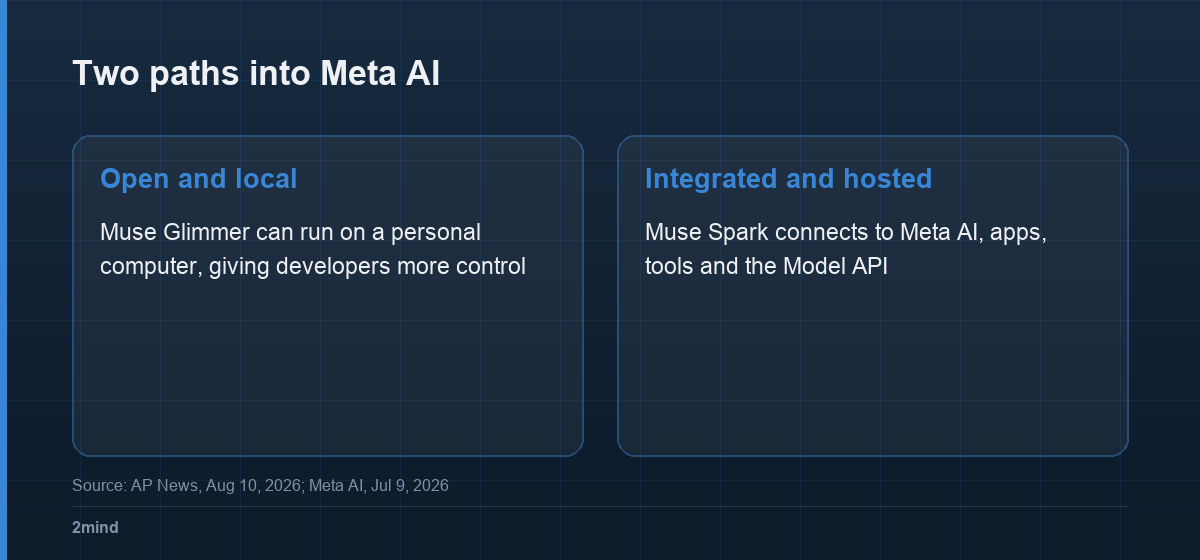
- Muse Glimmer adds a local, open route; Muse Spark 1.1 and the Meta Model API add a hosted developer route.
- Facebook AI Mode shows the distribution advantage: answers can draw on public posts in Groups and Reels inside a product people already use.
- Meta’s Q2 2026 filing shows the trade: $31.08 billion of quarterly capital expenditures supported a business still driven by engagement and advertising.
What happened
On August 10, Zuckerberg published an essay arguing that advanced AI should be broadly distributed rather than concentrated among a few institutions. AP independently reported the same day’s product move: Meta released Muse Glimmer, described as an open model capable of running on a personal computer, and said access to a more powerful Muse Spark 1.2 would follow.
Meta already offered Muse Spark 1.1 in the Meta AI app and through a public preview of the Meta Model API. One route puts a smaller model on a user’s machine; another sells access to a hosted system.
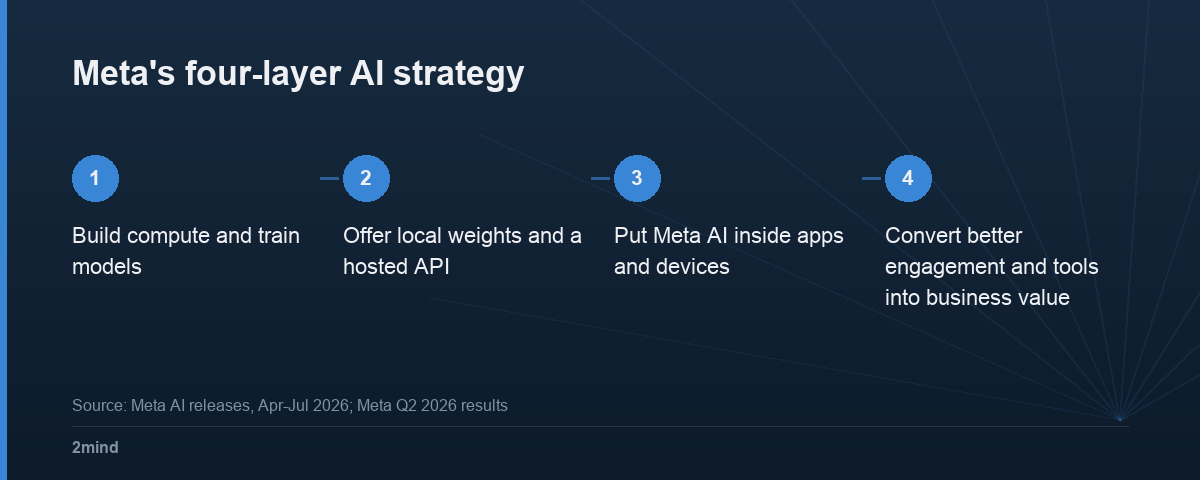
The four layers clarify what Meta is trying to own.
| Strategy layer | What Meta has shipped or disclosed | What success would look like | Main evidence to watch |
|---|---|---|---|
| Infrastructure | Data centers, training stack and large capital expenditure | Lower serving cost and enough capacity for Meta and customers | Utilization, cost per task, external compute revenue |
| Models | Muse Spark, Muse Glimmer, Muse Image and Muse Video | Competitive models for personal and agentic tasks | Independent evaluations and repeat usage |
| Distribution | Meta AI, Facebook AI Mode, Instagram, WhatsApp and devices | The assistant becomes a habitual interface | Usage, retention and incremental time spent |
| Monetization | Better recommendations and ads, plus developer access | AI improves core profit or creates material new revenue | Ad performance, API revenue and operating margin |
This is why renting AI capacity to Anthropic and reportedly distributing Claude do not necessarily contradict the strategy. If Meta owns the route to users and developers, it can earn from infrastructure or distribution even when another laboratory supplies the model.
The distribution layer is the real advantage
Facebook’s June 15 announcement is unusually direct. AI Mode answers questions using what people say publicly across Meta apps, including Groups and Reels, rather than returning only a generic list of links. Meta AI, powered by Muse Spark, appears inside an existing habit instead of asking users to begin with a new destination.
That is harder to copy than a benchmark lead. A rival can release a stronger model, but cannot quickly reproduce Meta’s social context and messaging surfaces.
Meta reported 3.60 billion Family daily active people on average in June, while ad impressions rose 14% year over year and average price per ad rose 12%. Those numbers do not prove AI caused the increases. They show the existing system into which Meta can insert an assistant.
Two Lenses
Lens one: Put capable AI within reach
The generous reading starts with access. A capable open model that runs locally can reduce dependence on a metered cloud API and keep some work on a user’s machine. The Meta Model API offers a different kind of access for teams that do not want to operate hardware. Together they let builders choose more control or more convenience.
If advanced systems are available only through a few closed services, those providers determine price and permitted uses. Open weights give researchers and developers more room to inspect and adapt a model. Meta’s earlier decision to restrict Claude Code and Codex internally shows, however, that openness narrows when training data and competitive advantage are at stake.
Lens two: Become the default guide to a person’s world
The uneasy reading begins at the same point: personalization. An assistant becomes more helpful when it knows relationships, interests, conversations, location and the content a person pauses over. Those are precisely the signals Meta’s products are positioned to connect.
The benefit and the cost grow together. A relevant answer can save time; one grounded in a company’s feeds can also shape which voices enter the frame. Local weights do not settle that if the most useful version still depends on Meta’s accounts and hosted tools.
Meta spent $31.08 billion on capital expenditures including finance-lease principal payments in Q2 2026. Its filing also reported revenue up 28% year over year while operating margin fell from 43% to 31%. Legal charges and severance affected that comparison, so it is not an AI profitability measure. It is a reminder that the assistant must eventually justify a very physical build.
Why it matters
For users, the question is which parts of life the assistant must observe, where that information is processed, and whether they can leave without losing useful context.
For developers, “open” needs a layer-by-layer reading. Weights may be available while training data remains undisclosed, app distribution stays controlled, and the most capable version is sold through an API. That differs from a fully closed model, but is not an open system end to end.
For investors, the test is whether AI improves the core advertising engine or creates a second material revenue stream before infrastructure and model refresh costs outrun those gains. Meta’s reported effort to sell computing power is evidence that management is exploring more than one route to recovery.
A checklist for the next Meta AI announcement
- Which of the four layers changes: infrastructure, model, distribution or monetization?
- Does the announcement create a new capability, or place an existing capability in front of more users?
- What remains on the user’s device, and what must travel to Meta’s servers?
- Is “open” describing weights, code, data, license terms or all four?
- Does the company disclose a measurable business result, or only a capability and a benchmark?
What would change our view
We would view Meta primarily as an open-model supplier if local Muse models became the dominant way people used its AI and developers could reproduce important results without Meta’s hosted services. We would view it as a new enterprise platform if Meta disclosed material Model API or external compute revenue separately from advertising.
The stronger evidence for the integrated-assistant thesis would be product-level disclosure that Meta AI increased retention, search use or commerce across several apps, paired with clear controls for data use and portability. Without both performance and control, familiarity may increase faster than trust.
FAQ
Q. What is Meta’s AI strategy in one sentence?
A. Meta is building models and infrastructure, distributing an assistant across its apps and devices, and using that assistant to strengthen engagement, advertising and new developer services.
Q. Is Meta still committed to open AI?
A. It released Muse Glimmer as an open model on August 10, 2026, according to AP, while also operating the hosted Muse Spark system and Meta Model API. The strategy includes both open-weight and controlled services rather than one uniform access model.
Q. How does Meta expect AI to make money?
A. The clearest current route is improving Meta’s existing products and advertising business. Developer API access and external infrastructure could add revenue, but Meta’s Q2 2026 release did not disclose them as separate material businesses.
Q. Does running a Meta model locally solve the privacy concern?
A. It can reduce the data sent to a hosted service for tasks performed entirely on the device. It does not by itself govern what happens when the model connects to Meta accounts, apps, search, cloud tools or advertising systems.
Sources
- Meta AI, “Introducing Muse Spark: Scaling Towards Personal Superintelligence” (Apr 8, 2026) — model, infrastructure and personal-superintelligence layers
- Meta, “New AI Tools to Help You Make Things Happen on Facebook” (Jun 15, 2026) — Facebook AI Mode, public social context and distribution
- Meta AI, “Introducing Muse Spark 1.1” (Jul 9, 2026) — agent capabilities and Meta Model API public preview
- Meta Platforms, Q2 2026 results (Jul 29, 2026) — users, advertising indicators, capital expenditure and margins
- Associated Press, “Zuckerberg outlines Meta’s ambitions for world-changing AI technology” (Aug 10, 2026) — Muse Glimmer release, publication time, open-model vision and independent criticism
Leave a Reply