Key Takeaways
- Google’s Gemini agent runs jobs on Gemini or Anthropic’s Claude models at launch, so the model layer is swappable by design.
- Four kinds of memory, plus skills, tool registries, agent identities and spend caps, live in Google’s cloud. The launch post we read gives no export terms for any of them.
- Lock-in has moved from the model to the agent around it. Ask what leaves with you before you ask which model is best.
AI agent lock-in is no longer about which model you pick. Google’s new agent separates the two, so the thing you cannot easily move is the agent’s accumulated memory and skills.
What Did Google Actually Announce?
On Thursday, Oct 8, 2026, Google Cloud CEO Thomas Kurian introduced the Gemini agent at Gemini at Work 2026, according to CBS News. Google calls it a “single, universal agent” for work.
The agent answers questions, writes and runs code, creates images and media, and works inside Gmail, Docs, Drive and Sheets. It also reaches Slack and Microsoft 365.
Kurian’s pitch was short: “You give it objectives, not instructions.” Work that takes hours or days keeps running in the cloud after you close your laptop.
Two design choices matter for lock-in. The agent picks a model per job, from the Gemini family and Claude at launch. And it keeps its own memory, skills and identity.
The Lock-In Ledger
We read Google’s launch post and sorted every claim into the layer it belongs to. Then we asked one question of each: does the post say how that layer leaves?
| Layer | What Google says | Exit terms in the post |
|---|---|---|
| Model | Gemini and Claude at launch, others later | Swappable by design |
| Memory | 4 kinds, kept in the cloud | None found |
| Skills and tools | Shared registries, MCP servers | MCP is open; registries none found |
| Identity and audit | Own identity, actions logged to the agent | None found |
| Spend control | Hard cap in Cloud Billing Console | Tied to Google Cloud |
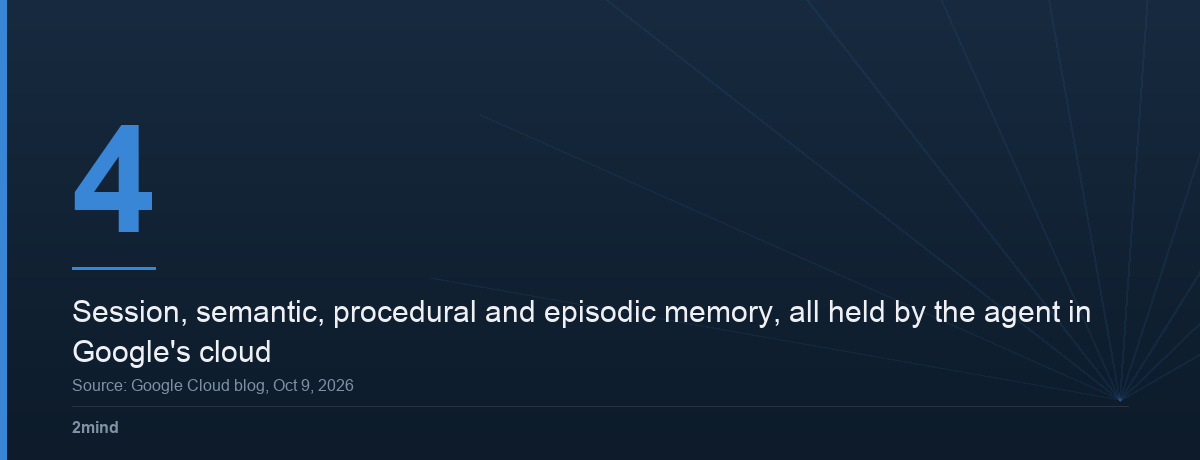
The four memories are session, semantic, procedural and episodic. Procedural memory includes skills the agent writes for itself. That is the part a buyer would most want back.
“None found” is a statement about one document. We searched its full text for “export”, “portab” and “lock-in” and got no matches. Google may publish terms elsewhere, and we did not check its contracts.
Why Is the Model No Longer the Trap?
Google argues that swapping models costs you nothing. Its post says keeping the choice open “means your context, your skills, and your data stay put” when the leading model changes.
That sentence is true for the model layer. It also tells you where the value sits: in the context and skills that stay put, inside Google’s agent.
Independent analyst Carmi Levy told Computerworld that Google “is trying to establish itself as the gatekeeper of the new enterprise operating system, powered by whatever underlying model makes the most sense.”
Levy also called the separation of agent and model Google’s “unique value proposition.” Both statements describe the same move. Make the model a commodity, and the agent becomes the product.
Two Lenses
The manager who never wants to re-brief
Anyone who has onboarded a new assistant knows the cost. Kurian says the agent “onboards itself the way a new hire would” and that you never re-brief it.
That is a real gain. The more it remembers, the less you repeat. A person who delegates daily work wants exactly this.
The buyer who wants a cheap exit
The same memory is what a procurement lead worries about. Each month of use adds context that only this agent holds.
A coworker agent also acts under its own identity, and its actions are logged to the agent rather than to a person. The audit trail is useful, but it lives where the agent lives.
Do We Weigh the Agent Layer Above the Model?
Yes, and this is our reading, not a fact from the launch. A model can be replaced in an afternoon. Months of memory and a shelf of skills cannot.
We would price an agent platform by its exit terms before its features. The model race changes every few months, as Kurian himself says. The memory does not reset on that schedule.
Our look at where an agent’s off switch should live made a similar point about control. Lock-in is control over time: who holds the agent’s state after you stop paying.
Cost shows the same pattern. Agents already use far more tokens than chatbots, and Google’s spend cap lives in its own billing console. When the cap triggers, that project’s agent pauses until someone resumes it.
The Exit Drill
You can test any agent platform’s portability before signing. It takes three steps and no special tools.
- Ask the vendor in writing for an export of one agent’s memory and skills, and note the file format they name.
- Save three real tasks the agent did well. Re-run them on a different model through the same agent and compare the results.
- Rebuild one skill by hand in a second product. Time it, and note what you had to recreate.
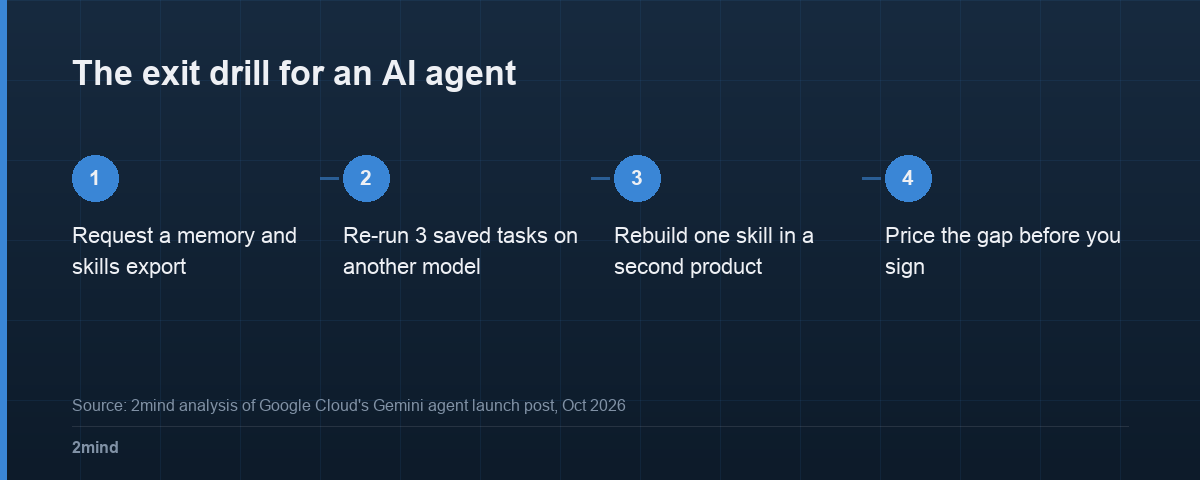
If step 1 returns nothing, you have learned the answer cheaply. The ledger above tells you which rows to ask about first.
What Would Change Our View
We would soften this reading if Google publishes a documented export for agent memory and skills in an open format. A written export path would move two rows of the ledger from “none found” to “portable.”
We would harden it if early customers report that memory and skills could not be moved when they switched agent platforms. A single documented migration would help more than any claim in a launch post.
FAQ
Q. Can the Gemini agent run on models other than Google’s?
A. Yes, Claude models from Anthropic at launch. Google says other private and open models will follow. The model choice is separate from the agent itself.
Q. Does Google say you can export the agent’s memory?
A. Not in the launch post we read. We searched its full text for “export” and “portab” and found no matches, so we treat it as unstated.
Q. What is agent lock-in?
A. It is the cost of leaving once an agent holds your context, skills and logs. With model-neutral agents, that cost moves from the model to the agent platform.
Sources
- Welcome to Gemini at Work 2026 — Google Cloud, Oct 9, 2026
- Google launches Gemini AI workplace agent — CBS News, Oct 8, 2026
- Google wants to be the gatekeeper for enterprise AI agents — Computerworld, Oct 8, 2026
Leave a Reply