Key Takeaways
- AI agents pay by receiving a price from a service and settling it inside the same web request, with no checkout page. The protocol Chainalysis studied is Coinbase’s x402.
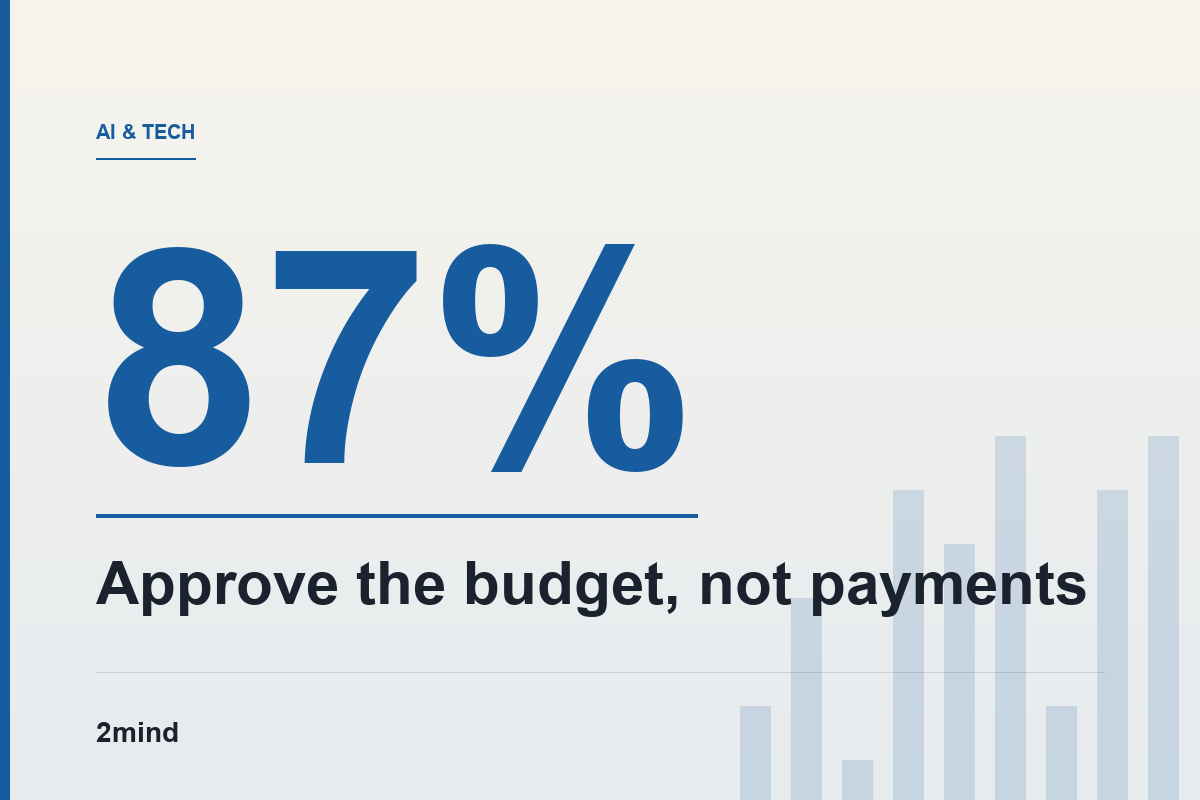
- Chainalysis counts more than 138 million cumulative x402 transactions on Base, and 87% of payments fell between a hundredth of a cent and a dime.
- The median wait from a wallet’s first deposit to its first payment fell from 73 days to 18 minutes.
- The owner’s approval moves from each payment to the setup: the funding, the budget and the services it may pay.
An agent that pays on its own changes what the owner reviews. Chainalysis’s report names the new checkpoints, and they are easy to turn into a short check before you fund one.
How Does an AI Agent Pay for Something?
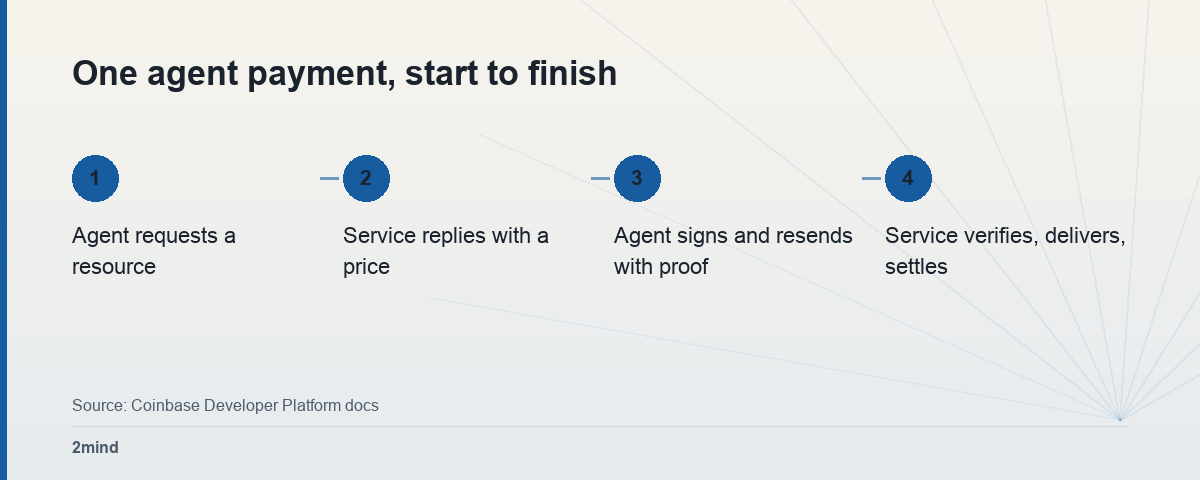
An agent asks a service for a resource. The service replies that payment is required and states the price. The agent signs a payment and asks again, and the service delivers once the payment is verified.
That is the flow in Coinbase’s x402 documentation. It describes x402 as an open standard for per-request payments over HTTP, with no checkout page, subscription or separate billing integration.
USDC, a dollar-pegged stablecoin, is the most common asset in that flow. Fortune describes the usual setup: a developer funds the agent’s wallet, and the agent pays for services as it works.
What Did Chainalysis Count on October 14, 2026?
Chainalysis’s report, published October 14, 2026, found more than 138 million x402 transactions on Base. Base is the blockchain Coinbase incubated, and the report calls it the most popular chain for agent payments.
We could not pin down the cutoff date. Chainalysis ties the count to the end of its 12-month period, which ended July 1, 2026. Fortune reports it as “by the third quarter of 2026.” Because the bases differ, we do not compute a daily rate.
The size of payments is clearer. Over 87% of payments fell between a hundredth of a cent and a dime, and the most common size was one to ten cents.
Chainalysis says tiny payments suit stablecoins because settling costs under a cent, while such amounts “don’t make fiscal sense for a credit card network to process.”
Where Control Moves When an Agent Pays
The table is our construction from the checkpoints Chainalysis lists. The left column is the familiar case of a person approving each purchase.
| Question | Person approves each payment | Agent with an allowance |
|---|---|---|
| Who approves the amount? | The buyer, each time | The owner, once, as a budget |
| How is the sender known? | At checkout | At the funding event |
| Who gets paid? | Whoever the buyer picks | Services the owner has named |
| What flags a problem? | A single odd purchase | A break in the spending pattern |
Chainalysis puts the shift this way: individual transactions are “too fast, too small, and too frequent” to be the checkpoint, so the logic moves “from screening each payment to screening the setup, the destination, and the pattern.”
It adds that accountability “must trace to whoever deployed and funded the agent, not the agent itself.”
Are Agent Payments Still Just Experiments?
Chainalysis says agentic commerce is still in an “experimentation phase,” a phrase it attributes to multiple experts. It also points to signs of settling in. Early x402 activity was driven by a memecoin, PING (Cointelegraph reports the same), and many users left when their funds ran out.
Three measures moved in the report:
- Wallets first funded in Q3 2025 got a second funding within 30 days 70.6% of the time. For wallets first funded in Q2 2026, it was 89.3%.
- Wallets that made a first payment within an hour of funding rose from 4% in Q3 2025 to 67% in Q3 2026.
- The median gap between a wallet’s first deposit and its first payment fell from 73 days in late 2025 to 18 minutes by Q3 2026.
Chainalysis counted only wallets that sent on two or more separate days, to leave out one-time experimenters.
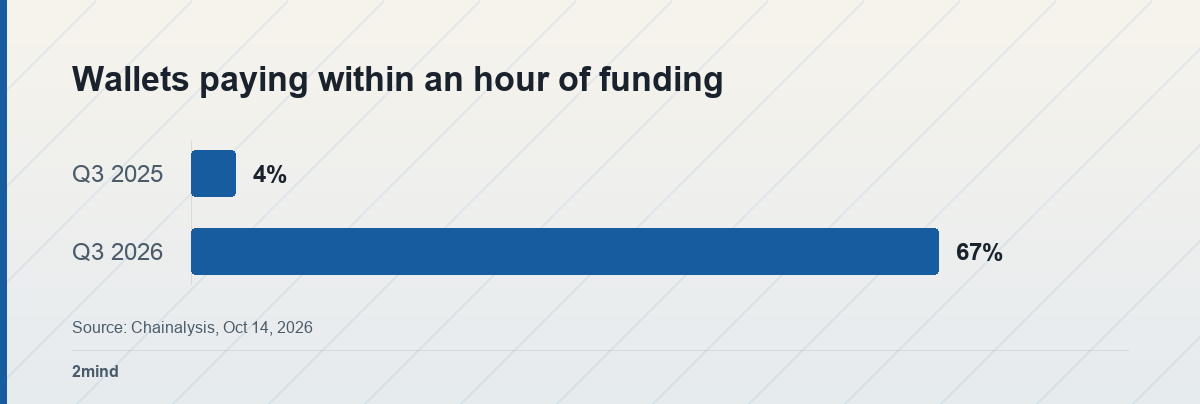
Chainalysis reads this as people funding a wallet for a job already queued. That is its interpretation. We cannot see inside the wallets.
What Are Agents Buying?
Chainalysis tracked millions of payments into information services, such as code review, financial intelligence, and data and search APIs. It also found payments for agent frameworks and tooling, and “one of the largest categories” was model inference.
Nationality shows up in the split. Wallets linked to the United States made 88.1% of geolocated model-inference payments. Chinese-linked wallets made 0.1%.
Chainalysis offers one possible explanation: Chinese open-weight models are free to use, while US metered models are not. It labels that a possible explanation, and so do we.
Two Lenses
Hand over a wallet
A developer who has to approve a seven-cent data pull forty times an hour has not delegated anything. Eric Jardine, Chainalysis’s head of research, told Fortune that speed plus low settlement cost is “the sort of thing that you would need if you were doing true AI-to-AI commerce.”
On this view the budget is the approval. It is made once, with full attention, and then the agent works.
Keep the receipts
The same setup means money leaves in amounts too small to notice one by one. A service the agent picks for a good reason is still a service the owner never saw.
Cost also compounds: our earlier piece on why agents use about four times the tokens of a chatbot shows how a single task multiplies its own spending.
We weigh the second view more for anything beyond a small, capped budget. A cap you can lose is a decision. An open balance is a hope.
How to Set an Allowance Before You Fund an Agent
This is our suggestion. We have not tested it on any agent, and Chainalysis does not prescribe it. It turns the report’s three checkpoints into steps.
- Fund a separate account with an amount you could lose outright. This is the funding event, and it is the one place the money’s origin is clear.
- Name the services the agent may pay, such as one data API and one model provider. Treat anything else as closed, and enforce it in the payment tool, not only in the prompt.
- Check the pattern on a schedule. Compare the spending to the jobs you queued, and look for payments to a service you did not name. For a way to stop an agent outright, see our look at where an off switch has to sit.
What Would Change Our View?
We could not verify how Chainalysis separates agent wallets from human ones. Coinbase incubated both x402 and Base, and a Coinbase Ventures executive is quoted in the report, so the data and the protocol’s sponsor are not fully independent.
If another analytics firm repeated the count with a different method and found a much lower share of repeat spending, we would treat “stickier” as unproven. If the large share of sub-dime payments turned out to be a few services paying each other, we would read the 138 million as activity, not demand.
This is an educational analysis of public reports, not financial or investment advice.
FAQ
Q. Do AI agents need crypto to pay for things?
A. No. x402 is one design, and Coinbase’s documentation says it is not tied to a single payment rail. Circle, quoted by Chainalysis, expects card rails for consumer-prompted agent payments and stablecoin rails for machine payments too small for cards.
Q. Can an agent spend my money without asking?
A. Only the money in the account you funded. In the setup Fortune describes, the developer funds the wallet and the agent pays from it without a person approving each purchase.
Q. Does 138 million payments mean agents are a big business?
A. Not by itself. Most payments were under a dime, and Chainalysis calls the field experimental. The count shows frequency, not total value.
Sources
- North America: Inside the Growth of Agentic Commerce — Chainalysis, Oct 14, 2026
- AI agents are on a shopping spree — Fortune, Oct 14, 2026
- How x402 works — Coinbase Developer Platform docs
- Agentic payment activity tops 100M transactions on Base — Cointelegraph, Jun 3, 2026
Leave a Reply