
Two headlines from opposite sides of the Atlantic — but I think they’re pointing at the same inflection point.
Key Takeaways
- Greece’s regulator is expected to reject Binance’s MiCA license before the June 30 deadline — and because MiCA passports across the EU, that effectively blocks Binance from the entire bloc.
- On the same day, more than 200 crypto firms urged the U.S. Senate to advance the Digital Asset Market Clarity Act, which has already passed the House.
- If Binance loses EU access, liquidity is more likely to migrate to offshore or decentralized platforms than to disappear.
- Coinbase, Kraken, and OKX all have EU licensing processes underway, making Greece’s decision a bellwether for the rest of the industry.
What Happened
| Region | Development | Status |
|---|---|---|
| EU (Greece/MiCA) | Binance license expected to be rejected | Deadline: June 30 |
| US (Senate) | 200+ firms push Digital Asset Market Clarity Act | Passed House; pending Senate |
On June 16, Reuters reported that Greece’s financial regulator is expected to reject Binance’s application for a MiCA (Markets in Crypto-Assets) license ahead of the June 30 deadline.
Because MiCA operates as a single passport across all EU member states, a denial in Greece effectively bars Binance from serving customers throughout the entire European Union — one of the world’s largest retail crypto markets.
On the same day, more than 200 crypto firms sent a joint letter urging the U.S.
Senate to advance the Digital Asset Market Clarity Act. The bill, which has already passed the House of Representatives, would establish a federal framework for digital assets and draw clearer jurisdictional lines between the SEC and the CFTC. The scale of industry coordination behind this push is, by most accounts, unprecedented.
The passporting mechanic is the part worth slowing down on. Under MiCA, a license granted — or denied — in any single EU member state applies across all member states at once.
That’s a deliberate design choice: it stops exchanges from license-shopping their way into the bloc through the most lenient regulator.
It also means Greece’s decision carries weight far beyond its own market size, because it functions as a gate for the entire European Union simultaneously.
The Two Lenses
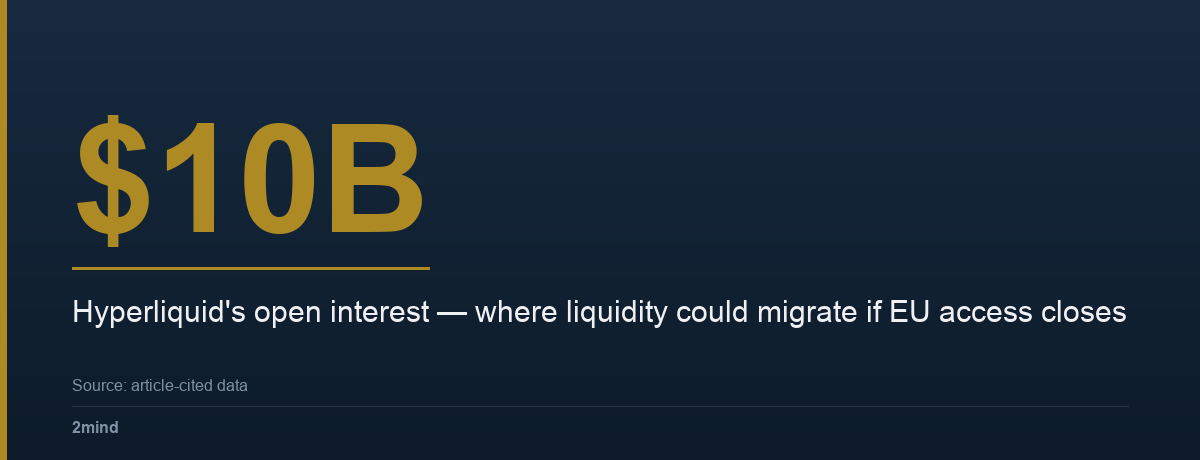
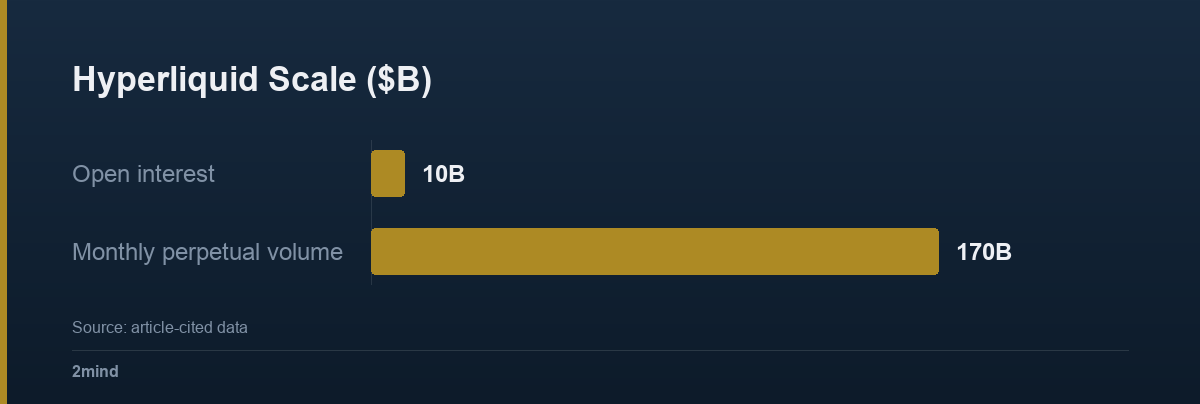
Hyperliquid’s scale is worth sitting with here, because it’s not a fringe alternative. Crossing $10 billion in open interest and processing over $170 billion in monthly perpetual volume puts it in a category that regulators weren’t necessarily designing MiCA around.
A decentralized platform doesn’t have a headquarters to deny a license to, which is exactly why “liquidity migrates rather than disappears” is more than a hedge — it describes where the rails already exist for that migration to happen quickly.
Lens one: Regulation is finally arriving, and it’s filtering out the weak.
MiCA was designed precisely for this moment. The EU built a unified licensing framework so that regulators — not exchanges — would set the terms of market access. Binance’s reported rejection isn’t a surprise to anyone who has followed the exchange’s compliance history.
From this angle, the system is working as intended: large, non-compliant actors face real consequences, and the market gradually shifts toward operators who can meet the bar. The 200-firm lobbying push in the U.S. fits the same logic — industry incumbents increasingly want clear rules, because clear rules create moats.
Lens two: Regulatory fragmentation is the actual risk.
If Binance loses EU access, liquidity doesn’t disappear — it migrates. To offshore platforms, to jurisdictions with lighter oversight, or to decentralized alternatives like Hyperliquid, which just crossed $10 billion in open interest and processes over $170 billion in monthly perpetual volume.
A rules-heavy EU and a still-unclear U.S. framework don’t produce a safer market; they produce a more fragmented one. The Digital Asset Market Clarity Act could help, but Senate timelines are unpredictable, and the gap between House passage and Senate action has historically been where crypto legislation dies.
Why It Matters
The immediate pressure falls on Binance’s European user base and any institutional counterparties relying on EU-regulated access. But the broader implication reaches further. If MiCA enforcement proceeds strictly — and Greece’s expected decision suggests it will — every major exchange currently operating in the EU on provisional authorization is now watching closely.
Coinbase, Kraken, and OKX all have EU licensing processes underway.
For the U.S. side, the 200-firm coalition signals that the industry has moved past the “resist all regulation” phase.
The question now is whether the Senate moves before the next election cycle reshuffles priorities again.
What I’d watch: whether Binance files an appeal or pursues licensing through a different EU member state, and whether the Senate Judiciary or Banking Committee schedules hearings on the Digital Asset Market Clarity Act before the August recess.
The era of operating in regulatory ambiguity is narrowing.
That’s not inherently good or bad — it depends entirely on what the rules turn out to be.
The exchanges named as watching this closely — Coinbase, Kraken, and OKX — aren’t neutral observers. Each has invested in building EU-compliant operations under the assumption that provisional authorization would eventually convert into full licensing.
A strict enforcement precedent out of Greece changes the risk calculus for all three, potentially pushing them toward more conservative compliance spending, or alternatively toward lobbying for clearer guidance before their own review dates arrive.
FAQ
Q. What is MiCA, and why does one country’s decision matter for the whole EU?
A. MiCA (Markets in Crypto-Assets) is the EU’s unified licensing framework for crypto firms. A license granted or denied in one member state passports across all of them, so Greece’s decision on Binance effectively determines its access to the entire EU market.
Q. Where would Binance’s EU users go if the license is denied?
A. Likely candidates include offshore platforms with lighter oversight and decentralized alternatives like Hyperliquid, which already processes over $170 billion in monthly perpetual volume. The liquidity doesn’t vanish — it relocates to wherever access remains open.
Q. What would the Digital Asset Market Clarity Act actually change?
A. It would establish a federal framework for digital assets in the U.S. and draw clearer jurisdictional lines between the SEC and the CFTC. It has already passed the House and is pending in the Senate.
What would change our view
If Binance successfully appeals or secures licensing through a different EU member state before June 30, the “regulation is filtering out weak actors” reading would need to soften considerably — it would suggest this was a Greece-specific compliance gap rather than a bloc-wide judgment on Binance itself.
And if the Senate moves on the Digital Asset Market Clarity Act quickly, the fragmentation risk on the U.S. side would look overstated in hindsight.
Sources
- CoinDesk (citing Reuters) — 2026-06-16. On June 22, Reuters reported that Greece's financial regulator is expected to reject Binance's application for
- Davis Wright Tremaine — 2026-05. More than 200 crypto firms sent a joint letter urging the U.S. Senate to advance the Digital Asset Market Clarity Act
- U.S. House Committee on Financial Services — 2025-07-17. The Digital Asset Market Clarity Act has already passed the House of Representatives
- Datawallet — 2026-06. Hyperliquid processes over $170 billion in monthly perpetual volume
Leave a Reply