I keep coming back to this idea that the biggest AI shift right now isn’t a new chatbot — it’s AI starting to check its own work.
Key Takeaways
- Researchers and practitioners are describing a shift from single-prompt AI interactions to “loop engineering,” where AI systems repeat cycles of experimentation and verification on their own.
- Andrej Karpathy’s “autoresearch” experiment is the starting point — analysts named the pattern the “Karpathy Loop,” and a second layer, “bilevel autoresearch,” runs a loop on top of that loop.
- The shift matters because it changes AI from a tool that answers questions into a system that iterates toward better answers with less human step-by-step guidance.
What happened
Generative AI usage is moving beyond the simple “prompt in, answer out” model toward what is now being written up as “loop engineering” — a workflow where the model plans, acts, checks its own result, and repeats, without a human manually restarting each step.
As one guide puts it: a prompt is one instruction, after which you decide the next step; a loop is a goal the model pursues until it arrives.
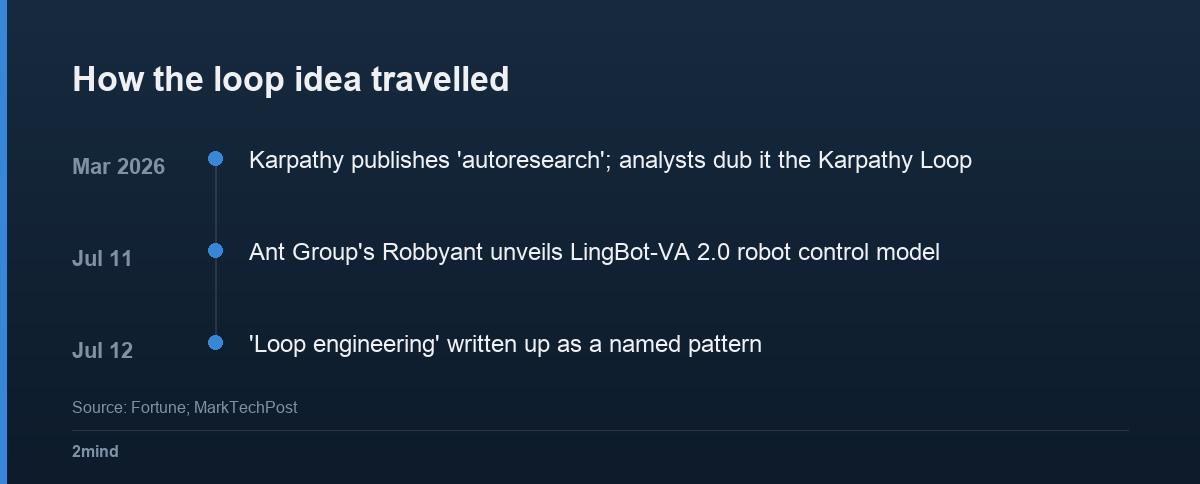
The concept traces back to AI researcher Andrej Karpathy, who in March 2026 let a coding agent run 700 experiments over two days and turn up 20 optimisations that cut training time for a small language model by 11%. He called the system “autoresearch”; an analyst writing in The New Stack named the pattern the “Karpathy Loop.”
This development sits alongside other signals of AI systems taking on more autonomous, agent-like roles.
Chinese technology group Ant Group, through its robotics arm Robbyant, released a robot control model called LingBot-VA 2.0 on July 11, described as an embodied-native foundation model and a successor to LingBot-VA 1.0 — part of a push toward “physical AI” platforms that let robots perceive and act in real environments.
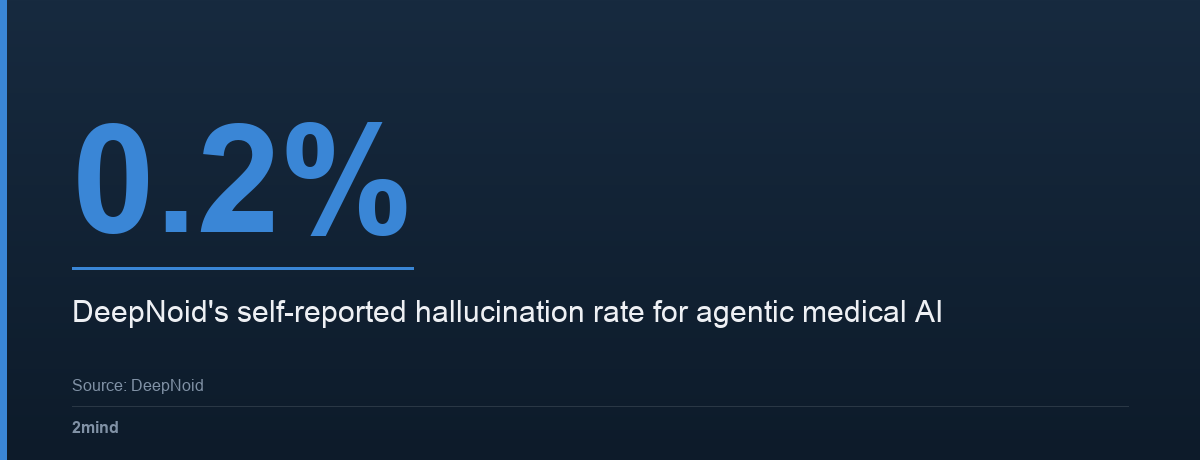
The same pattern is being pitched into higher-stakes settings. Medical AI vendors have begun marketing “agentic” systems for clinical workflows, quoting their own hallucination rates as the reassurance — figures that, so far, come from the vendors themselves rather than from independent evaluation.
| Development | Core claim |
|---|---|
| Loop engineering / autoresearch | AI iterates its own experiments beyond single-prompt use |
| Karpathy’s autoresearch run | 700 experiments in two days, 20 optimisations, 11% faster training |
| Ant Group LingBot-VA 2.0 | Robot control model for “physical AI” platforms |
What ‘bilevel autoresearch’ actually adds
The Key Takeaways mention a second layer stacked on top of Karpathy’s original loop — bilevel autoresearch, a loop that runs on top of the loop that’s already iterating.
I read that as the natural next step once the first layer proves itself. If one loop can improve training efficiency by 11% over 700 experiments, the obvious move is a second process that tunes the first loop’s search strategy.
That shifts a decision humans used to make — how the experiment loop itself should adapt — onto the system running it.
None of this tells us whether bilevel autoresearch is actually running in production anywhere yet, or whether it remains a described pattern more than a deployed one.
The two lenses
Lens one: this is the natural maturation of AI tooling. From this angle, loop engineering is simply what happens when AI systems become reliable enough to trust with iterative tasks.
Karpathy’s framing of autoresearch isn’t about AI “thinking for itself” in some dramatic sense — it’s an engineering pattern, similar to how software development moved from manual testing to automated CI/CD pipelines.
Ant Group’s robotics models point toward AI systems becoming components in larger automated pipelines rather than standalone chat interfaces. This is consistent with a broader trend of AI moving from consumer chat products into infrastructure-level tooling.
Lens two: this is autonomy outpacing oversight. The more cautious reading is that as AI systems take on more of the experimentation and verification loop themselves, human oversight of each individual step necessarily shrinks.
A sub-1% hallucination rate sounds reassuring, but in medical contexts even small error rates compound at scale — and when the number is self-reported, there is no way to check what it was measured against. “Agentic” framing can also obscure how much independent judgment the system is actually exercising versus following a scripted pipeline.
Robotics models that combine perception, control, and real-time world modeling are also moving physical AI from lab demonstrations toward deployment, which raises the stakes of any single failure mode. The faster loop engineering scales, the harder it becomes for humans to meaningfully audit each cycle.
The gap between LingBot-VA 1.0 and 2.0
Ant Group’s Robbyant didn’t introduce the embodied-native foundation model concept with version 2.0 — it’s a successor to LingBot-VA 1.0.
That means this is an iteration on an existing platform, not a first attempt at the idea. It matters for how much weight to put on the July 11 release.
It’s evidence of a company continuing to invest in physical AI as a category, not a single company testing the waters for the first time.
Why it matters
Enterprises evaluating AI vendors should watch how “agentic” and “autoresearch” claims are substantiated with concrete error rates and audit trails, rather than taken at face value.
Developers and researchers should track whether loop engineering tools remain interpretable as they scale, since the value of automated iteration depends on being able to trust — or verify — what happened inside each loop.
The medical and robotics use cases specifically deserve close attention, since these are domains where autonomous iteration carries real-world consequences beyond a wrong chatbot answer.
This is a trend worth tracking closely over the next few quarters rather than reacting to immediately.
Karpathy’s own framing versus how it’s being used
Karpathy called his own experiment ‘autoresearch’ — a fairly modest, descriptive label for a coding agent running iterations.
The New Stack’s ‘Karpathy Loop’ framing, and the broader ‘loop engineering’ guide language that followed, expand that into something closer to a named methodology.
That tends to happen once a technique gets picked up outside the team that built it.
The gap between how an idea is first described and how it gets marketed afterward is worth watching in the medical AI examples, where vendors are already borrowing agentic language for clinical workflows.
That’s a much higher-stakes setting than the small language model Karpathy was optimizing when this pattern started.
FAQ
Q. What is “loop engineering” in AI?
A. It refers to a workflow where AI systems repeatedly run experiments, check results, and adjust their own approach with minimal human intervention at each step, rather than requiring a new prompt for every iteration.
Q. What does a very low hallucination rate mean for medical AI?
A. It would indicate how often the system produces inaccurate or fabricated outputs. In practice these figures are company-reported, and the measurement conditions — which dataset, which task, judged by whom — are usually not published, so they cannot be compared across vendors.
What would change our view
An independent, third-party audit of a medical AI vendor’s hallucination rate — rather than a vendor-reported figure — would change how much weight I put on Lens two’s caution, in either direction.
If a documented failure emerged from a loop-engineered system operating with minimal human review, in medicine or in the robotics deployments Ant Group is pushing toward, that would be the clearest sign yet that autonomy is outrunning oversight.
Sources
- Fortune, Andrej Karpathy’s “autoresearch” and the loop it started (17 March 2026)
- MarkTechPost, A guide to loop engineering (12 July 2026)
- MarkTechPost, Ant Group’s Robbyant unveils LingBot-VA 2.0 (11 July 2026)
Leave a Reply