Here’s a detail that stopped me mid-scroll: the company that helped fund OpenAI is reportedly shopping around for a cheaper alternative.
Key Takeaways
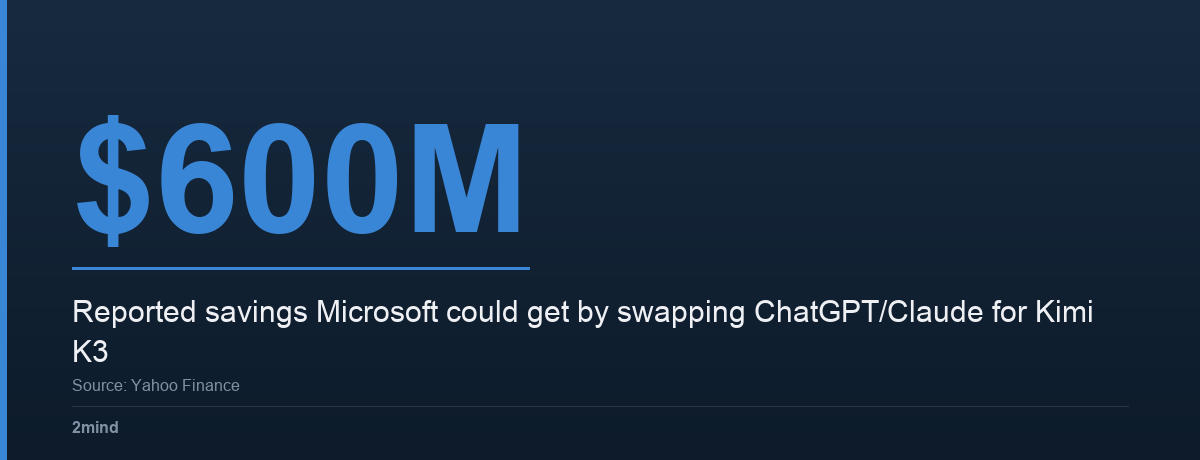
- Microsoft is reportedly considering replacing ChatGPT and Claude with Moonshot AI’s Kimi K3 model to save roughly $600 million.
- The move comes in the same week Alphabet posted 82% growth in Google Cloud revenue, showing AI infrastructure spending paying off elsewhere.
- The contrast suggests AI cost discipline and AI infrastructure conviction are now running in parallel inside the same industry, not sequentially.
What happened
According to a report from Yahoo Finance, Microsoft is evaluating whether to replace its use of OpenAI’s ChatGPT and Anthropic’s Claude with Kimi K3, a large language model developed by Chinese AI lab Moonshot AI. The motivation cited is cost: the switch could save Microsoft an estimated $600 million.
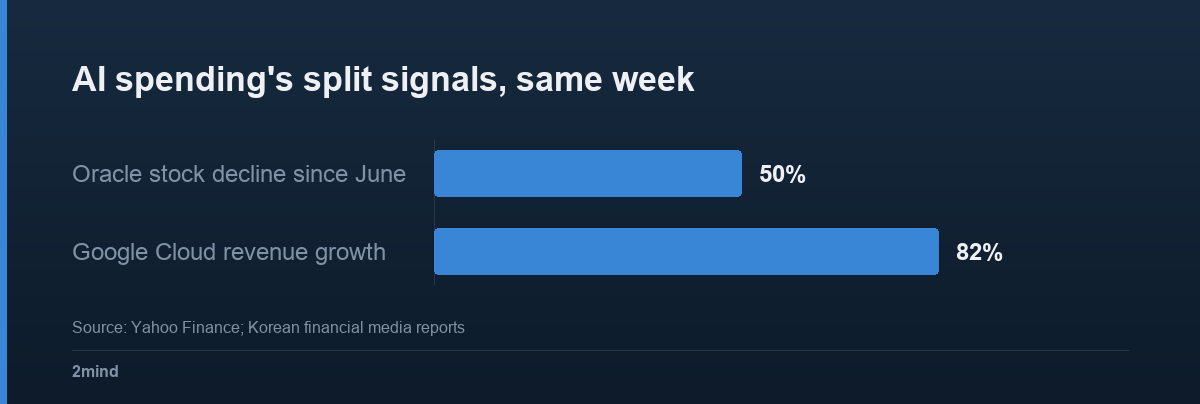
This surfaced during a week when AI spending itself was under intense scrutiny across markets. Chip stocks had already dragged the Nasdaq into a reported $3.3 trillion sell-off in the prior week, and Oracle’s stock had reportedly fallen roughly 50% since June amid concerns over AI infrastructure economics.
Against that backdrop, Alphabet’s second-quarter results landed as a counterpoint: Google Cloud revenue grew 82%, and the company confirmed plans to raise capital expenditure to a range of $195 billion to $205 billion for the year, according to Korean financial media reports, with Alphabet’s overall Q2 revenue reaching $119.8 billion, above the roughly $116.9 billion analysts had expected.
| Company | AI-related move this week |
|---|---|
| Microsoft | Reportedly evaluating cheaper Kimi K3 to cut ~$600M in costs |
| Alphabet | Raising capex to ~$200B; cloud revenue up 82% |
What $600 million buys at Microsoft’s scale
$600 million sounds enormous in isolation, but it only means something in proportion to what Microsoft spends on AI overall. For a company running model access across its entire enterprise product suite, that figure is a meaningful line item — not a rounding error, but not existential either.
What makes it notable is the source of the saving: swapping the underlying model itself, not just renegotiating the same vendor’s price. That’s different leverage than a typical enterprise cost-cutting exercise, because it puts a specific dollar figure on how commoditized frontier model access has become.
It’s also a reminder that “premium” pricing in AI now competes against genuine substitutes, not just theoretical ones. A year ago, this kind of comparison wouldn’t have been credible enough to report.
The token math, run directly
The $600 million figure comes from Yahoo Finance’s report, not from Microsoft. To see how large that price gap has to be, 2mind pulled the current list prices each vendor publishes for API access (checked September 2026) — the same numbers a buyer evaluating a swap would be pricing against.
| Model | Input $/1M tokens | Output $/1M tokens |
|---|---|---|
| Kimi K3 (Moonshot AI) | $3.00 | $15.00 |
| GPT-5.6 Astra (OpenAI flagship) | $10.00 | $50.00 |
| Claude Opus 5 (Anthropic flagship) | $5.00 | $25.00 |
At official list price, Kimi K3 undercuts OpenAI’s actual flagship tier — GPT-5.6 Astra, not the cheaper mid-tier Sol some coverage conflates with it — by 70% on both input and output tokens, and undercuts Claude Opus 5 by 40% on both. At enterprise-scale token volume, a nine-figure saving isn’t a stretch; it’s roughly what the sticker prices alone would predict.
The $600 million also needs a denominator. Microsoft’s own fiscal-2026 filings report $80.1 billion in “additions to property and equipment” for the nine months through March 31, 2026, alone. $600 million against that nine-month capex total works out to about 0.75% — real money, but small enough that, by this one measure, it leans closer to the cost-discipline case in Lens one than the ROI-doubt case in Lens two.
The two lenses
Lens one: this is smart cost discipline, not a loss of AI conviction.
Large enterprises routinely benchmark vendors, and Microsoft evaluating a lower-cost model doesn’t necessarily mean it’s abandoning its OpenAI partnership or its broader AI roadmap.
From this angle, the Kimi K3 evaluation looks like ordinary procurement behavior scaled to an enormous budget — when a company spends billions on AI infrastructure and model access, shaving hundreds of millions off compute or licensing costs is simply good stewardship of shareholder capital.
It also reflects a maturing AI vendor landscape: a year or two ago, there weren’t credible alternatives capable of prompting this kind of comparison.
The fact that a Chinese-developed model is now considered viable competition for Western flagship products is itself a sign of how quickly the underlying technology has commoditized, which in theory should benefit buyers across the industry, not just Microsoft.
Lens two: this signals real doubt about return-on-investment for premium AI models.
The more skeptical reading treats this as evidence that even the biggest AI spenders are starting to question whether premium-priced models justify their cost at scale.
Considering a $600 million saving big enough to warrant swapping out ChatGPT — a product Microsoft has deeply integrated into its own ecosystem — is not a trivial signal. It arrives during the same stretch where chip and AI infrastructure stocks were under visible pressure, and where Oracle’s cloud-related stock decline was being discussed openly.
Under this reading, Alphabet’s strong cloud number doesn’t contradict the caution story; it may simply mean capital is concentrating around infrastructure providers rather than model licensors, while enterprises quietly shop for the cheapest model that gets the job done.
This kind of bifurcation — infrastructure demand staying strong while individual model economics get squeezed — has shown up in prior tech cycles too.
Reading Alphabet’s number against Microsoft’s
Alphabet’s 82% cloud growth and Microsoft’s cost evaluation aren’t necessarily in tension with each other. One measures demand for AI infrastructure — chips, servers, data centers. The other measures price sensitivity around which model sits on top of that infrastructure. Both can be true in the same week.
That distinction matters for anyone trying to read this as one unified AI story. Infrastructure demand and model-vendor economics are increasingly separate questions, and treating them as a single narrative — “AI is booming” or “AI is faltering” — misses what’s actually happening in each layer.
Why it matters
This matters most for enterprise AI buyers, OpenAI and Anthropic as vendors facing new pricing pressure, and investors trying to separate “AI infrastructure demand” from “AI model vendor profitability” as two increasingly distinct stories.
If a company as large as Microsoft is willing to publicly float a switch away from marquee Western models, smaller enterprises may feel emboldened to negotiate harder or diversify their own model stacks. What’s worth watching next is whether Microsoft actually follows through, and whether other major cloud or software companies make similar moves.
It’s also worth watching whether Alphabet’s strong cloud results represent a durable pattern or a single strong quarter — one data point doesn’t settle whether AI infrastructure spending is broadly justified yet.
What Chapter 11-scale switching costs actually look like
Swapping a foundation model isn’t like swapping a cloud vendor. ChatGPT is reportedly woven into Microsoft’s own product suite, which means an evaluation like this involves testing output quality, retraining internal workflows, and managing risk across products that customers already rely on daily.
That complexity is exactly why a $600 million saving has to clear a high bar before it becomes a real switch rather than a negotiating chip. Evaluating an alternative costs far less than actually migrating, and companies float evaluations publicly for leverage more often than they follow through immediately.
Whether Microsoft follows through says less about Kimi K3’s quality and more about how much switching friction Microsoft is willing to absorb for a nine-figure saving.
FAQ
Q. Does this mean Microsoft is ending its OpenAI partnership?
A. The report describes this as Microsoft evaluating an alternative model for cost reasons, not an announced end to its OpenAI relationship; no such termination has been confirmed.
Q. Why would a Chinese AI model be considered by a major US company?
A. According to the report, the primary driver cited is cost savings of roughly $600 million, suggesting the decision is being framed around budget efficiency rather than technical superiority alone.
What would change our view
If Microsoft confirms it made the switch and follows through with a public announcement, the cost-discipline reading strengthens considerably. If this remains an internal evaluation that never resurfaces, or Microsoft reaffirms its OpenAI commitment publicly, the more likely explanation becomes routine vendor benchmarking rather than a real shift.
Sources
- Microsoft considers replacing ChatGPT and Claude with China’s Kimi K3 to save $600 million — Yahoo Finance
- Kimi K3 API pricing — Moonshot AI (official, checked September 2026)
- GPT-5.6 model pricing — OpenAI (official, checked September 2026)
- Claude Opus 5 API pricing — Anthropic (official, checked September 2026)
- Microsoft FY2026 Q3 press release — nine-month capital expenditure figure
Leave a Reply