I keep noticing how many Bitcoin mining companies are quietly turning into something else entirely.
Key Takeaways
- Hut 8’s shares jumped after the company signed an AI data center deal reportedly worth $9.8 billion.
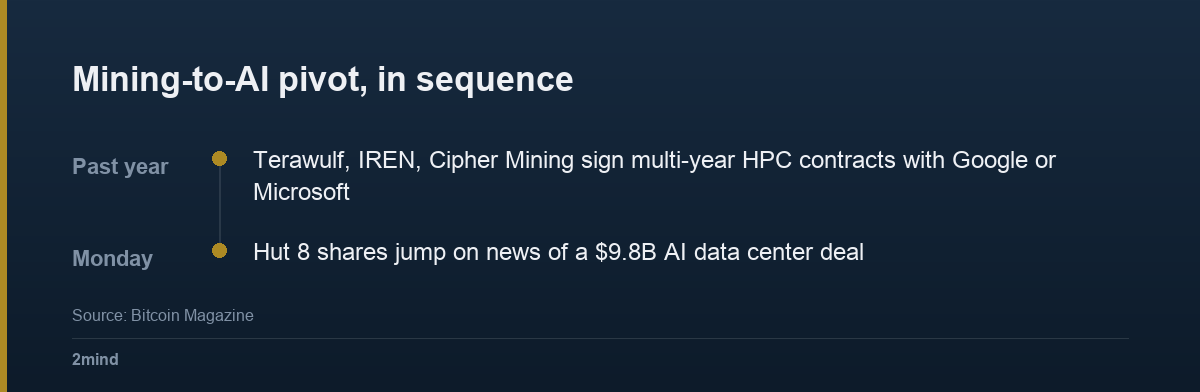
- Hut 8 joins Terawulf, IREN, and Cipher Mining, all of which have signed multi-year HPC contracts with Google or Microsoft over the past year.
- The 2mind take: Bitcoin mining’s real value today may lie less in the coins produced and more in the power infrastructure already built.
What happened
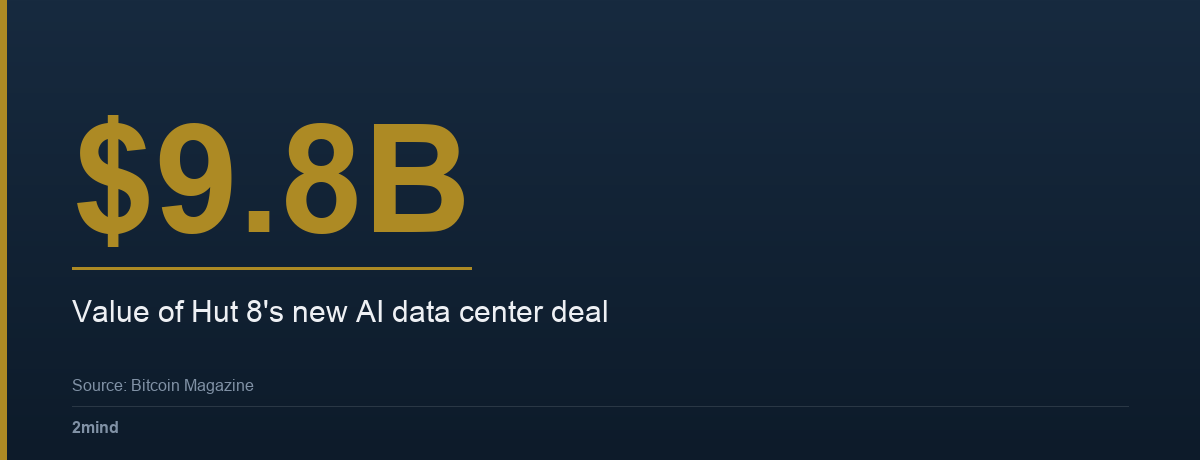
Hut 8, a publicly traded Bitcoin mining company, saw its share price jump on Monday after news broke of a data center agreement tied to AI compute demand, valued at roughly $9.8 billion, according to Bitcoin Magazine.
The deal places Hut 8 alongside a growing list of former “pure” Bitcoin miners — Terawulf, IREN, and Cipher Mining among them — that have already signed multi-year high-performance computing (HPC) contracts with Alphabet’s Google or Microsoft over the past year.
The pattern is consistent. Instead of shutting down mining operations outright, these companies are rebranding as “compute” or “digital infrastructure” providers, switching between mining Bitcoin and renting out computing power for AI workloads depending on which is more profitable at any given moment.
This comes as Bitcoin itself traded around $66,570, up roughly 2% on the day, while broader crypto markets showed a mixed but generally positive tone — Ethereum near $1,932, XRP near $1.14. Institutional demand for spot Bitcoin products has also been building in parallel, though that flow is separate from what’s happening at the mining-company level.
| Company | Move |
|---|---|
| Hut 8 | $9.8B AI data center deal |
| Terawulf | Multi-year HPC contract with Google/Microsoft |
| IREN | Multi-year HPC contract with Google/Microsoft |
| Cipher Mining | Multi-year HPC contract with Google/Microsoft |
A deal of this size is worth sizing up against what Bitcoin miners have historically been worth as businesses. Mining companies have typically traded on hash rate and electricity contracts — infrastructure metrics, not the long-duration compute contracts data center operators command. A near-$10 billion figure signals the market is starting to price Hut 8 closer to the latter.
The fact that Terawulf, IREN, and Cipher Mining all signed comparable contracts within roughly the same year suggests this isn’t one company’s opportunistic pivot — it looks more like several mining operators reaching the same conclusion about where their infrastructure holds more durable value, at roughly the same point in the AI buildout cycle.
Bitcoin’s roughly 2% gain to around $66,570 on the same day, alongside a generally positive tone across Ethereum and XRP, is a useful backdrop — it means Hut 8’s share jump wasn’t simply riding a broader crypto rally, since a single-company AI deal is a distinct catalyst from market-wide price movement.
The two lenses
Lens one: rational diversification. Bitcoin mining margins are notoriously thin and cyclical — tied to Bitcoin’s price, network difficulty, and energy costs, all of which can swing hard in short windows. AI compute demand, by contrast, has been remarkably stable and, in many cases, contractually locked in for years.
From this angle, Hut 8’s move isn’t opportunistic — it’s simply prudent capital allocation. These companies already own or lease the two things AI data centers need most: land and power access.
Pivoting existing infrastructure toward HPC contracts means smoothing out revenue rather than betting everything on Bitcoin’s price cycle. Investors reward this as de-risking, not abandonment of the core business.
Lens two: mining companies may be overreaching. AI data centers are not simply “bigger mining rigs.” They require different cooling systems, different chip architectures (GPUs versus ASICs), different latency and reliability standards, and considerably more specialized operational expertise.
Bitcoin Magazine’s own reporting notes this directly — the transition “isn’t always easy.” A company built around running ASIC racks in low-cost energy regions doesn’t automatically know how to operate enterprise-grade AI infrastructure that clients like Google or Microsoft demand.
There’s a real risk that some of these pivots are more marketing than substance, chasing the AI narrative to boost share prices without the operational depth to execute long-term.
Lens two’s operational-gap point is worth sitting with a little longer. ASIC racks and GPU clusters don’t just use different chips — they have different cooling, power density, and uptime requirements, and enterprise clients like Google or Microsoft typically demand service-level guarantees a mining operation was never built to provide.
That gap doesn’t mean the pivot fails. It means the execution risk sits mostly in the months between signing a contract and actually delivering infrastructure that meets an AI client’s standards — the period Bitcoin Magazine’s own reporting flags as ‘not always easy,’ and the one worth watching most closely.
The two readings aren’t fully separable over time, either. A miner that successfully executes an AI pivot validates Lens one in hindsight; one that struggles with the operational gap Lens two describes retroactively makes the same pivot look like reaching. The deal signing is the start of that test, not the conclusion.
Why it matters
This trend matters to a wider audience than crypto-native investors. Bitcoin miners are becoming a proxy for AI infrastructure exposure on public markets, which means their stock prices are now driven by two very different forces — Bitcoin’s price action and AI compute demand cycles — that don’t always move together.
For AI companies like Google and Microsoft, partnering with miners offers a shortcut to power-ready sites without building from scratch. For Bitcoin’s mining ecosystem itself, the question is whether hash rate growth slows as more capacity gets redirected toward HPC contracts.
Watch for whether more mid-tier miners announce similar pivots, and whether any of these AI data center deals actually get delivered on schedule versus running into the operational friction described above.
The line between “Bitcoin miner” and “AI infrastructure company” is getting harder to draw, and I don’t think that’s an accident.
For Bitcoin’s own hash rate trajectory, this matters in a way that’s easy to miss. Every megawatt of capacity redirected toward HPC contracts is a megawatt not mining new blocks, which could slow network-wide hash rate growth even as individual mining companies report strong revenue from their AI contracts.
It also changes what due diligence looks like for anyone evaluating these stocks. A miner-turned-compute-provider now needs to be assessed on two separate track records — mining economics and enterprise data center delivery — and strength in one doesn’t guarantee competence in the other.
It’s also worth remembering that hash rate data lags these announcements. Any slowdown in network-wide hash rate growth tied to capacity redirection would likely take months to show up clearly in the numbers, not weeks.
FAQ
Q. Does this mean Hut 8 has stopped mining Bitcoin?
A. No — Hut 8 and similar companies typically continue mining while adding AI compute contracts as an additional, often more stable, revenue stream.
Q: Why would Google or Microsoft partner with a Bitcoin miner instead of building their own data center?
A: Miners often already control power-dense sites and infrastructure, which can be faster to repurpose than building new data centers from the ground up.
What would change our view
If Hut 8 or its peers deliver these AI data center contracts on schedule and expand them in follow-on deals, the diversification reading would gain real support.
If delivery slips or clients report service issues tied to the operational gap described above, that would favor the overreach reading instead.
Sources
- [Bitcoin Miner Hut 8 Shares Jump On $9.8 Billion AI Data Center Deal] — Bitcoin Magazine
- [Bitcoin recovers into the cloud as a profit-taking zone approaches] — KITCO
Leave a Reply