
When a public mining company sells 100% of its newly mined Bitcoin, it’s worth pausing to ask whether that’s a business decision — or a distress signal.
Key Takeaways
- Bitdeer has sold 100% of the Bitcoin it has mined since February 21 — over 3,231 BTC worth more than $205 million — leaving no BTC on its balance sheet.
- This comes about 26 months after the April 2024 halving cut mining rewards from 6.25 BTC to 3.125 BTC per block, tightening margins across the industry.
- Spot Bitcoin ETFs have posted six straight weeks of net outflows, though the pace has slowed sharply — from $1.72 billion to roughly $227 million in a single week.
- Strategy, by contrast, holds roughly 843,000 BTC on its balance sheet — same asset, opposite posture.
What happened
Bitdeer, a Nasdaq-listed Bitcoin mining firm, has sold more than 3,231 BTC worth over $205 million since February 21 — every coin it has mined since, sold on production. This is not a partial liquidation or a one-off treasury rebalancing. It is a standing policy, and it leaves the balance sheet at zero.

The news surfaced this weekend, roughly 26 months after Bitcoin’s fourth halving in April 2024, which cut block rewards from 6.25 BTC to 3.125 BTC per block.
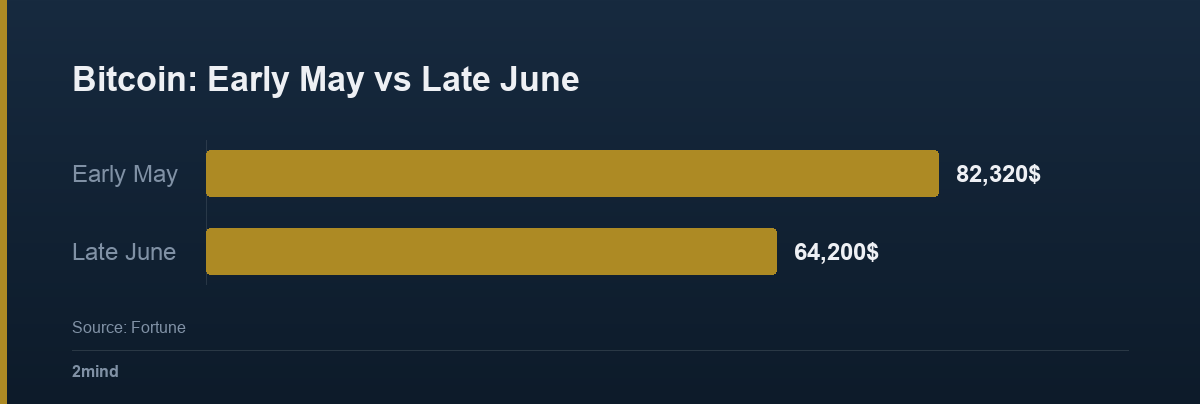
At the same time, Bitcoin is trading around $64,200 — down from about $82,000 in early May, with spot Bitcoin ETFs recording six consecutive weeks of net outflows, though the pace has slowed sharply: from $1.72 billion in the first week of June to roughly $227 million, a decline of about 87%.
The halving detail is easy to skim past, but it’s the mechanical root of why this matters.
Cutting the block reward from 6.25 BTC to 3.125 BTC doesn’t just reduce a miner’s revenue — it does so instantly and permanently, while the fixed costs of running a mining operation, like electricity contracts, hardware leases, and facility overhead, don’t adjust on the same schedule.
Roughly 26 months out from that halving, any miner whose cost structure hasn’t caught up is operating on a thinner margin than the headline Bitcoin price suggests.
The two lenses
| Company | Bitcoin Posture |
|---|---|
| Bitdeer | Sells 100% of mined BTC (3,231+ BTC, ~$205M since Feb 21) |
| Strategy | Holds ~843,000 BTC on balance sheet |
Lens one: this is rational cost management. Post-halving, mining economics are structurally tighter. Revenue per block is half of what it was in early 2024, while energy costs, equipment depreciation, and operational overhead haven’t halved with it.
If Bitdeer’s all-in mining cost sits anywhere near the current spot price, holding BTC on the balance sheet becomes a leveraged bet the company may not be positioned to take.
Selling everything is, in this reading, disciplined financial hygiene — not panic.
Lens two: this is a meaningful sentiment indicator. Miners have historically been among the most committed long-term holders. When a major miner shifts from accumulation to full liquidation, it tells you something about where insiders believe the near-term price ceiling is.
Bitdeer is not a small operation — $205 million in sales is a real supply event. Combined with ETF outflows still running negative for six straight weeks, the picture that emerges is one of institutional patience wearing thin, not building.
Neither reading is obviously wrong.
What makes this harder to dismiss is the contrast with Strategy, which holds roughly 843,000 BTC on its balance sheet. Two major Bitcoin-adjacent public companies, same asset, radically different postures.
The Bitdeer-Strategy contrast is sharper than it first looks, because the two companies aren’t really playing the same game.
Strategy raises capital specifically to buy and hold Bitcoin — its business model depends on the asset appreciating over a long horizon, and it has the balance sheet flexibility to absorb drawdowns.
Bitdeer’s revenue comes from mining and selling, meaning its cash flow is tied to operational costs that don’t wait for a bull market.
Comparing their BTC posture as if it reflects the same conviction level misses that they’re solving for different things.
Why it matters
For anyone watching the mining sector, Bitdeer’s move raises a practical question: how many other mid-tier miners are in a similar position, quietly liquidating rather than holding?
If this becomes a pattern across the industry, it introduces persistent sell-side pressure that doesn’t show up in ETF flow data or whale wallet trackers.
The ETF outflow deceleration is the thing to watch most closely in the coming weeks.
Six weeks of net outflows with a sharply declining magnitude could mean the worst of the institutional exit is over — or it could mean the sellers are simply running out of positions to exit.
The next two to three weeks of ETF flow data will be more informative than any price level.
Bitdeer’s decision to sell everything is, at minimum, an honest read on where one major miner stands. That honesty is worth more than a dozen bullish price predictions.
That roughly 87% drop in weekly outflows — from $1.72 billion down to about $227 million — is doing a lot of work in this story, and it can be read two ways.
A shrinking outflow could mean sellers are running low on positions to exit, which would suggest the pressure is nearly spent.
It could just as easily mean new buyers are stepping in to absorb what’s left, which would be a genuinely bullish signal. The direction of the next one or two weekly prints should clarify which of those is happening.
FAQ
Q. Why would a Bitcoin miner sell 100% of what it mines?
A. Post-halving, mining margins are structurally tighter — revenue per block is half of what it was before April 2024, while operating costs like energy and equipment haven’t fallen at the same rate. Selling everything it mines lets Bitdeer cover costs without carrying additional price risk on top of its operating risk.
Q. Does this mean Bitdeer is in financial trouble?
A. Not necessarily. Selling mined Bitcoin on production can be disciplined risk management rather than distress — it depends on whether Bitdeer’s all-in mining cost sits close to the current spot price. The company hasn’t framed this as an emergency measure.
Q. How does this compare to Strategy’s approach?
A. Strategy holds roughly 843,000 BTC and has built its business around long-term accumulation, funded separately from operations. Bitdeer’s cash flow comes from mining itself, so its BTC posture reflects operational needs rather than a directional bet on price.
What would change our view
If Bitdeer starts holding even a small share of its monthly production going forward, the “disciplined cost management” reading would need revisiting — that would suggest the company sees upside it’s currently choosing not to price in.
Similarly, if other mid-tier miners report the same 100%-sold policy in the coming weeks, this stops being one company’s balance sheet decision and starts looking like an industry-wide signal about where miners think the price floor actually is.
Sources
- Crypto Briefing, Bitdeer has sold more than 3,231 BTC worth over $205 million since February 21 (20 June 2026)
- Crypto Briefing, US spot Bitcoin ETFs bleed $227M in a sixth straight week of outflows
- Fortune, Bitcoin’s price on 6 May 2026 and on 22 June 2026
- CoinDesk, Strategy’s bitcoin holdings and sales pace (6 July 2026)
- Coinbase, What is the Bitcoin halving?
Leave a Reply