Key Takeaways
- A 1-gigawatt AI data center in Abilene, Texas is estimated at about $30 billion by Bloomberg, with roughly $17 billion (57%) going to chips and servers.
- The itemized lines we found add up to $27.0 billion. About $3.0 billion is not itemized by any source we opened.
- Most of the bill is computers, not concrete.
One gigawatt of AI capacity costs about $30 billion in Bloomberg’s high-end estimate, and the largest line is the chips inside the building. That figure is a model of a theoretical site, not a budget from a real campus.
What Does One Gigawatt Actually Cost?
Bloomberg’s Lynn Doan priced a theoretical 1-gigawatt AI data center in the Abilene, Texas area at roughly $30 billion, according to an AI Weekly summary published Oct 12, 2026.
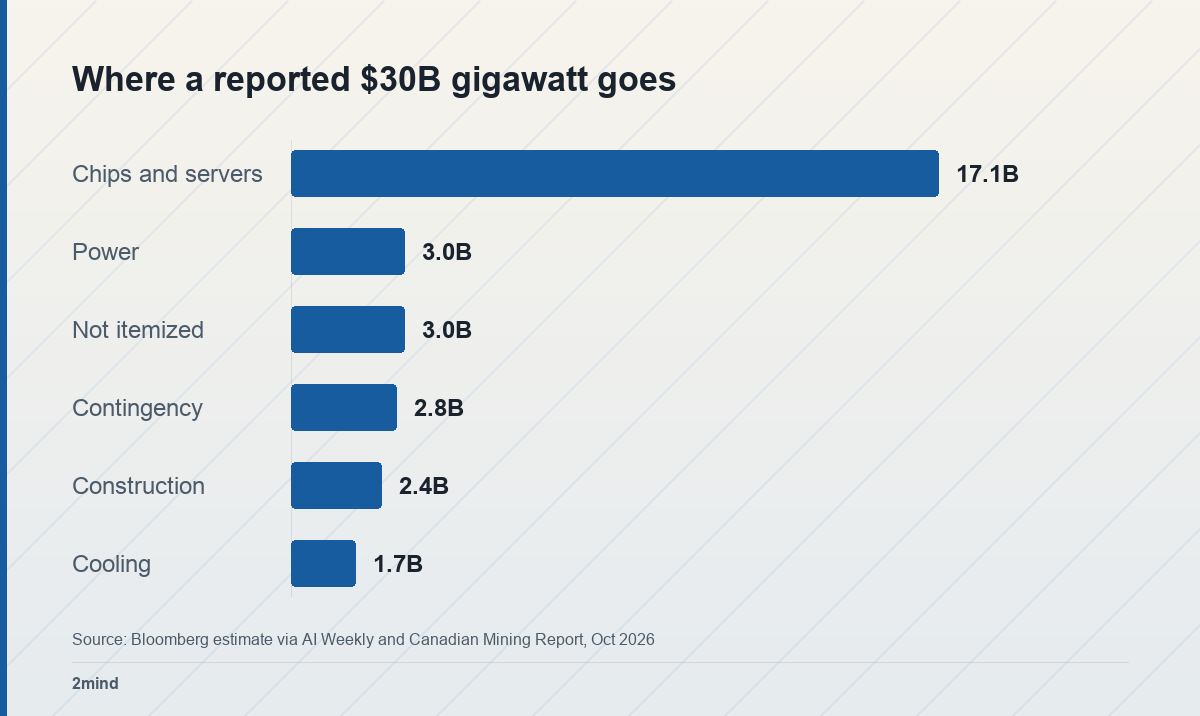
The breakdown drew on an exclusive cost estimate prepared with Cushman & Wakefield. Chips were put at about $17 billion, power infrastructure at $3 billion and shell and construction at $2.4 billion.
Bloomberg blamed compounding pressures. Steel and cement rose with trade wars and fuel costs, and the AI boom lifted chips and copper. Memory used in data centers costs more than five times what it did a year ago.
We could not open Bloomberg’s own article. Every Bloomberg figure here comes through the two summaries named in Sources.
The $30 Billion Ledger
A Canadian Mining Report column recounts Doan’s fuller split from a Bloomberg broadcast. We put those lines side by side and added the shares.
| Line | Reported $B | Share of $30B |
|---|---|---|
| Chips and servers | 17.1 | 57% |
| Power | 3.0 | 10% |
| Construction | 2.4 | 8% |
| Cooling | 1.7 | 6% |
| Contingency | 2.8 | 9% |
| Not itemized | 3.0 | 10% |
The first five lines sum to $27.0 billion. The last row is our subtraction: $30.0 billion minus $27.0 billion. The column says the remainder is smaller items such as network gear, engineering, land and commissioning.
That is a statement about one retelling. The column says these were spoken figures, a high-end sketch, not a contract.
Two numbers stand out:
- Chips cost $17.1 billion, against $12.9 billion for everything else ($30.0B minus $17.1B). That is about 1.3 dollars of chips for each dollar of building.
- Contingency, at $2.8 billion, is larger than cooling. Planners left more money for surprises than for the cooling plant.
Does the Building Cost Match Cushman & Wakefield’s Benchmark?
Not obviously. In its 2026 Data Center Development Cost Guide, released Sep 3, 2026, Cushman & Wakefield puts all-in greenfield costs in the United States and Canada at $17.6 million per megawatt, excluding chips and GPUs.
One gigawatt is 1,000 megawatts. Our arithmetic: $17.6M × 1,000 = $17.6 billion for the building alone at the national average.
Bloomberg’s non-chip total is $12.9 billion, or $12.9 million per megawatt. That sits about 27% below the national average, and Cushman says Texas ranks among the lowest-cost markets.
We do not claim the two reconcile. The guide’s categories and Bloomberg’s “high end” may be defined differently. The gap is a reason to ask which lines each number includes.
Power fits better. Cushman puts power infrastructure at an average of 21% of greenfield costs. Bloomberg’s $3.0 billion is 23% of its $12.9 billion non-chip total.
Two Lenses
The builder who needs the first check to clear
A developer sees $17 billion of chips and a $2.4 billion shell. The shell is the part they control, and it is the small part.
Their wish is for orders to keep coming. Dell’Oro Group’s forecast says global data center capex will pass $3 trillion by 2030, nearly double its January 2026 outlook.
The lender who owns the building, not the boxes
A lender financing the shell is paid by rent. The chips are paid for up front, and their earnings come later from use.
If use disappoints, the chip maker has already booked the sale. The owner of the room holds machines that must earn the interest on a very large bill.
Who Carries the Chip Risk?
This is our reading, not a reported fact. The 57% share means a gigawatt headline is mostly a bet on the computers, not on real estate.
Our look at when AI capex pays back argued that spending and payback run on different clocks. The ledger shows why. The biggest check clears first, and the earnings that justify it arrive years later.
Dell’Oro’s Baron Fung told Data Center Knowledge that accelerators should be about a third of the $3 trillion. Our arithmetic: one third of $3 trillion is about $1 trillion.
That is below the 57% chip share on the Abilene model. The two numbers measure different things. Dell’Oro counts accelerators across all data center capex, while Bloomberg’s line also includes servers.
Lease commitments add another layer, as we found in the $1.09 trillion of off-balance-sheet data center leases.
Bloomberg also reports that more than 60 gigawatts of this capacity is expected in the United States over four years. Multiplying 60 by $30 billion gives $1.8 trillion. The column makes the same multiplication and calls it a ceiling, because many sites will cost less and some will not be finished.
The Headline Check
You can test any “billions per gigawatt” claim in three steps. It needs a calculator and the source article.
- Find which lines are chips and servers, and which are power, shell and cooling. If the article does not say, treat the total as unexplained.
- Add the listed lines and compare the sum with the headline. Name the gap, as we did with the $3.0 billion.
- Divide the non-chip lines by the megawatts and compare with $17.6 million per megawatt. Ask what each side includes before calling the gap a bargain or a miss.
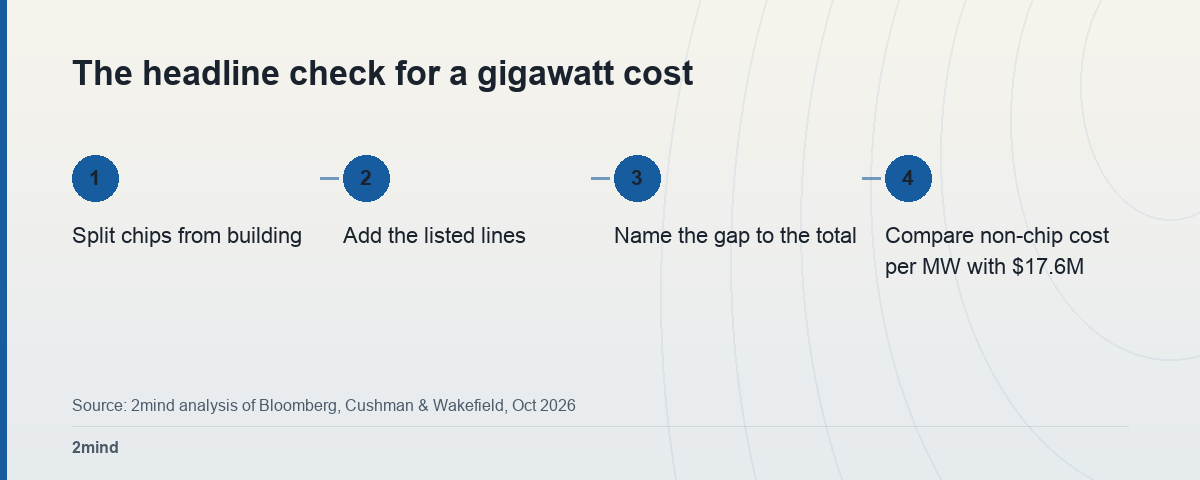
If step 1 fails, you have learned something cheaply. The number is a headline, not a budget.
What Would Change Our View
We would trust the chip share more if Bloomberg or Cushman & Wakefield published the full line-item table, including the $3.0 billion we cannot attribute.
We would read the building risk as larger if the 2030 power-equipment backlogs Bloomberg describes start delaying real sites. A delayed turbine is a cost that no chip order shows.
FAQ
Q. How much does a 1 gigawatt AI data center cost?
A. About $30 billion in Bloomberg’s high-end estimate for a theoretical Abilene site. Cushman & Wakefield’s separate national benchmark, excluding chips, implies about $17.6 billion for the building alone.
Q. How much of that goes to chips?
A. Roughly $17 billion, or about 57%, per the Bloomberg estimate as relayed by AI Weekly and Canadian Mining Report. We could not open Bloomberg’s original.
Q. Is the $30 billion the cost of OpenAI’s Abilene campus?
A. No. The column describes it as a model of a theoretical site, not a receipt from that campus.
Sources
- Bloomberg Pegs Abilene 1GW AI Data Center at $30B — AI Weekly, Oct 12, 2026
- Two Checks for One Gigawatt — Canadian Mining Report, Oct 2026
- 2026 Data Center Development Cost Guide — Cushman & Wakefield, Business Wire, Sep 3, 2026
- Data Center Capex Forecast Above $3 Trillion — Data Center Knowledge, Oct 2026
Leave a Reply