On July 10, 2026, Apple sued OpenAI in federal court, alleging trade secret theft tied to OpenAI’s consumer hardware effort. This post separates Apple’s allegations from OpenAI’s denials, tracks the case through the court docket as of October 2, and keeps the Waymo v. Uber comparison only where its figures can be sourced.
Key Takeaways
- Apple sued OpenAI, io Products and two individuals, Tang Tan and Chang Liu, on July 10, 2026 in the Northern District of California, alleging trade secret misappropriation and breach of contract.
- OpenAI denies wrongdoing and has moved to dismiss. Apple has moved for a preliminary injunction and expedited discovery. The docket lists no ruling on any of these motions through its last entries on October 1.
- The court moved the hearing on all three motions from October 1 to October 14, 2026 (September 14 minute entry), so the injunction question is still open.
What happened
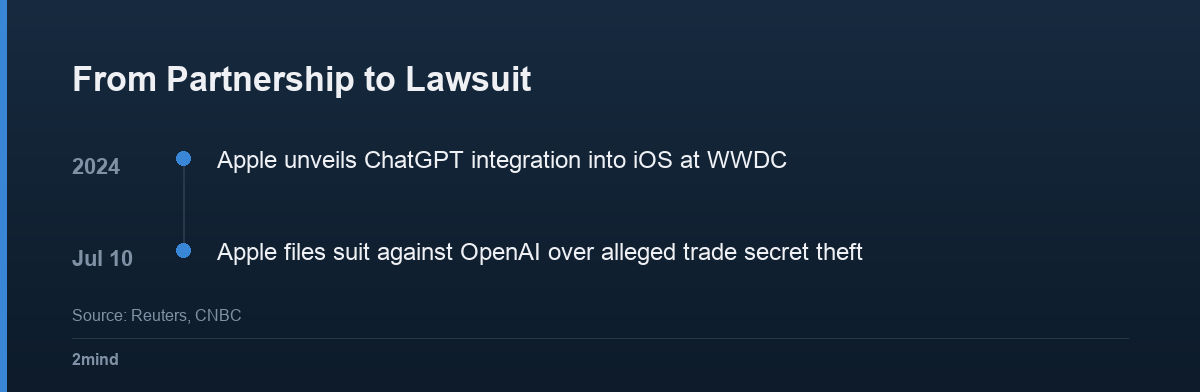
| 2024 | 2026 | |
|---|---|---|
| Public framing | Apple announces ChatGPT integration into iPhones at WWDC | Apple sues OpenAI over alleged trade secret theft |
| Reported by | Apple’s WWDC keynote | TechCrunch, CNBC (July 10) |
Apple Inc. v. Liu et al. (case 5:26-cv-07078, N.D. Cal., San Jose) names OpenAI Foundation, OpenAI Group PBC, io Products, Tang Tan and Chang Liu. The complaint pleads trade secret misappropriation and breach of contract. Tan is OpenAI’s chief hardware officer and spent 24 years at Apple; Liu joined OpenAI in January 2026.
The dispute concerns OpenAI’s consumer hardware effort, not the ChatGPT integration announced in 2024. Apple’s injunction papers describe hardware, manufacturing and supplier information. OpenAI’s separate custom-chip work with Broadcom is covered in our earlier post.
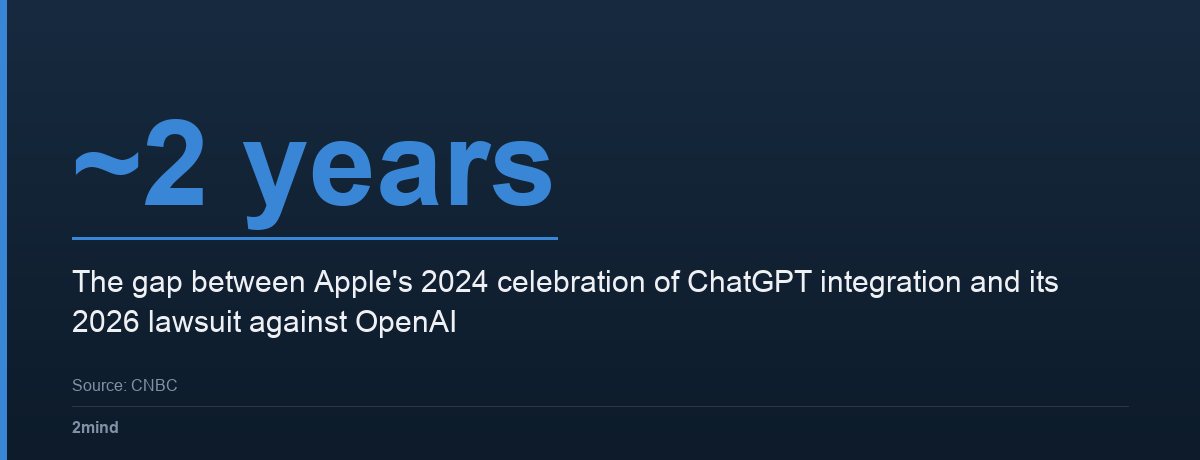
CNBC reports relations chilled after OpenAI announced its hardware plans last year, and that Apple’s updated Siri this fall is based on Google’s Gemini models rather than OpenAI’s technology. Apple did not say whether the suit affects the ChatGPT partnership.
These are allegations in a pending case, not findings. This is news analysis, not legal or investment advice.
What Apple alleges, and what OpenAI says
Each row pairs a main allegation with OpenAI’s reported response. Both columns are the parties’ own positions as reported; the court has decided none of them.
| Topic | Apple alleges | OpenAI responds |
|---|---|---|
| Tang Tan’s recruiting | Used Apple project code names while recruiting, asked candidates still at Apple to bring parts to interviews, and coached leavers on evading security (TechCrunch, CNBC) | Says its hardware chief followed industry-wide recruiting standards and told his team not to use other companies’ confidential information (Claims Journal/Bloomberg, MacRumors) |
| Chang Liu’s access | Used leftover access to Apple’s cloud storage on at least five occasions to download confidential files, and did not return an Apple laptop (Apple’s motion, TechCrunch) | Says Apple employees asked Liu for help after he left, and an Apple manager stayed logged into his personal iCloud account (TechCrunch, Aug 6) |
| Metal finishing | Says OpenAI had a manufacturing partner use an Apple-invented finishing process while misleading the partner about permission (CNBC) | Says Apple has not specified which trade secrets are at issue and calls its categories generic (TechCrunch, Aug 6) |
| February letter | Says it wrote to OpenAI in February and got no response (TechCrunch) | Says Apple’s counsel emailed the wrong person and it heard nothing for five months (MacRumors) |
| 400 former Apple staff | Complaint says more than 400 former Apple employees now work at OpenAI (MacRumors) | Says it wants to hire the best engineers and calls the suit pretextual (TechCrunch, Claims Journal) |
Where the case stands (docket through October 1, 2026)
The CourtListener docket for Apple Inc. v. Liu lists the steps below. A ruling on the motions would appear as a new entry; none is listed through the last filing on October 1.
| Date (2026) | Step | Docket entry |
|---|---|---|
| Jul 10 | Apple files the complaint | Dkt. 1 |
| Aug 3-4 | Apple moves for a preliminary injunction and for expedited discovery | Dkt. 38, 49 |
| Aug 5 | OpenAI, io Products, Tan and Liu move to dismiss | Dkt. 59 |
| Aug 31 | Defendants file their opposition to the injunction | Dkt. 97 |
| Sep 14 | Status conference; hearing on all three motions moved from Oct 1 to Oct 14, 9:00 a.m. | Dkt. 145 |
| Sep 17 | Apple files its reply with expert declarations | Dkt. 152, 153 |
| Sep 24 | Defendants file objections to Apple’s reply evidence (9to5Mac: asks the court to strike two declarations) | Dkt. 167 |
Apple’s proposed order would bar defendants from using or disclosing Apple confidential information, require forensic imaging of their devices and repositories within 28 days, and require return of any Apple material, pending trial (Dkt. 38-1). The court weighs four factors: likely success, irreparable harm, balance of equities and public interest.
The September 14 entry also says the court “agrees re narrowed requests” on discovery and ordered a joint statement by September 18. Coverage written before then still gives October 1 as the hearing date. CourtListener’s copy can lag PACER, so check PACER for anything after October 1.
Waymo v. Uber: one past data point, with its inputs
Waymo v. Uber (2017-2018) was a trade secret case over self-driving technology. NBC News reported Waymo sought $1.9 billion and settled for an equity stake worth $245 million. IPWatchdog reported the settlement came during trial, before the fifth day of testimony.
The $245 million depends on the valuation used. CNBC priced Uber’s 0.34% stake at about $245 million on a $72 billion valuation. Bloomberg noted that at SoftBank’s $54 billion blended valuation it was worth $184 million. Against $1.9 billion, that is 12.9% or 9.7%.
| Waymo v. Uber (2017-2018) | Apple v. OpenAI (2026) | |
|---|---|---|
| Damages sought | $1.9B (NBC News) | No amount reported; Apple seeks damages and injunctions (CNBC) |
| Outcome | Settled for 0.34% of Uber: $184M-$245M depending on valuation | No ruling or settlement on the docket through Oct 1 |
| Stage reached | Settled during trial | Motions to dismiss and for an injunction pending |
One case is a data point, not a base rate, and it does not predict this outcome. It does matter procedurally: Apple’s injunction brief cites the Waymo court’s May 2017 preliminary-injunction ruling for the point that guarding against misuse early is better than enjoining technology after trial (Dkt. 38).
Two Lenses
Apple’s position
“at every level, from members of its Technical Staff to its Chief Hardware Officer, and in coordination with business partners, OpenAI has been stealing Apple’s trade secrets,” the filing says (CNBC). Apple calls this “the tip of the iceberg” and says its investigation is ongoing (TechCrunch).
OpenAI’s position
“We have no interest in other companies’ trade secrets” (CNBC). Its motion calls the suit “baseless and pretextual” (Claims Journal/Bloomberg) and argues Apple’s own offboarding and security practices weaken its claim that the information is a protected trade secret (TechCrunch, Aug 6).
Three facts in the record would test these positions most. Each is checkable as the case moves, and none has been resolved yet.
- Specificity. Whether Apple identifies concrete trade secrets, which OpenAI says it has not done (TechCrunch, Aug 6).
- Protection measures. Whether Apple’s offboarding and cloud-account practices meet the reasonable-measures element, which OpenAI contests; Apple’s expert declarations address its security practices (9to5Mac, Sep 25).
- Forensics. What inspections of devices, cloud storage, email and messaging platforms show, if the court allows expedited discovery. Apple says OpenAI agreed to some of its five requested terms but not all (9to5Mac, Aug 4).
Why it matters
The filings argue over two operational details any employer can check: what access former employees keep after they leave, and what candidates are asked to bring to interviews. That is a checklist drawn from the disputed facts, not legal advice or a finding about either company.
What to watch next: the October 14, 2026 hearing on the injunction, expedited discovery and dismissal motions (Dkt. 145), any sealing rulings that reveal which trade secrets are at issue, and whether the court narrows the discovery Apple wants.
FAQ
Q. What exactly is Apple accusing OpenAI of doing?
A. Apple alleges that OpenAI, io Products, Tang Tan and Chang Liu misappropriated trade secrets about unreleased products, manufacturing processes and suppliers, and that Tan and Liu breached their agreements with Apple. OpenAI denies wrongdoing. Some technical details remain sealed.
Q. Does this affect the ChatGPT integration currently in iPhones?
A. None of the coverage we reviewed reports a change. Apple did not say whether the suit affects the partnership, which includes ChatGPT in Apple Intelligence (CNBC). The claims concern OpenAI’s hardware effort, not the current software feature.
Q. Has the court ruled yet?
A. The docket lists no ruling through October 1, 2026. The hearing on Apple’s injunction motion moved from October 1 to October 14.
What would change our view
If the court grants the injunction, it will have found Apple likely to succeed on at least some claims. That is a preliminary finding, not a final judgment, and it would strengthen Apple’s account. A denial or a dismissal would not by itself show the allegations are false.
A settlement before discovery would leave both accounts untested. Forensic findings, a ruling on which trade secrets are adequately identified, or unsealed exhibits would test them.
Sources
- [Apple suing OpenAI over alleged trade secret theft] — CNBC
- [Uber settles trade secret case with Waymo for $245 million] — IPWatchdog
- Apple sues OpenAI over alleged trade secret theft — TechCrunch, July 10, 2026
- Apple sues OpenAI alleging trade secret theft, says scheme was ‘at every level’ — CNBC, July 10, 2026
- Apple Inc. v. Liu, 5:26-cv-07078 (N.D. Cal.) docket — CourtListener/RECAP, entries through Oct 1, 2026
- Apple’s motion for a preliminary injunction (Dkt. 38, redacted) — N.D. Cal. filing, Aug 3, 2026
- OpenAI Posts Public Rebuttal to Apple’s Trade Secrets Lawsuit — MacRumors, Aug 4, 2026
- Apple moves for preliminary injunction in OpenAI trade secrets lawsuit — 9to5Mac, Aug 4, 2026
- OpenAI says Apple’s own security practices undermine its trade secrets case — TechCrunch, Aug 6, 2026
- OpenAI Asks Judge to Toss Apple’s Trade Secrets Lawsuit — Claims Journal (Bloomberg), Aug 7, 2026
- OpenAI accuses Apple of improperly adding new evidence to trade secrets case — 9to5Mac, Sep 25, 2026
- Uber, Waymo reach $245 million settlement in self-driving car trade secrets case — NBC News, Feb 9, 2018
- Uber-Waymo lawsuit settlement — CNBC, Feb 9, 2018
- Uber Agrees to Pay Waymo $245 Million Equity to Settle Suit — Bloomberg via IndustryWeek, Feb 12, 2018
Leave a Reply