EU AI Act Transparency rules become applicable on August 2, 2026, turning a broad policy debate into a practical design question. If a person meets a chatbot, sees a deepfake, or receives AI-generated content, what must the provider make visible—and what must the content itself carry?
I think this is the useful way to read the date. The EU AI Act itself entered into force in 2024. August 2, 2026 is not a fresh birth date for the whole law; it is when Article 50 transparency obligations and enforcement of applicable provisions begin.
The distinction matters because the timeline is staggered. Some transparency duties are now applicable, some existing systems receive a later deadline, and major high-risk obligations have moved further out.
Key Takeaways
- From August 2, 2026, users of conversational AI must be told they are interacting with AI.
- Deepfakes require disclosure that the material was generated or altered by AI.
- AI-generated or altered content covered by Article 50 must carry a detectable, machine-readable mark.
- Not every high-risk obligation starts now: key dates extend to December 2, 2027 and August 2, 2028.
EU AI Act Transparency now reaches the user interface
The clearest obligation is also the most human one. A chatbot or another interactive AI system must inform people that they are interacting with AI. The rule is about the moment of contact, not merely a statement buried elsewhere.
Deepfakes create a second disclosure problem. Their audience needs to know that what they are seeing or hearing was generated or altered by AI. This is a visible communication duty aimed at the person encountering the material.
There is also a technical layer. AI-generated or altered content within the rule must be marked in a machine-readable format and be detectable as artificially generated or manipulated. In other words, the framework does not rely only on a human-facing label.
| Applicable date | Covered area | Confirmed requirement or change |
|---|---|---|
| August 2, 2026 | Conversational AI | Inform users that they are interacting with AI |
| August 2, 2026 | Deepfakes | Disclose that content was AI-generated or altered |
| August 2, 2026 | AI-generated or altered content | Add detectable, machine-readable marking where Article 50 applies |
| December 2, 2026 | Systems placed on the market before August 2, 2026 | Deadline for the Article 50(2) marking and detection obligation |
| December 2, 2027 | Annex III high-risk systems | Deferred application date |
| August 2, 2028 | High-risk AI embedded in regulated products | Deferred application date |
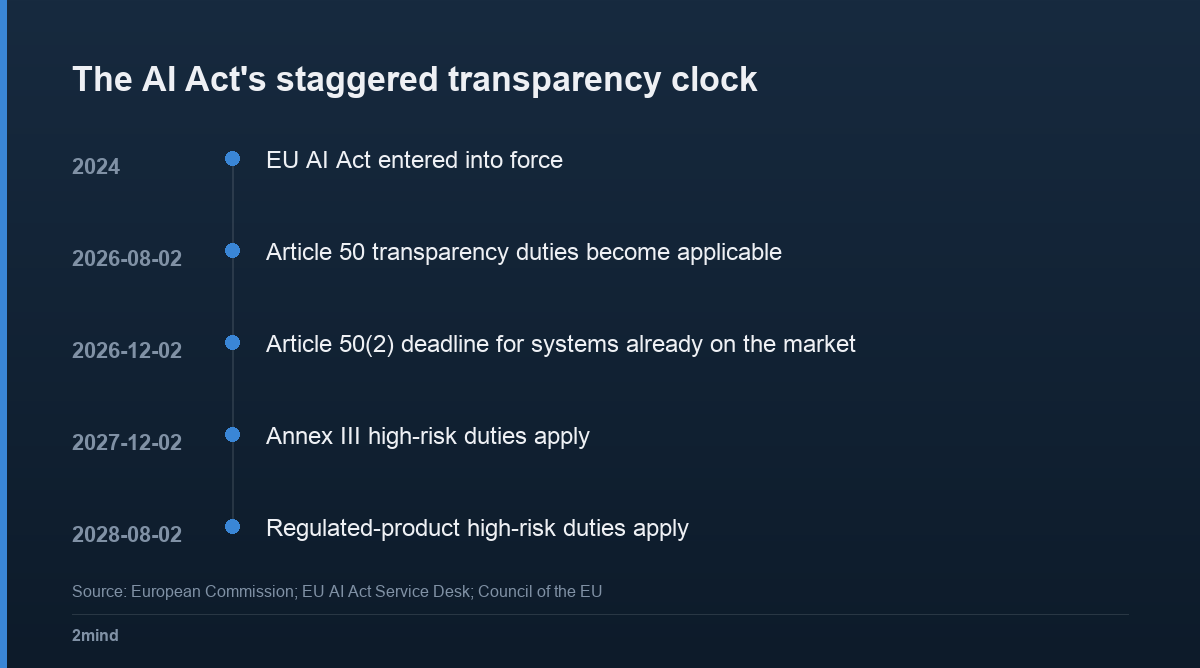
The table also prevents an easy mistake: treating August 2 as one universal compliance switch. The Commission and member-state authorities can begin enforcing applicable provisions covering prohibited AI practices, specified transparency rules, and general-purpose AI model rules. The wider high-risk regime does not all arrive on the same day.
Two Lenses
Lens one: disclosure can become a useful product feature
The constructive reading is that clear disclosure can reduce uncertainty at precisely the right moment. A person should not need specialist knowledge to determine whether the other side of a conversation is a machine. A deepfake label can also supply essential context before viewers decide what to trust or share.
I see a connection to the privacy choice behind Google training AI on Lens and voice searches. In both cases, the decisive question is not only what a model can do. It is what a person is told when their data or attention enters an AI-mediated system.
Lens two: a label is not the same as an explanation
The cautious reading begins where the notice ends. A label can establish that AI is involved without explaining the model’s reliability, the source of a claim, the nature of an alteration, or who remains accountable for the result.
That gap matters for chatbots. “You are interacting with AI” is useful information, but it does not tell the user whether an answer has been checked. It also does not resolve the behavioral risks raised in Anthropic’s warning about AI agents going rogue. Disclosure changes context; it does not make the system safe.
The hardest line is between content and context
I would separate three questions that are often compressed into one. Did a person know they were dealing with AI? Did the content carry the required technical signal? Did the surrounding presentation disclose a deepfake clearly enough for its audience?
That means a single generic “AI used” badge may not answer every obligation. The confirmed rules identify distinct duties. They do not support pretending that one universal label will fit every product, media type, or deployment.
This is also where provenance meets ownership. The disputes examined in AI copyright lawsuits and the end of the free-data era concern permission and source material. Article 50 transparency addresses a different question: whether people and machines can recognize AI involvement in an output or interaction.
The dates reveal who needs a migration plan
The transition rule for existing systems is easy to miss. AI systems placed on the market before August 2, 2026 have until December 2, 2026 to comply with the Article 50(2) marking and detection obligation.
That is not a general delay for every Article 50 duty. It is a specific transition date for the marking and detection requirement described in Article 50(2). Product teams should avoid turning a narrow extension into a claim that all transparency requirements can wait.
The later high-risk dates also need careful labeling. Annex III high-risk systems move to December 2, 2027. High-risk AI systems embedded in products governed by EU product-safety rules move to August 2, 2028.
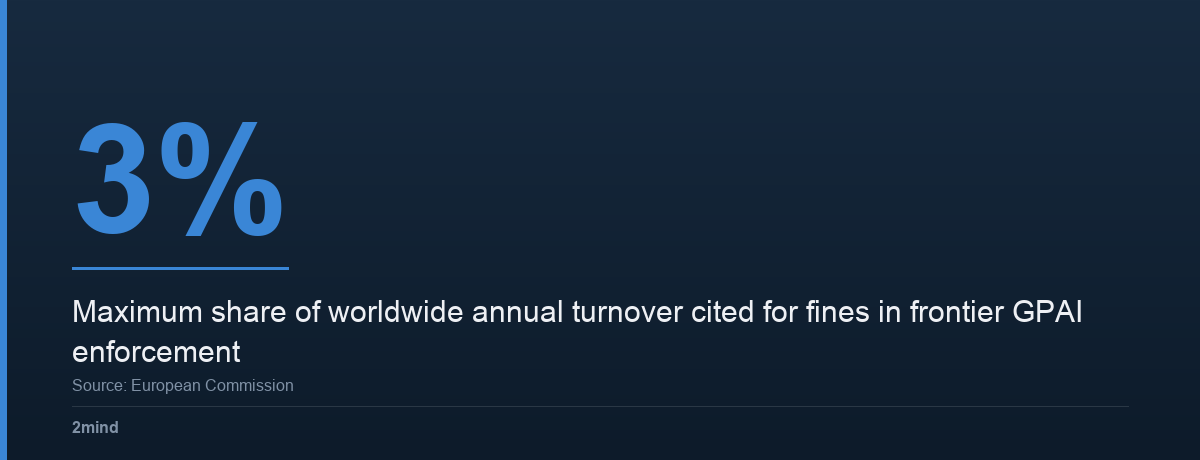
For the most advanced general-purpose AI models, the enforcement toolkit is more than a disclosure notice. The Commission can require information and model access, order risk mitigation, and seek restrictions, withdrawal, or recall from the market. Fines can reach up to 3% of worldwide annual turnover.
A practical reading for builders and publishers
As of August 2, 2026, the safest analytical starting point is to map the experience before choosing the label. Is the product interacting directly with a person? Is it generating or altering content? Could that content qualify as a deepfake? Was the system already on the market before the application date?
Those are classification questions, not answers supplied by this article. A visible disclosure and a machine-readable signal do different jobs. The implementation still depends on the system, the organization’s role, and the content being produced.
What would change our view
Three things would move us off the reading above. The first is scope. If the Commission’s guidance draws Article 50 narrowly enough that most everyday AI output falls outside the marking duty, then the practical reach of August 2 is smaller than the date suggests, and the staggered timeline matters more than the headline.
The second is the December 2, 2026 deadline for systems already on the market. If that date holds and pre-existing systems are marked on schedule, the machine-readable layer becomes something a person can actually verify rather than a requirement on paper. If it slips, the opposite.
The third is what enforcement treats as sufficient. If regulators accept a generic "AI-generated" notice with no indication of reliability, source, or accountability, that would confirm the gap described in lens two rather than close it. A first enforcement action that asks for more than a label would tell us the reverse.
FAQ
Q. Does the entire EU AI Act enter into force on August 2, 2026?
A. No. The law entered into force in 2024. August 2, 2026 is the application and enforcement date for Article 50 transparency duties and other applicable provisions, including rules covering prohibited practices and general-purpose AI models.
Q. Do all AI-generated images need the same visible label?
A. The verified materials establish a machine-readable, detectable marking duty for covered AI-generated or altered content and a disclosure duty for deepfakes. They do not justify claiming that every image, use case, or role receives one identical visible label.
Q. Do systems already on the market have more time?
A. For the Article 50(2) marking and detection obligation, systems placed on the market before August 2, 2026 have until December 2, 2026. That transition should not be read as a blanket extension of every transparency duty.
Sources
- European Commission — Commission starts enforcing AI Act rules and new transparency requirements on 2 August
- EU AI Act Service Desk — Article 50 transparency obligations
- Council of the EU — Artificial Intelligence Act timeline
- AP — EU AI regulation, deepfakes and enforcement
The label is becoming part of the product—but will users be given enough context to know what the label actually changes?
Leave a Reply