KLA AI chip inspection is not the glamorous end of the artificial-intelligence story. It sits behind the models, accelerators and data centers, checking whether increasingly complicated chips can actually be manufactured at useful yields. KLA’s latest results suggest that this less visible layer is becoming more valuable as the AI buildout becomes harder.
The company reported its fiscal fourth-quarter results after the U.S. market closed on July 28.
Quarterly revenue reached $3.658 billion, up from $3.175 billion a year earlier, while GAAP net income rose to $1.363 billion from $1.203 billion, according to KLA’s earnings release. Those are strong numbers.
But the more interesting signal is where management says the demand is coming from: leading-edge foundry and logic, more demanding memory, and advanced packaging for AI infrastructure.
Key Takeaways
- KLA’s quarterly revenue reached $3.658 billion, compared with $3.175 billion in the year-earlier quarter, according to the company’s release.
- Management connected demand for process control to more sophisticated leading-edge designs, tighter memory specifications and advanced packaging used in AI infrastructure, according to the same primary source.
- The next quarter’s revenue midpoint is $4.0 billion, with a stated range of $3.8 billion to $4.2 billion, according to KLA’s guidance. The opportunity is expanding, but so is the market’s dependence on continued AI capital spending.
KLA AI chip inspection, in plain English
A cutting-edge semiconductor is not produced by drawing a design once and pressing “make.” Manufacturing adds layer after layer to a wafer, and tiny defects can turn an expensive chip into unusable material. KLA sells process-control and process-enabling systems used across wafers, reticles, integrated circuits, packaging and printed circuit boards, as the company explains in its business description.
That job becomes more important when chipmakers push toward denser designs or combine components through advanced packaging. Each manufacturing step creates another place where a defect can appear. KLA is therefore selling into greater manufacturing difficulty, not simply “more chips.”
I think this distinction matters. AI demand is often discussed as a volume story: more accelerators, more memory and more data centers. KLA’s results frame it as a complexity story too.
Even if the number of finished chips were unchanged, harder designs could require more inspection, measurement and control during production.
Management explicitly said that the number and sophistication of leading-edge designs, rising memory requirements and advanced packaging are driving demand for its process-control portfolio in the July 28 release.
The quarter behind the signal
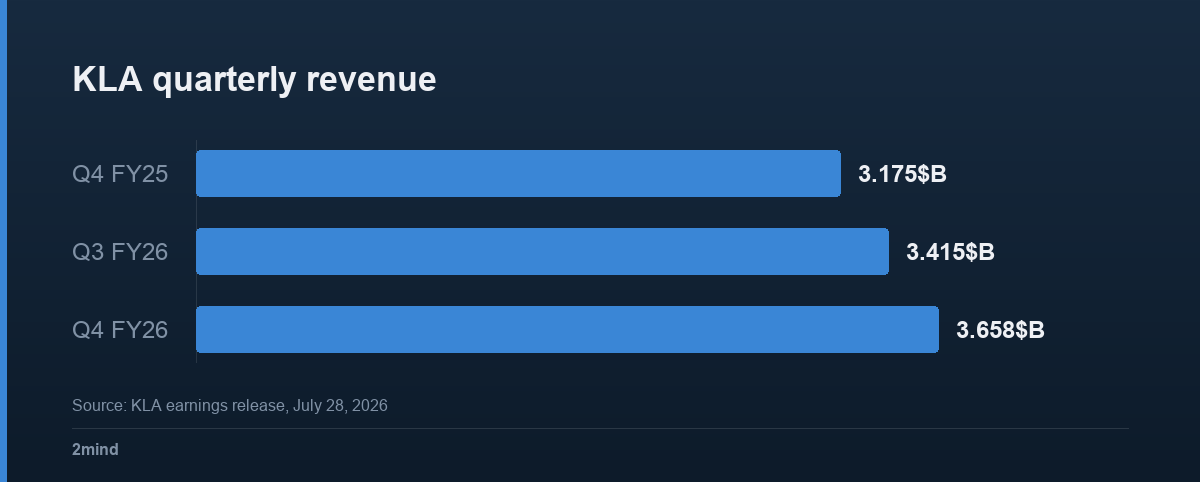
The reported quarter gives that argument financial weight. Revenue was $3.658 billion, compared with $3.415 billion in the preceding quarter and $3.175 billion in the comparable prior-year quarter, according to KLA’s GAAP results table.
GAAP diluted earnings per share were $1.04, versus $0.91 in both comparison periods; KLA notes that per-share figures were adjusted for its stock split in the same release.
Cash generation was substantial as well. Operating cash flow was $906.4 million for the quarter, and KLA’s non-GAAP free-cash-flow measure was $817.1 million, according to the company reconciliation. For the full fiscal year, KLA reported $13.58 billion of revenue and $4.83 billion of GAAP net income in its official results.
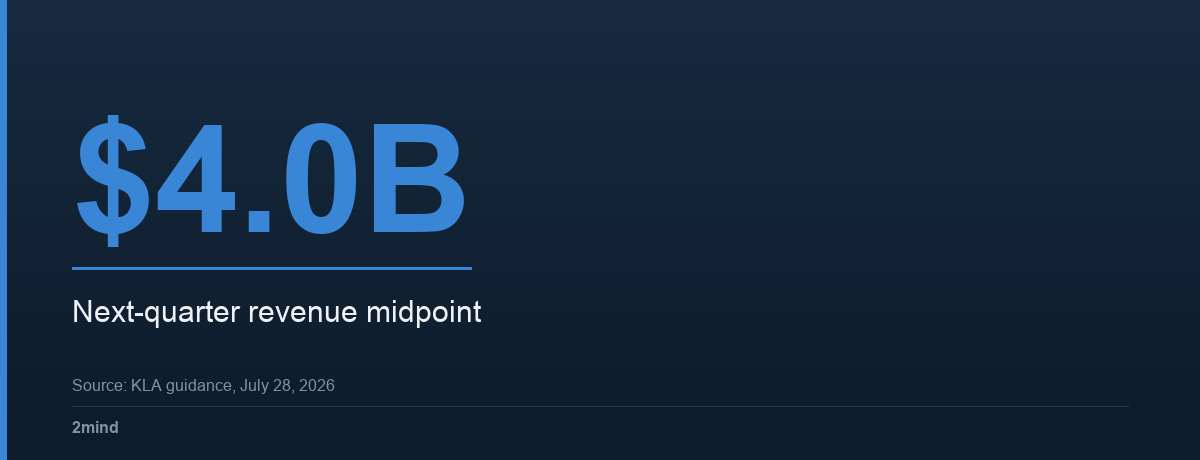
The forward view is stronger than the just-finished quarter. KLA guided to $4.0 billion of revenue, plus or minus $200 million, for the quarter ending in September, according to its published outlook.
It also projected GAAP gross margin of 61.6%, plus or minus one percentage point, and GAAP diluted earnings per share of $1.14, plus or minus $0.10, in that same outlook.
| Metric | Reported quarter | Comparison or outlook | Verified source |
|---|---|---|---|
| Revenue | $3.658B | $3.175B a year earlier | KLA results |
| GAAP net income | $1.363B | $1.203B a year earlier | KLA results |
| Operating cash flow | $906.4M | $4.143B for the fiscal year | KLA reconciliation |
| Next-quarter revenue | — | $4.0B ± $200M | KLA guidance |
Two Lenses: a tollbooth and a weather vane
The tollbooth view
Lens one — KLA sits at a checkpoint that complexity keeps widening. The optimistic reading is that KLA occupies a durable checkpoint in advanced semiconductor manufacturing. Model preferences can change quickly, but manufacturers still need to detect defects before valuable wafers become sellable chips.
AI may deepen that need because the infrastructure uses several demanding technologies at once: leading-edge logic, high-performance memory and advanced packaging.
KLA’s chief executive described the company as being on the “critical path” of AI infrastructure expansion and connected all three areas to process-control demand in the earnings announcement.
The language comes from management, so it should not be treated as independent proof. The reported revenue trajectory, however, gives it evidence.
This is why I see KLA as a tollbooth on complexity rather than a simple bet on volume. As designs become harder to manufacture, the cost of poor measurement rises.
The weather-vane view
Lens two — the same position makes it a proxy for someone else’s capex. The cautious reading starts in the same place.
A supplier tied to leading-edge foundry, memory and packaging spending can show where the AI capital cycle is heading, but it cannot escape that cycle.
KLA itself lists semiconductor-industry cyclicality, concentrated customers, changing investment patterns and U.S. restrictions affecting sales and service to certain customers in China among the risks in its forward-looking statement.
In other words, complexity can raise process-control intensity while customers are spending, yet a pause in fab or packaging investment can still delay orders. Strong guidance is management’s current expectation, not guaranteed revenue.
The company’s own stated range spans $3.8 billion to $4.2 billion for the next quarter, derived directly from the $4.0 billion midpoint and $200 million variation in its guidance.
Both views can be true. KLA can have an advantaged position inside a volatile investment cycle. That tension is more useful than labeling the report simply bullish or bearish.
The clue hidden behind bigger models
The AI debate tends to stop at compute demand. KLA adds another layer: manufacturing confidence. A new accelerator architecture is not economically meaningful merely because it performs well in a laboratory. It has to be produced reliably, combined with memory and packaged at scale.
That shifts the question I would ask about AI infrastructure. Instead of only asking how many chips buyers want, ask how difficult the next generation will be to manufacture. If difficulty rises faster than unit volume, process control may capture value without appearing in consumer-facing AI headlines.
There is also a useful limit to this interpretation. KLA does not disclose a standalone “AI revenue” figure in the July 28 earnings release. I would not convert management’s comments into a precise AI sales estimate. The evidence supports the direction of demand, not an exact division of revenue.
What would change our view
The tollbooth reading rests on process control staying necessary as designs get harder to manufacture. It would weaken if inspection intensity per wafer stopped rising — for example if customers found they could hold yields with less measurement, or if process-control spending grew more slowly than the wafer starts behind it.
The weather-vane reading would weaken in the opposite case: if KLA’s revenue held through a visible pause in leading-edge foundry, memory or packaging investment. That would suggest the position is more insulated from the capital cycle than a supplier’s usual exposure implies.
The company’s own risk disclosure names the things to watch — industry cyclicality, customer concentration, and U.S. restrictions on sales and service to certain customers in China. Guidance is management’s current expectation, not booked revenue, so the cleanest test is whether the next quarter lands inside the stated range without the range itself being walked down.
FAQ
Q. What does KLA do in the AI chip supply chain?
A. KLA provides process-control and process-enabling equipment and services used in semiconductor manufacturing, including wafer, reticle, integrated-circuit and packaging workflows, according to the company’s official description. In practical terms, its systems help manufacturers inspect, measure and control production as chip designs become more complex.
Q. Did KLA report how much revenue came directly from AI?
A. No standalone AI revenue amount appears in KLA’s July 28 earnings release. Management identified AI infrastructure as a driver across foundry and logic, memory, advanced packaging and services, but the reported financial tables do not separate those sales into a single AI line.
Sources
- KLA Corporation Reports Fiscal 2026 Fourth Quarter and Full Year Results — KLA Investor Relations, July 28, 2026
- KLA Announces Fourth Quarter Fiscal Year 2026 Earnings Date — KLA Investor Relations, July 1, 2026
- KLA Form 10-Q for the quarter ended March 31, 2026 — SEC filing
The visible AI race is about better models; the quieter contest may be over who can manufacture their hardware without losing control of the process.
Leave a Reply