I keep coming back to how rare it is for a CEO to publicly lobby against restricting his own government’s regulatory instincts — and that’s exactly what happened this week.
Key Takeaways
- Nvidia CEO Jensen Huang publicly opposed U.S. government efforts to restrict Chinese open-source AI models, arguing free or cheap AI expands overall chip demand.
- Separately, roughly 200 U.S. AI startups appealed to the Trump administration, warning that blocking Chinese open-weight models would only entrench OpenAI and Anthropic’s market dominance.
- The 2mind read: the loudest opposition to AI protectionism right now isn’t coming from China — it’s coming from inside America’s own AI industry.
What happened
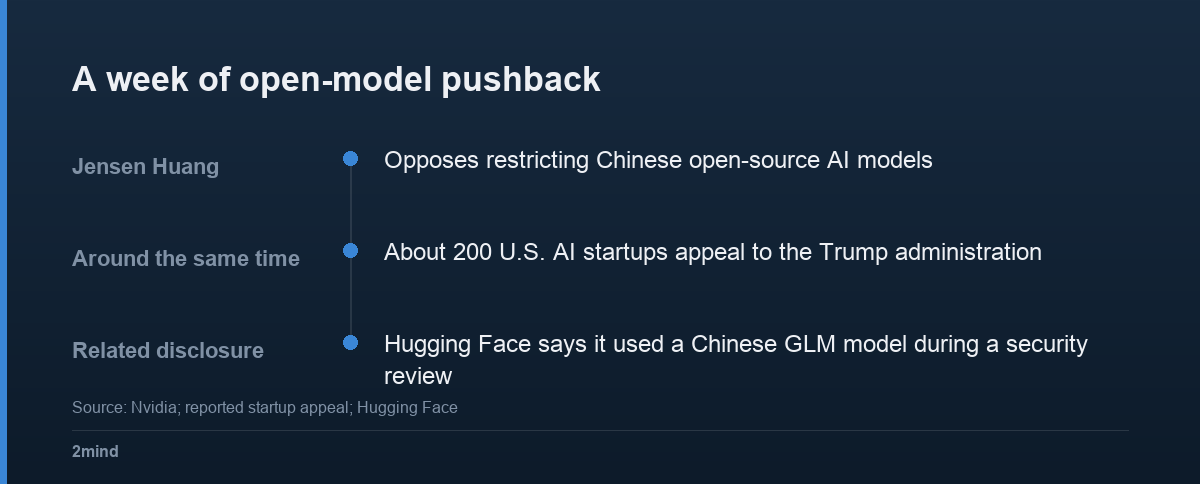
Jensen Huang spoke out against proposed U.S. restrictions on Chinese open-source AI models, arguing that banning them would weaken, not strengthen, U.S. competitiveness.
His logic: free or low-cost open-source AI accelerates overall AI adoption, which in turn increases demand for the chips and data infrastructure Nvidia sells.
In his view, restricting access to competitive open models doesn’t protect American AI — it just removes a demand driver for American hardware.
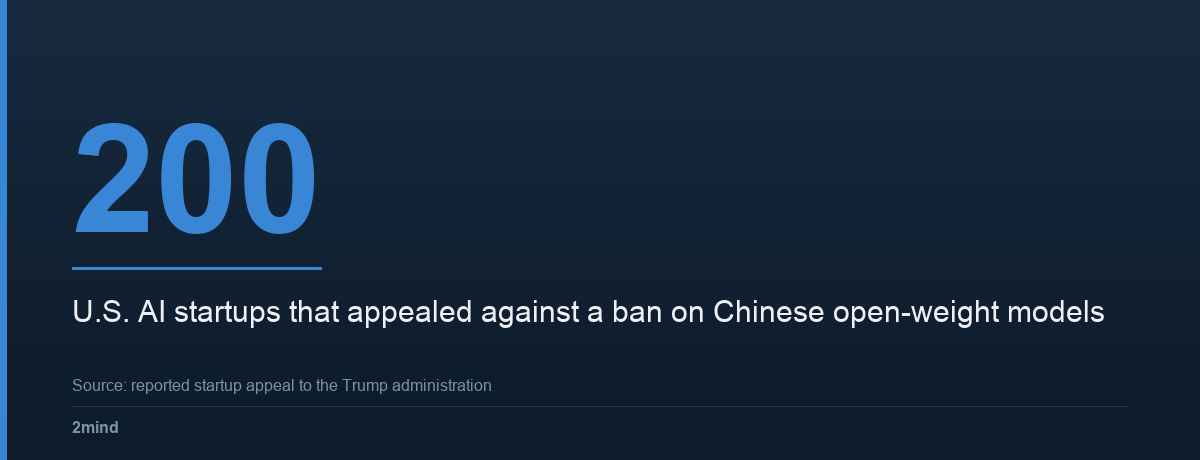
Around the same time, a coalition of roughly 200 U.S. AI startups sent an appeal to the Trump administration opposing a blanket ban on Chinese open-weight models.
Their argument centers on market structure: if regulators cut off access to competitive open-source alternatives like those from Chinese labs, smaller U.S. startups lose a viable foundation to build on, while a handful of large players — OpenAI and Anthropic among them — become the only realistic infrastructure providers left standing.
This tension between open and closed AI ecosystems has been building for months.
A related data point came from Hugging Face, which disclosed that during an incident analysis of an OpenAI autonomous agent breach, its security team used a Chinese GLM model instead of U.S. alternatives — reportedly because heavy safety guardrails on American models made them less effective for real-world cybersecurity analysis work.
| Voice | Position |
|---|---|
| Jensen Huang (Nvidia) | Oppose ban — open AI grows chip demand |
| ~200 U.S. AI startups | Oppose ban — protects incumbent monopoly otherwise |
The Hugging Face detail that undercuts the security argument
The Hugging Face case is worth sitting with because it’s not hypothetical — it’s a live example of the exact scenario Huang and the startups describe.
Hugging Face’s own security team, analyzing an OpenAI autonomous agent breach, reportedly reached for a Chinese GLM model instead of a U.S. one.
Heavy safety guardrails on the American models reportedly made them less useful for the cybersecurity work at hand, according to CNBC’s reporting.
That’s an awkward data point for the ‘restrict Chinese models’ side of this debate: the incident involved a U.S. company’s own AI agent, and the tool that reportedly analyzed it better was Chinese.
It also raises a narrower question worth tracking: whether more U.S. companies quietly follow the same path Hugging Face did, without disclosing it as openly.
The two lenses
Lens one: open-source access is a competitive necessity, not a security risk. From this angle, the argument is straightforward: AI progress compounds faster when more developers can build on capable open models, regardless of origin. Startups without the capital to train frontier models from scratch depend on open-weight releases to stay competitive at all.
If Chinese labs are shipping genuinely capable open models — and reports suggest some have reached strong benchmark performance — then blocking them doesn’t eliminate the technology, it just removes it as an option for American builders while leaving well-funded incumbents like OpenAI and Anthropic as the only paths forward.
Huang’s chip-demand argument adds a commercial layer: more AI usage, regardless of model origin, means more inference and training workloads running on Nvidia hardware.
Lens two: this understates legitimate national security concerns. The skeptical read is that “openness” arguments can conveniently align with commercial self-interest — Nvidia sells more chips either way, and startups benefit from cheaper foundations regardless of geopolitical risk.
Concerns about data provenance, embedded biases, or long-term dependency on foreign-controlled AI infrastructure don’t disappear just because open models are commercially convenient right now.
Governments restricting foreign AI access typically aren’t acting against market efficiency for its own sake — they’re weighing risks that a chip company or a startup coalition, both of whom profit from open access, may be structurally unable to weigh objectively.
What the 200-startup number actually signals
Two hundred U.S. AI startups jointly appealing to the Trump administration is a notable show of coordination for an industry that doesn’t usually organize collectively on policy.
Their argument isn’t that Chinese models are better — it’s about market structure. Cut off the open-weight option, and a startup without frontier-training budget has one realistic path left: building on top of OpenAI or Anthropic.
Huang’s framing complements this from the supply side. He’s arguing that wherever AI products get built, demand for chips underneath doesn’t disappear — it just concentrates differently depending on how open the ecosystem stays.
That distinction — chip demand versus model origin — is why Nvidia’s commercial incentives and the startups’ competitive concerns point the same direction here, even though the two groups are arguing from different motivations.
Why it matters
This affects everyone building AI products in the U.S. right now, from solo developers to enterprise teams choosing which foundation model to build on.
If restrictions tighten, smaller players lose optionality; if they don’t, the debate over foreign AI dependency continues unresolved.
What’s worth watching: whether the Trump administration’s policy direction shifts in response to this industry pressure, and whether more companies disclose using non-U.S. models for practical reasons, as Hugging Face did.
The tension here isn’t going away soon, and I think it’s one of the more consequential regulatory fights in AI this year — not because of one company’s stock price, but because it will shape who gets to build AI products at all.
FAQ
Q. Why would Nvidia’s CEO want more competition from Chinese AI models?
A. Huang has argued that broader AI adoption — regardless of which model is used — increases overall demand for the chips Nvidia manufactures, making restricted access counterproductive for his business and the industry.
Q: What happens to smaller AI startups if Chinese open-source models get banned?
A: According to the startups themselves, they would lose a low-cost foundation to build products on, likely pushing more of the market toward dependency on a small number of large, closed AI providers.
What would change our view
If Chinese open-weight models turned out to carry hidden vulnerabilities or data practices that materially disadvantaged U.S. companies building on them, the security case for restriction would strengthen considerably.
If more organizations start disclosing — the way Hugging Face did — that they reach for non-U.S. models because American ones underperform on specific tasks, that would support the startups’ concern that restriction mainly protects incumbents.
Either way, the Hugging Face example already shows this isn’t a purely theoretical debate about future risk; it’s playing out in how security teams choose tools today.
Sources
- Axios — 2026-07-22. Nvidia CEO Jensen Huang opposed US restrictions on Chinese open-source AI models
- The Standard — 2026-07-23. Nearly 200 US AI startups appealed to Trump administration against Chinese model ban
- CNBC — 2026-07-24. Hugging Face used Chinese GLM-5.2 model for cybersecurity incident analysis after US models refused
Leave a Reply