Decentralized AI inference is not automatically cheaper than centralized cloud inference. It becomes cheaper only when the lower compute quote survives four tests: measured throughput, tail latency, service reliability and the cost of verification and fallback.
Key Takeaways
- A decentralized GPU price is only an input; total cost also includes utilization, transfer, verification, fallback and operations.
- Bittensor is a subnet-specific incentive system. Its official documentation does not define one universal inference product or service-level promise.
- Render’s AI network may fit distributed-GPU workloads, but its public rendering price is not an LLM token price. Compare the same model and request mix, then record p95 latency, failures and fully loaded cost.
The first mistake is comparing the wrong unit
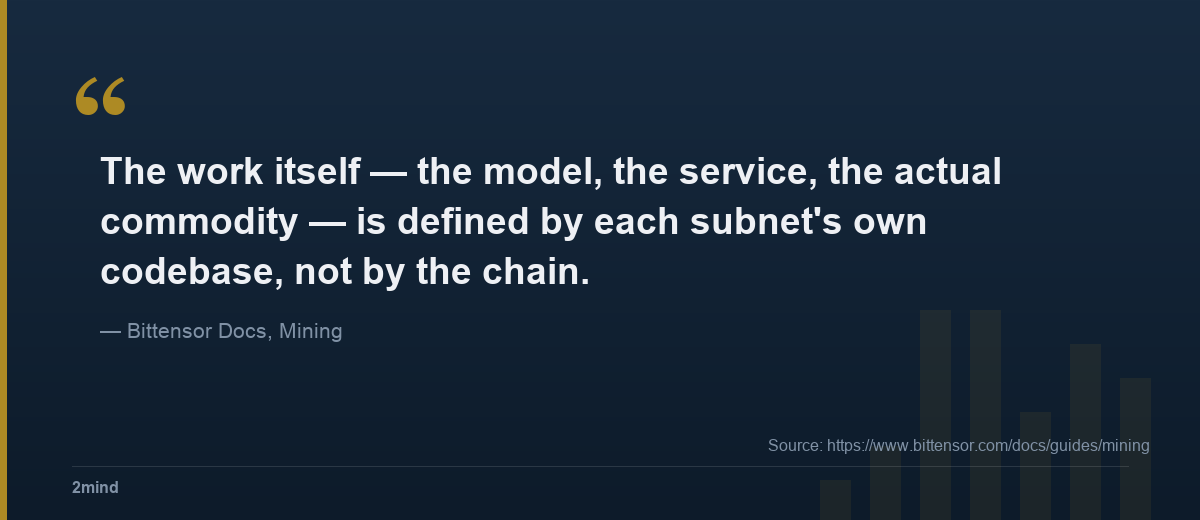
The word “decentralized” hides several different businesses. Bittensor’s mining guide says a miner performs whatever work a subnet’s incentive mechanism rewards. The model, service or actual commodity is defined by that subnet’s codebase, not by the chain. Validators then score miners, and emissions are distributed through the network’s rules.
That makes Bittensor closer to a market for task-specific AI services than to a single cloud GPU rental catalog. A subnet may reward inference, prediction, storage or another service. The buyer must inspect the subnet’s model, endpoint, validator logic and data handling before comparing it with an API.
Render is a different layer. Its official compute-client page says the network supports machine-learning training, inference, fine-tuning and generative AI imaging through an API. The Render Foundation describes a separate Compute Network that connects consumer-grade GPU operators with AI application developers.
Render’s public FAQ explains that its established rendering network prices jobs using OctaneBench and a fixed Euro rate per tier. That is workload-specific pricing, not evidence of a particular text-inference cost per million tokens.
| Question | Bittensor subnet | Render Compute Network | Centralized AI cloud |
|---|---|---|---|
| What is purchased? | A subnet-defined service or output | Distributed GPU capacity for supported AI work | A provider-defined API, instance or reserved capacity |
| How is work judged? | Validator scoring under that subnet’s rules | Node availability, completed work and workload-specific allocation | Provider benchmarks, monitoring and contract terms |
| What does the public price mean? | Emission and registration mechanics, not one universal API price | Render’s published rendering unit is OctaneBench; AI pricing must be checked separately | A quote still needs utilization, egress and operational assumptions |
| Main question before use | Is this subnet’s service good enough? | Can the network meet the model’s latency and data needs? | How much are reliability and lock-in worth? |
A lower GPU bill can still produce a higher inference cost
The unit that matters is not the GPU’s hourly price. It is the cost of delivering an acceptable answer. A practical estimate is:
Effective cost per 1M tokens = compute charge ÷ (measured tokens per second × utilization × 3,600) + network + verification + fallback + operations.
The formula is deliberately plain. If a cheaper provider delivers fewer tokens per second, the apparent saving may disappear. If it has uneven availability, a reserved fallback becomes part of the cost. If requests contain sensitive data, secure routing, isolation and review are not optional extras.
This is the part that connects to our earlier look at why AI inference costs keep rising even as the price per token falls. A cheaper model call can encourage more calls, longer contexts and more agentic loops. A cheaper GPU route can create its own overhead through routing, health checks and recovery.
| Gate | The question to measure | A failed test looks like |
|---|---|---|
| Workload fit | Can the job tolerate batch execution, variable nodes or a warm-up period? | A real-time product is sent to a route designed for flexible background work |
| Throughput | What tokens-per-second result appears with the same model, precision, context and batch size? | A low hourly quote hides lower useful output |
| Tail latency | What happens at p95 and p99, not only in the average? | Most requests are fine, but the slow tail breaks the user experience |
| Trust and recovery | Who can see the prompt, verify the output and take over when a node fails? | The system has no clear privacy boundary or fallback path |
Two Lenses
Lens one: Buy the spare capacity you can actually measure
The useful reading is practical rather than ideological. Distributed networks can make idle GPUs available without asking every small team to buy and operate an enterprise fleet. Render’s own description of its Compute Network is aimed at AI builders that need inference, fine-tuning, data processing or edge workloads from distributed hardware.
That can be valuable for batch summarization, offline classification, image processing, open research and burst capacity. The buyer is not asking one GPU to behave like a managed global platform. The buyer is asking for a measurable job to finish at an acceptable fully loaded cost.
It is a supply option to test when a centralized provider is capacity-constrained or expensive, especially if the application keeps a managed fallback.
Lens two: Keep the cheap route from becoming the fragile route
The uncomfortable reading begins with the network between the GPUs. The Parallax paper identifies heterogeneous hardware, limited interconnect bandwidth and changing availability as central scheduling problems. A separate FusionAI study makes a similar design point: consumer GPUs are plentiful, but memory, bandwidth and device variability complicate large-model deployment.
The privacy question is more direct. Bittensor’s mining documentation says traffic passes through validators and miners with no confidentiality guarantee in either direction. That single sentence is enough to exclude unprotected customer prompts from a casual pilot. Render’s FAQ expresses the goal of user control, but a goal is not the same as a workload-specific security contract.
The trade is therefore familiar: more supply choice can reduce dependence on a few providers, while more moving parts can make reliability someone’s job that was previously hidden inside a cloud contract. The bill is lower only if the team is willing to measure and operate the new route.
The decision belongs to the workload, not the token
I would start with a representative request set, a fixed model version and the same output-quality rule on both routes. I would record throughput, p50/p95 latency, errors, data transfer, verification and operating attention.
Then I would split the result by use case. A retryable background job may tolerate a node leaving; a customer-facing assistant may not. A private document classifier may need a stronger data boundary than a public-image pipeline.
The four clocks behind AI capital payback also help. Add a recovery clock: how quickly can the system move to a known-good provider?
The smallest useful conclusion is not “decentralized wins” or “cloud wins.” It is a routing rule: use the distributed path when the workload is measurable, tolerant of variation and protected by a tested fallback; use the managed path when latency, privacy or accountability is the product.
What would change our view
I would become more confident in a decentralized inference cost claim when a provider publishes a reproducible comparison using the same model, precision, context length, batch size, network assumptions and uptime target as the centralized baseline. The result should include p95 latency, failed work and the cost of the fallback route, not only a spot GPU quote.
I would become more cautious if the claim stayed attached to a token chart, a registration incentive or a rendering benchmark while the actual AI endpoint remained undefined. A lower entry price can attract supply. It cannot, on its own, prove that a production answer is cheaper to deliver.
FAQ
Q. Is Bittensor a cheaper replacement for AWS inference?
A. Not as one universal product. Each subnet defines its work and incentives, so compare a specific subnet, model, endpoint and workload.
Q. Is Render Network the same as Bittensor?
A. No. Render connects GPU operators and requestors, with a rendering network and a newer AI Compute Network. Bittensor organizes subnet-specific services around validator scoring and emissions.
Q. What is the cheapest way to run AI inference?
A. There is no honest answer without the model and workload. Measure useful throughput, tail latency, reliability, data movement, verification and fallback together.
Q. Can decentralized inference protect private prompts?
A. It can be designed with stronger privacy, but decentralization alone does not prove protection. Bittensor’s documentation explicitly warns that traffic has no confidentiality guarantee, so sensitive data needs a verified security boundary.
Sources
- Bittensor Docs, “Mining” — subnet-defined work, validator path, availability and confidentiality warning
- Bittensor Docs, “Emissions” — how TAO and alpha are distributed through subnets
- Render Network, “Participate as a Compute Client” — AI inference, fine-tuning and compute-client API scope
- Render Foundation, “Frequently Asked Questions” — distributed GPU compute, AI workloads and OctaneBench rendering pricing
- Tong et al., “Parallax: Efficient LLM Inference Service over Decentralized Environment” — scheduling heterogeneous volunteer GPUs for decentralized inference
- Tang et al., “FusionAI: Decentralized Training and Deploying LLMs with Massive Consumer-Level GPUs” — consumer-GPU memory, bandwidth and heterogeneity constraints
Leave a Reply