Microsoft is no longer OpenAI’s exclusive partner. Since April 27, 2026, Microsoft’s license to OpenAI’s models has been non-exclusive, and OpenAI can sell its products through any cloud provider, including Amazon and Google.
What has not changed is the money. OpenAI still owes Microsoft a revenue share through 2030, and Microsoft still holds IP rights to OpenAI’s models through 2032 — even as Microsoft now ships its own reasoning model, built without a line of OpenAI’s training data.
The two facts sit uneasily together. Microsoft spent eight months negotiating its way out of exclusivity, then spent the same eight months making sure the old deal’s money still flows.
Key Takeaways
- Microsoft’s OpenAI license flipped from exclusive to non-exclusive on April 27, 2026 — the first break in an exclusivity arrangement that had held since 2019.
- OpenAI still pays Microsoft a revenue share through 2030, and Microsoft’s IP access to OpenAI’s models runs through 2032.
- Microsoft shipped its own reasoning model, MAI-Thinking-1, on June 2, 2026, trained “without distillation from third-party models” — a direct reference to not copying OpenAI’s outputs.
- OpenAI supplied about $24.1 billion, roughly 70% of Microsoft’s FY2026 AI revenue — detailed here — the same relationship Microsoft is now building an alternative to.
What Actually Changed in Microsoft’s OpenAI Contract?
We read Microsoft’s own blog posts from October 2025, February 2026, and April 2026 side by side, plus the June 2026 Build keynote, to line up what each one actually changed rather than restated.
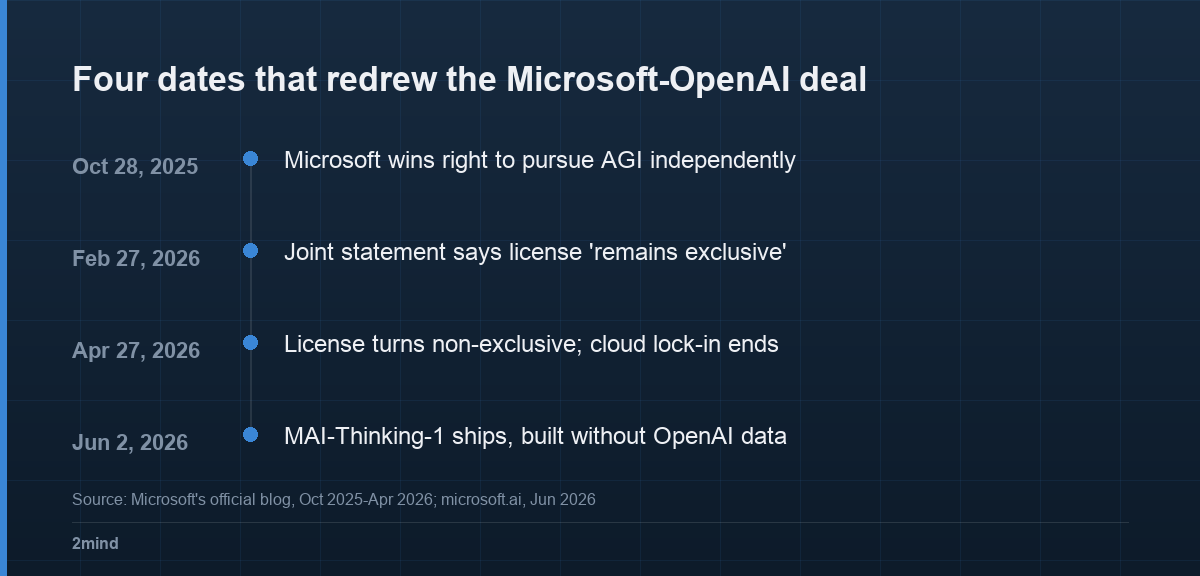
Four dates carry the whole story. Each one moved a different lever: who owns what, who pays whom, or who gets to build what.
On October 28, 2025, Microsoft’s blog confirmed the company “can now independently pursue AGI alone or in partnership with third parties.” That single clause is why MAI-Thinking-1 could exist eight months later without breaching any agreement.
The same October announcement extended Microsoft’s IP rights through 2032, including rights to OpenAI’s post-AGI models, in exchange for Microsoft’s stake settling near 27%, valued at roughly $135 billion.
Four months later, nothing had moved yet. Microsoft and OpenAI’s February 27, 2026 joint statement said plainly that “Microsoft maintains its exclusive license and access to intellectual property across OpenAI models and products.”
Two months after that, the exclusivity clause broke. Microsoft’s own April 27, 2026 post confirmed: “Microsoft’s license will now be non-exclusive,” and OpenAI could serve customers “across any cloud provider.”
| Date | What changed | Who gained ground |
|---|---|---|
| Oct 28, 2025 | Microsoft won the right to pursue AGI independently; IP extended to 2032 | Microsoft |
| Feb 27, 2026 | Joint statement confirmed the license “remains exclusive” | Status quo held |
| Apr 27, 2026 | License turned non-exclusive; OpenAI can sell on any cloud | OpenAI |
| Jun 2, 2026 | Microsoft shipped MAI-Thinking-1, trained without OpenAI data | Microsoft |
| Now | OpenAI still supplied ~70% of Microsoft’s FY2026 AI revenue | Both |
Read top to bottom, the pattern is a trade: Microsoft gave up its exclusive claim on OpenAI’s technology, and got, in the same round of changes, the contractual room to stop needing it.
Two Lenses
Building the exit before you have to use it
Microsoft’s own language for MAI-Thinking-1 is specific: the model was trained “from the ground up on clean, traceable and enterprise-grade data, without distillation from third-party models.” That is a direct answer to a dependency risk, not a marketing line.
Microsoft’s chief communications officer, Frank X. Shaw, framed it the same way in a public post: OpenAI “has a huge role for us AND we are building frontier models for specific things we want to do as well.” The company is not choosing between the two paths — it is funding both at once.
Custom AI accelerators are part of the same logic. Microsoft has said its newest Maia chip generation delivers up to 40% efficiency-per-watt gains over its prior generation, lowering the cost of running any model — OpenAI’s or its own — at scale.
Cashing the check while you build the exit
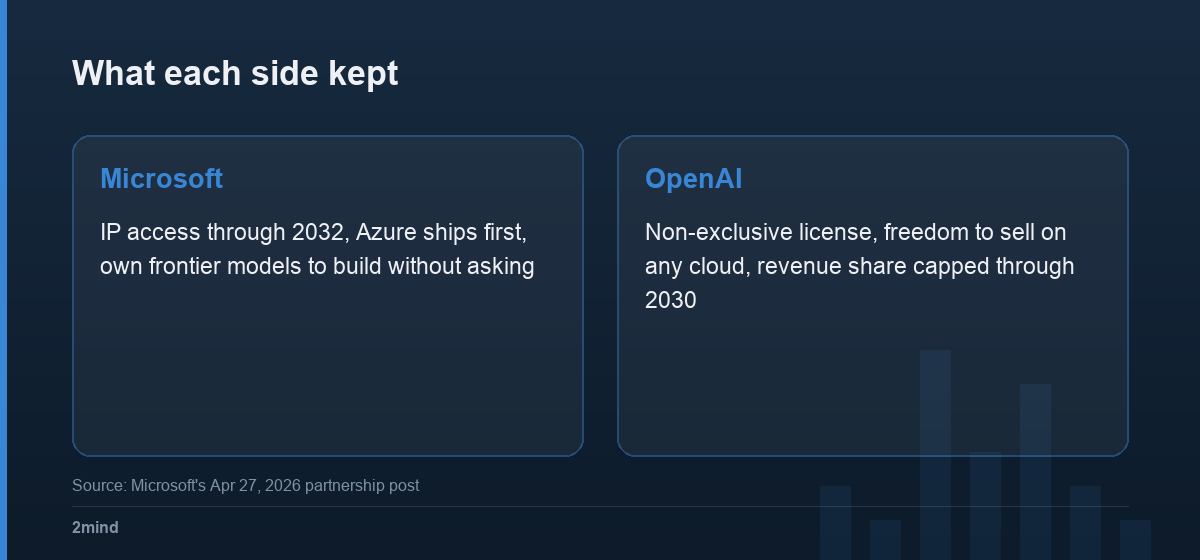
None of that independence work has touched the revenue Microsoft already collects. OpenAI’s payments to Microsoft continue through 2030, unchanged in percentage, only capped in total — Microsoft still keeps the growth it already priced in.
Azure also kept a privileged position that the April amendment did not remove: OpenAI’s products still “ship first on Azure, unless Microsoft cannot and chooses not to support the necessary capabilities.” Multi-cloud freedom is OpenAI’s on paper; in practice, Azure is still first in line.
Microsoft’s own FY2026 disclosures put a number on how much that first-in-line position is worth: OpenAI accounted for roughly 70% of Microsoft’s AI revenue. Building an alternative supplier is a hedge, not yet a replacement.
Does Giving Up Exclusivity Cost Microsoft Money?
Not directly, and not yet. The April 2026 change removed Microsoft’s exclusive IP license, but it did not cut the dollar amount OpenAI already owes through 2030 — it only stopped that amount from growing indefinitely with OpenAI’s revenue.
The cost, if there is one, is competitive rather than contractual. OpenAI can now build products on AWS or Google Cloud that used to be Azure-only, giving rival cloud providers a foothold with a customer Microsoft used to fully control.
Three questions sort a future Microsoft-OpenAI headline from noise:
- Does it touch the 2032 IP license, or only where training data comes from? Those are different questions with different answers today.
- Does money move between the two companies, or only get capped? The April 2026 change was a cap, not a cut.
- Does a new Microsoft model replace OpenAI in a shipping product, or run alongside it? MAI-Thinking-1 launched as an option in Microsoft Foundry, not a Copilot swap.
What would change our view
If Microsoft moved a flagship Copilot product off OpenAI’s models entirely and onto MAI-Thinking-1, that would be a materially stronger signal than a parallel model sitting in a developer catalog.
If the independent panel verifies that OpenAI has reached AGI before 2030, Microsoft’s research IP rights shift onto a different clock entirely — worth watching regardless of which company reports it first.
FAQ
Q. Is Microsoft still OpenAI’s exclusive cloud provider?
A. No. As of April 27, 2026, OpenAI can serve products through any cloud provider. Microsoft kept a narrower right: OpenAI’s products still ship first on Azure unless Microsoft opts out of supporting them.
Q. Does Microsoft still make money from OpenAI?
A. Yes. OpenAI continues paying Microsoft a revenue share through 2030 at an unchanged percentage, now subject to a total cap. Microsoft’s FY2026 disclosures show OpenAI supplied about 70% of its AI revenue.
Q. Is MAI-Thinking-1 meant to replace OpenAI’s models inside Microsoft’s products?
A. Not yet, based on what Microsoft has said publicly. The company describes a “huge role” for OpenAI continuing alongside its own frontier models, launched for “specific things” rather than as a full swap.
Sources
- The next chapter of the Microsoft-OpenAI partnership — Microsoft, Oct 28, 2025
- Joint statement on continuing partnership — Microsoft, Feb 27, 2026
- The next phase of the Microsoft-OpenAI partnership — Microsoft, Apr 27, 2026
- Introducing MAI-Thinking-1 — Microsoft AI, Jun 2, 2026
- Microsoft’s AI sales mostly come from OpenAI — Bloomberg, Aug 5, 2026
- OpenAI shakes up partnership with Microsoft, capping revenue share — CNBC, Apr 27, 2026
Leave a Reply