Tether got its first full financial-statement audit on August 13, and the opinion was clean. KPMG U.S. found no exceptions in Tether International’s 2025 books. But the $6.8 billion reserve cushion that audit verified had already swung twice by the time the opinion became public — up, then down by half.
That’s not a scandal. It’s what an audit is: a photograph of one day, not a live feed. The confusion comes from treating “audited” and “always this solvent” as the same claim — a distinction that matters for what actually backs a stablecoin more broadly, not just for Tether.
Key Takeaways
- KPMG’s unqualified opinion covers Tether International, S.A. de C.V., for the year ended December 31, 2025, and found a $6.814 billion reserve surplus.
- Tether’s own next two quarterly attestations show that surplus rose to $8.23 billion on March 31, 2026, then fell to $4.11 billion on June 30, 2026 — a 50.1% drop in one quarter.
- The audit checked one legal entity and one balance-sheet date. It did not cover Tether’s wider holding structure or any disclosure made after December 31, 2025.
- USDT’s circulating supply grew from roughly $144 billion to $184 billion during the eight months between the audited date and the announcement.
What Did KPMG Actually Check?
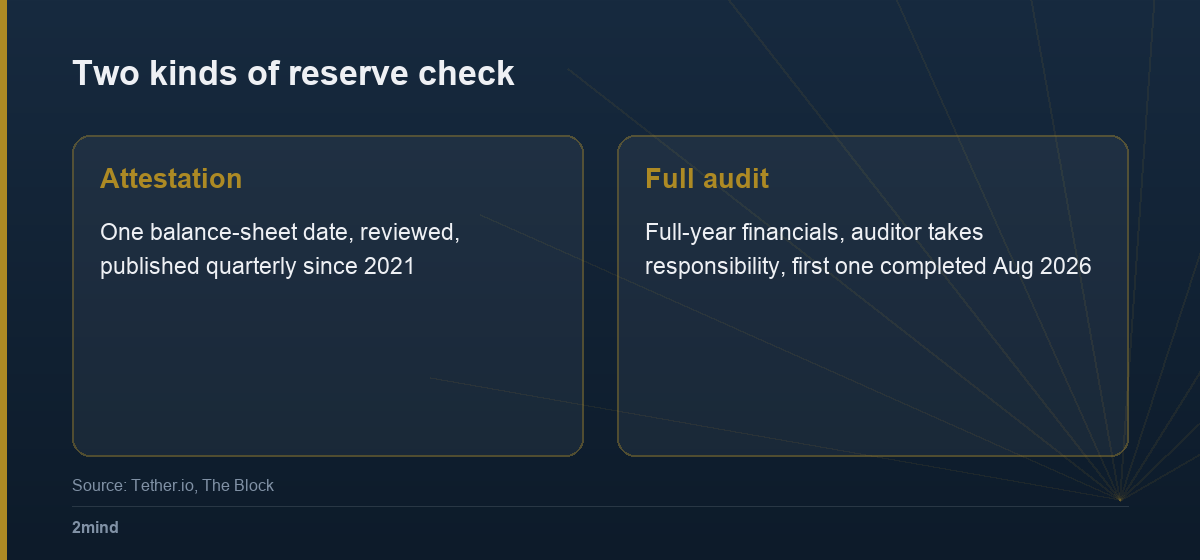
An attestation, the kind Tether has published quarterly since 2021, confirms reserves matched liabilities on one date. It’s reviewed, not audited under full accounting standards. An audit goes further: it examines internal controls across the year and the auditor takes professional responsibility for the opinion.
KPMG’s audit covered the full balance sheet, income statement, changes in equity, and cash flows for Tether International in 2025. Fieldwork reportedly included a physical count of the company’s gold bars. The opinion was unqualified — the strongest rating an auditor can give.
| Basis | Attestation | This audit |
|---|---|---|
| Coverage | One balance-sheet date | Full-year financials |
| Verifier stance | Reviewed, not certified | Auditor takes legal responsibility |
| Frequency | Quarterly | First-ever, one-off so far |
| Entity scope | Tether Group figures | Tether International only |
USD1, the stablecoin we covered when it won a preliminary bank charter this month, still has neither an audit nor Tether’s quarterly attestation history. Circle’s USDC, by contrast, has published audited annual reports since 2018 — this is Tether’s first, not the industry’s first.
The GENIUS Act, the federal stablecoin law enacted in July 2025, only requires audited annual financial statements from issuers with more than $50 billion outstanding. Tether, at roughly $184 billion, clears that bar. USD1 doesn’t yet — which is why its bank charter and Tether’s audit answer two different questions about the same word, “backed.”
Two Lenses
The urge to stop asking once the opinion is clean
A Big Four name attached to “unqualified” is exactly the signal skeptics have demanded from Tether for a decade. CEO Paolo Ardoino called it a “defining moment,” adding that “for years, some detractors said an audit of Tether could not be completed.”
For a reader who has watched Tether face insolvency accusations since 2017, a clean opinion from KPMG is enough to close the question.
The discipline to keep checking, because the number moves faster than the audits
The same reserve figure the audit certified changed twice within two quarters. Nothing in the audit was wrong — it was accurate on December 31, 2025.
But a stablecoin issuer’s solvency isn’t a fact confirmed once a year. It’s a number that moves with Treasury yields, redemptions, and new issuance every week. One clean opinion buys trust in the process, not a permanent guarantee about the balance.
How Much Did the Buffer Move in Six Months?
Line up Tether’s own three most recent disclosures and the trend isn’t a straight line. It’s a swing.
- December 31, 2025 (KPMG audit): reserves exceeded liabilities by $6.814 billion.
- March 31, 2026 (BDO attestation): the buffer rose to $8.23 billion, up about 20.8% from the audited figure.
- June 30, 2026 (BDO attestation): the buffer fell to $4.11 billion, down about 50.1% from three months earlier.
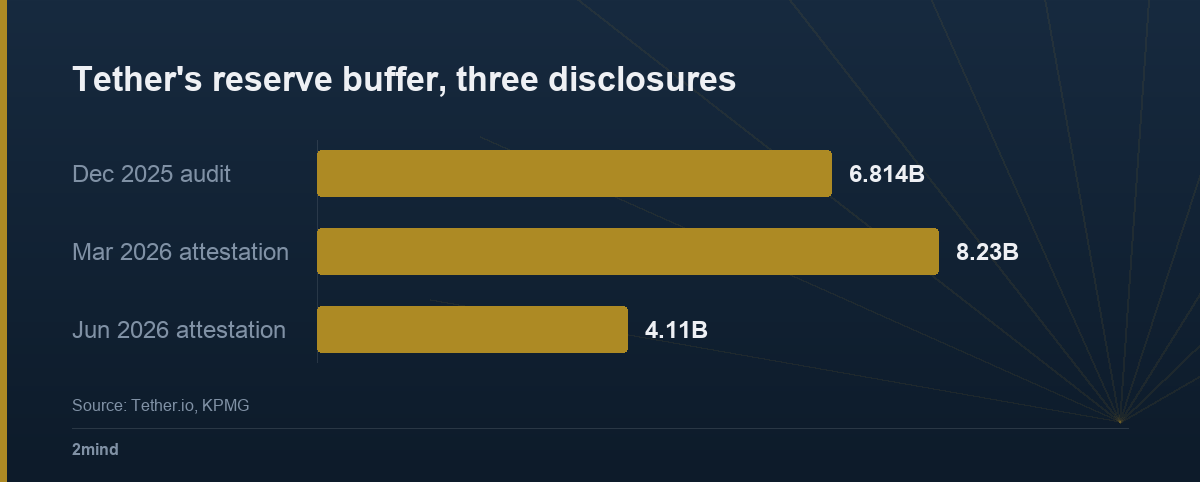
Our calculation: dividing Tether’s three disclosed totals gives a rise of about 20.8% from the audit to Q1, then a fall of about 50.1% from Q1 to Q2 — figures Tether has not itself stated as percentages in any release.
Tether has not published a line-item account of where the Q2 drop came from. Its own release for that quarter reported $1.5 billion in net operating profit, plus growing gold and bitcoin holdings.
That makes a shrinking dollar buffer look less like distress and more like a shift in what backs the tokens. But “looks like” isn’t the same as a disclosed reconciliation.
What Doesn’t This Audit Cover?
Three gaps matter for anyone reading the headline as “Tether is now fully verified.”
The audit covers Tether International specifically, the USDT issuer, not every entity in Tether’s wider corporate structure. Intra-group transactions between those entities aren’t part of this opinion.
The full audit report, including notes and key audit matters, hasn’t been made public. Outside reviewers are working from Tether’s summary announcement, not the underlying document KPMG signed.
“Secured loans” — reserve assets backed by collateral rather than cash or Treasuries — remain a disclosure gray area. Tether said in 2023 it would eliminate this category. A 2024 filing still showed billions outstanding, and neither the audit summary nor the Q2 attestation breaks out the current figure.
Reading the audit and the two attestations side by side is also the fastest way to see why a single certified number can’t answer a question that keeps changing. That’s the same lesson our stablecoin reserve pillar piece makes about redemption rights: what backs a stablecoin is a live claim, not a fixed fact you check once.
What would change our view
If Tether publishes the full audit report with entity-level and related-party detail, or moves to auditing every quarter instead of once, that would close most of the gap between “audited” and “continuously verified.”
If the reserve buffer keeps swinging by 40–50% a quarter without an explanation of what moved, that would weigh against treating any single snapshot — audited or not — as a stable answer.
FAQ
Q. Is Tether audited or just attested?
A. Both, at different times. Tether has published quarterly attestations since 2021 and completed its first full audit, covering fiscal year 2025, in August 2026.
Q. Does the audit mean USDT is fully backed right now?
A. It confirms USDT was fully backed, with a $6.814 billion surplus, on December 31, 2025. Later attestations show that surplus has since moved by tens of percent.
Q. Why did Tether’s reserve buffer fall 50% in one quarter?
A. Tether has not published a line-item breakdown. Its Q2 2026 release points to $1.5 billion in operating profit and expanded gold and bitcoin holdings during the same period.
Sources
- Tether completes first inaugural audit — Tether.io, Aug 2026
- Tether Q2 2026 results, $4.11B buffer — Tether.io, Jul 2026
- Tether says KPMG issued clean opinion — The Block, Aug 2026
- Tether posts $1.5B profit, buffer halves — CoinDesk, Jul 2026
- Tether’s transparency issues aren’t over — Odaily, Aug 2026
- GENIUS Act $50B audit threshold — S.1582, GENIUS Act text
Leave a Reply