
Key Takeaways
- Michael Saylor said at BTC Prague on June 14, 2026: “I said to you, never sell your Bitcoin. I never said that the company wouldn’t sell its Bitcoin.”
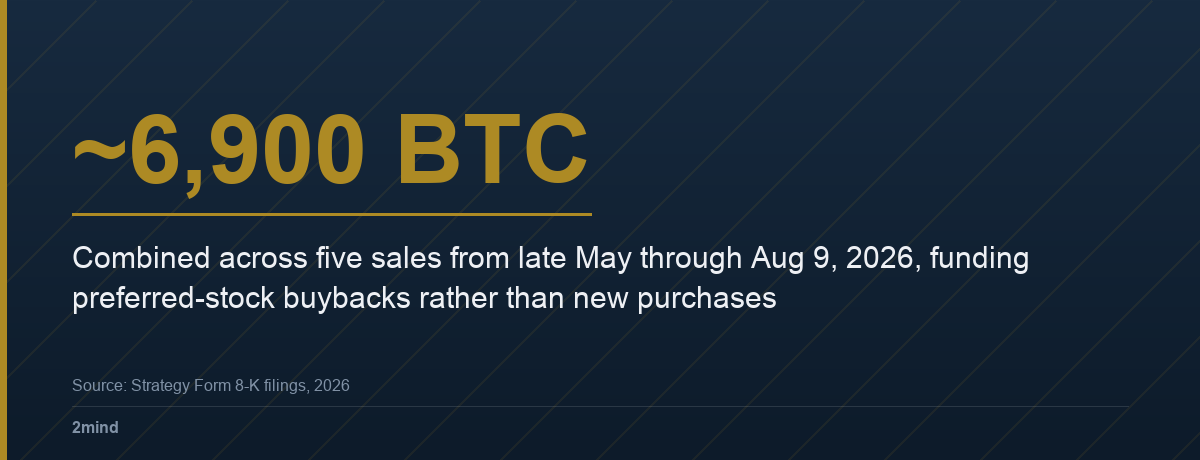
- Strategy sold roughly 6,900 BTC (about $431 million) across five separate sales between late May and August 9, 2026 — all below its average cost of $75,385 per coin.
- The US Strategic Bitcoin Reserve’s “will not be sold” rule comes from Executive Order 14233 (signed March 6, 2025), which a future president could reverse without Congress.
- Only the BITCOIN Act (S.954, still pending) would convert that reserve rule from an order into a statute.
“Never sell your Bitcoin” has been said by a president, a corporate chairman, and — implicitly — a company built entirely on that idea. Only one of the three has kept it clean, and that is the one nobody can actually verify: Michael Saylor’s personal holdings.
Strategy, his company, sold bitcoin in five separate transactions between May and August 2026. The US government has not sold, but its no-sell rule sits in an executive order, not a law.
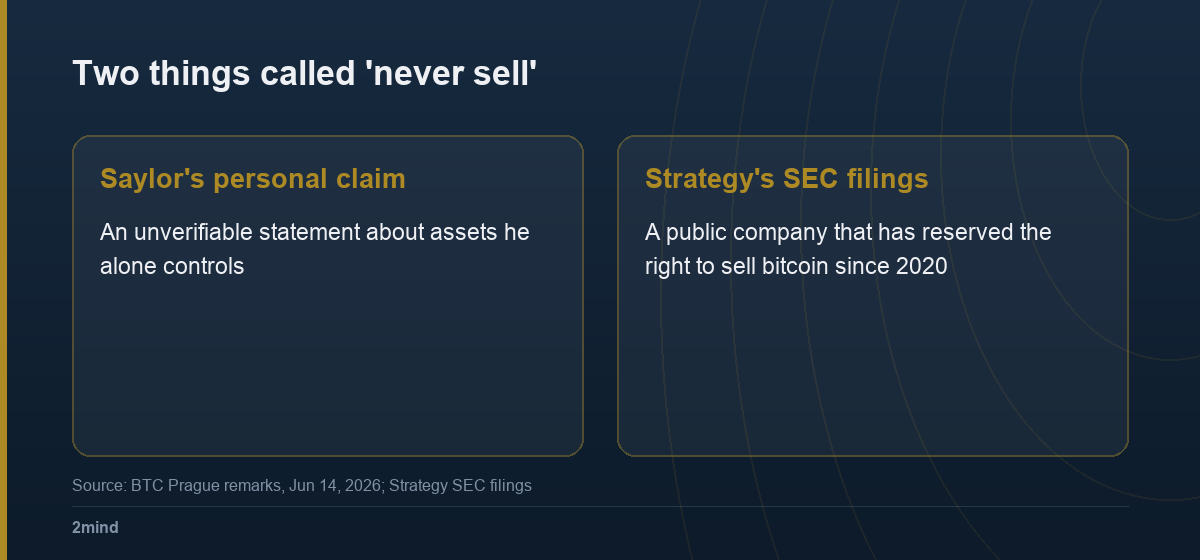
These are not the same promise. Confusing them is why every Strategy sale reads online as a betrayal, when the company’s own SEC filings have permitted sales since 2020.
What Does Each Pledge Actually Say?
Saylor’s version is the oldest and the most personal. He has repeated some form of “never sell your Bitcoin” at least five times since 2022, most recently in an Aug 3, 2026 post: “I have never sold mine. Not one satoshi… Strategy is not my wallet.”
Nobody outside Saylor can confirm that claim. It rests entirely on his word, because personal wallets are not disclosed the way a public company’s treasury is.
Strategy, the company, never made that promise in its own name. Its SEC filings have described bitcoin purchases and potential sales as part of “capital management” since 2020 — five years before this year’s sales started.
What changed in 2026 was frequency, not policy. A $1.0 billion Digital Credit Securities Repurchase Program, authorized June 29, 2026, gave the company a standing reason to sell bitcoin most weeks to fund preferred-stock buybacks — the same mechanism behind the deeper structural problem in its treasury model.
The government’s version is different again. On March 6, 2025, President Trump signed Executive Order 14233, which states that bitcoin deposited into the Strategic Bitcoin Reserve “will not be sold” and will be held as a US reserve asset.
At the same day’s White House Crypto Summit, Trump told the room: “America will follow the rule that every bitcoin holder knows very well — never sell your Bitcoin… I don’t know if that’s right or not. But so far it’s been right.”
He framed it as folk wisdom for the audience, even while signing an order that made a narrower, formal commitment for the government’s own holdings.
What Actually Binds Whom?
| Pledge | Who it binds | Legal weight | Sold since the pledge? |
|---|---|---|---|
| Saylor’s personal “never sell” | Only Saylor, by his own account | None — an unverifiable personal claim | No confirmed personal sale |
| Strategy’s treasury policy | The company, under SEC disclosure rules | Filings have permitted sales since 2020 | Yes — ~6,900 BTC since May 2026 |
| US Strategic Bitcoin Reserve | Federal agencies holding reserve BTC | Executive order — reversible by a future president | No sales reported to date |
The government’s reserve is not legally the strongest of the three, despite reading that way. An executive order carries the weight of the president who signed it and can be undone by the next one with a signature.
The Treasury has not published an audited count of reserve holdings. Independent trackers put the total anywhere from roughly 198,000 to 328,372 BTC, depending on how much forfeited bitcoin has finished moving from individual agencies into the consolidated reserve.
Why Do the Sales Still Feel Like a Broken Promise?
Strategy’s stock has traded below its net asset value in 2026, and each new 8-K filing showing a bitcoin sale gets read online as confirmation that “never sell” failed. That reaction assumes Strategy made a pledge it did not make.
What it actually promised, in writing, was that bitcoin would be central to its balance sheet — not that the position would never move.
We counted five separate sales in Strategy’s own 8-K filings from late May through August 9, 2026, totaling roughly 6,900 BTC, every one of them funding preferred-stock buybacks or dividends rather than covering a shortfall. None of the five filings describes a forced sale.
Three questions sort a “never sell” claim from an enforceable rule:
- Who is the subject? A person’s own wallet, a company’s disclosed treasury, or a government reserve — each carries a different obligation.
- Where is the promise written down? A stage quote has no legal weight. An SEC filing does. A statute outweighs an executive order.
- Who can undo it, and how easily? Saylor can only contradict himself. A board can amend a capital policy. A president can reverse an executive order with a signature; only Congress can repeal a law.
The confusion has a source. Saylor has spent years using “never sell” as a public slogan for the company he chairs, in interviews, on stage, and in the branding around Strategy’s bitcoin treasury.
The June 14 clarification — that the phrase was always personal advice, not a corporate guarantee — arrived only after the sales had already started drawing criticism.
Two Lenses
The promise was always about the person, not the balance sheet
Read narrowly, nothing has broken. Saylor’s personal claim is intact by his own account. Strategy’s filings never promised otherwise. The government’s reserve, the pledge with the most formal weight, has not sold anything.
Under this reading, “never sell bitcoin” was never a corporate or government commitment in the first place. It was a slogan borrowed from individual bitcoin holders and applied loosely to institutions that operate under different rules entirely.
A promise people rely on is a promise they think is binding
Read from the audience’s side, the distinction Saylor draws now is one he did not draw as clearly while the slogan was building Strategy’s brand. Retail shareholders who bought MSTR stock, and citizens who heard Trump’s line at the crypto summit, had no way to know in advance which “never sell” carried force of law.
The gap between what was implied and what was actually promised is where trust erodes — regardless of whether any rule was technically broken.
What would change our view
If Strategy sells bitcoin to cover a margin call, a missed debt payment, or anything outside its stated buyback-and-dividend use, that would be a materially different signal than the mechanical sales seen so far.
If the BITCOIN Act passes and the reserve’s no-sell rule becomes statute rather than executive order, the government’s pledge would move from reversible to binding — a real change in what “never sell” means at the federal level.
FAQ
Q. Has Michael Saylor personally ever sold bitcoin?
A. Not that has been publicly disclosed. He maintains he has not sold any personal bitcoin, but personal holdings are not filed with regulators, so this claim cannot be independently verified the way Strategy’s corporate sales can.
Q. Is Strategy’s bitcoin the same as Michael Saylor’s bitcoin?
A. No. Strategy’s holdings are corporate assets disclosed in SEC filings that have reserved the right to sell since 2020. Saylor’s “never sell” pledge, by his own June 2026 clarification, refers only to bitcoin he personally controls outside the company.
Q. Could the US government still sell its Bitcoin reserve?
A. Yes. The “will not be sold” rule comes from Executive Order 14233, not a law passed by Congress. A future president could reverse it without new legislation; the pending BITCOIN Act would close that gap if enacted.
Sources
- White House Fact Sheet, Strategic Bitcoin Reserve — Mar 6, 2025
- Executive Order 14233 text — reserve will not be sold
- Trump and Saylor said never sell Bitcoin, but scorecard says otherwise — Yahoo Finance, Aug 13, 2026
- Michael Saylor Fires Back: I Never Said The Company Wouldn’t Sell Its Bitcoin — Yahoo Finance, Jun 14, 2026
- Strategy Form 8-K, Digital Credit Securities Repurchase Program — filed Jun 29, 2026
- S.954, BITCOIN Act of 2025 — Congress.gov
Leave a Reply