Key Takeaways
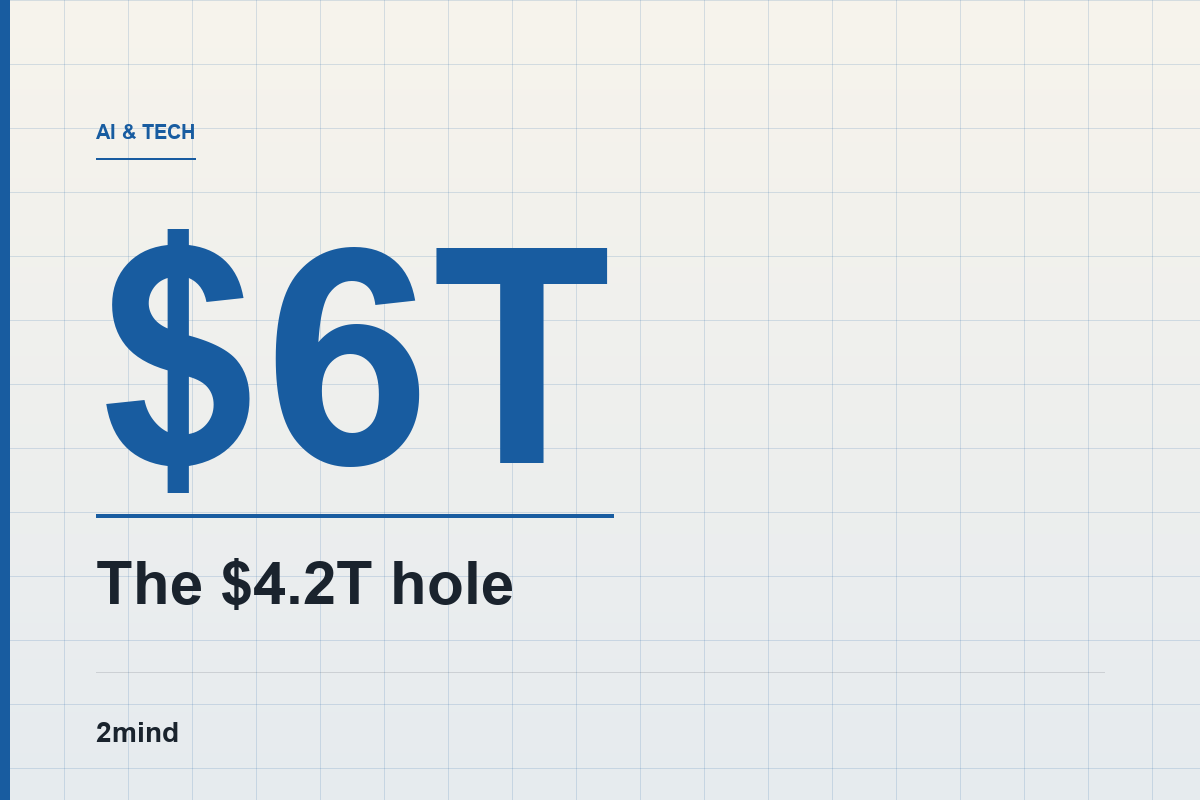
- Bain & Company says AI would need about $6 trillion in annual revenue by 2031 to fund the data centers being built.
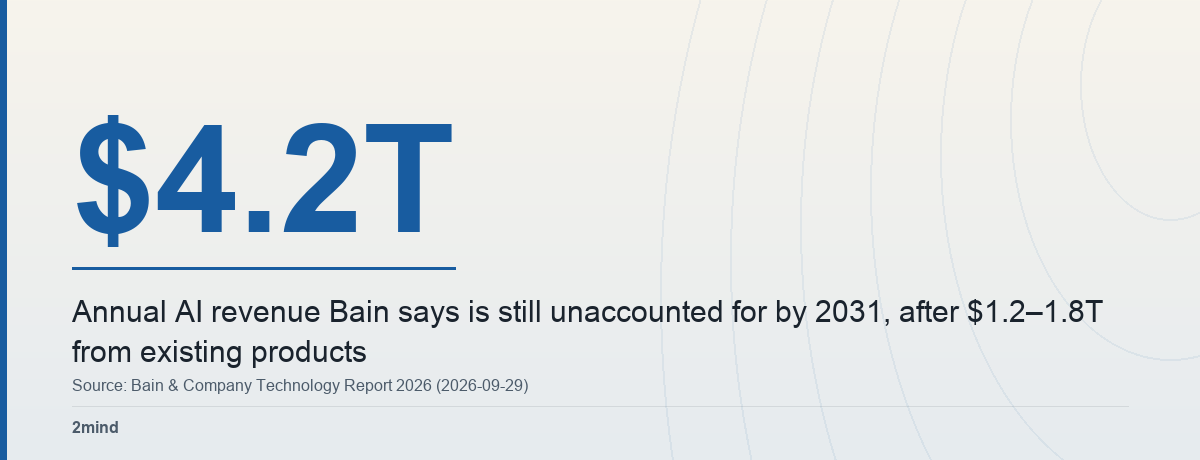
- Existing consumer and enterprise AI could supply $1.2–1.8 trillion, leaving up to $4.2 trillion to find.
- Bain puts dollar figures on only $1.4–1.5 trillion of that gap, about a third. Our calculation.
- The $6 trillion rests on one assumption: capex equals 25% of industry revenue.
How Much Revenue Does AI Need to Justify Its Data Centers?
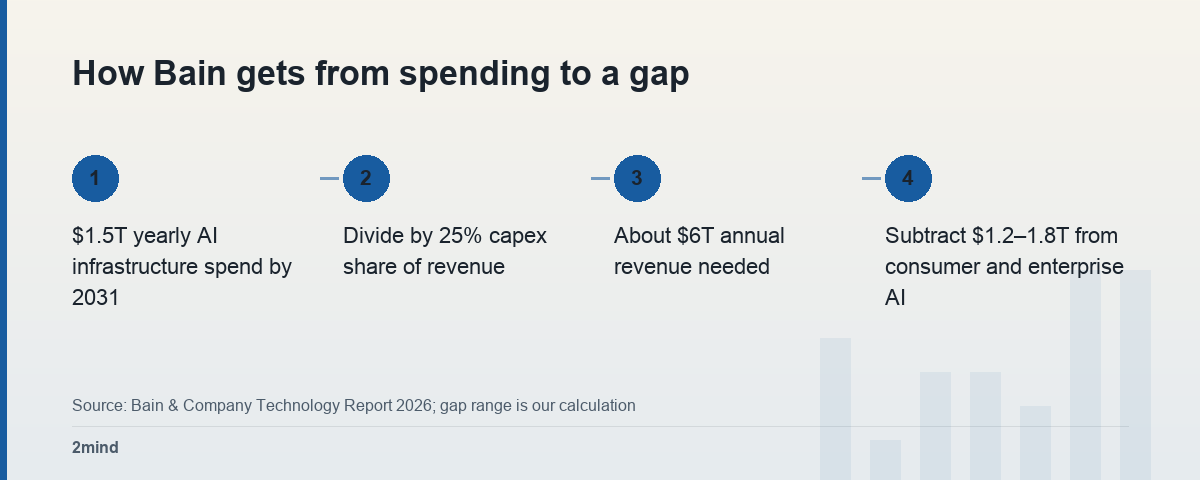
About $6 trillion a year by 2031, according to Bain’s 2026 Technology Report, published September 29. That is the revenue Bain says would sustain roughly $1.5 trillion of annual AI infrastructure spending.
It is a requirement, not a forecast. Bain does not predict AI will earn $6 trillion. It asks what revenue would make the spending look sensible.
The spending side is large. Bain estimates that Microsoft, Google, Amazon, Meta and Oracle could spend $780 billion on capex in 2026, nearly five times the level of three years earlier.
David Crawford, chairman of Bain’s global technology practice, framed the problem this way: “The debate today is fixated on employee productivity. The economics of AI infrastructure demand trillions in new revenue beyond productivity gains.”
Bain’s $6 Trillion Sensitivity Table
The $6 trillion is one division: $1.5 trillion of yearly infrastructure spending divided by 25%. Bain calls 25% “ambitious but reasonable” based on cloud providers’ trends.
We reran that division at other capex shares. The gap columns subtract Bain’s $1.8 trillion and $1.2 trillion estimates for existing consumer and enterprise AI.
| Capex share of revenue | Revenue needed | Gap at $1.8T | Gap at $1.2T |
|---|---|---|---|
| 20% | $7.5T | $5.7T | $6.3T |
| 25% (Bain) | $6.0T | $4.2T | $4.8T |
| 30% | $5.0T | $3.2T | $3.8T |
| 35% | $4.3T | $2.5T | $3.1T |
Bain’s headline $4.2 trillion uses the top of its existing-revenue range. At the bottom of that range, the same math gives $4.8 trillion.
Which New Revenue Streams Does Bain Actually Price?
Bain names four categories that could fill the gap. Three carry a dollar figure. The fourth, products that do not exist yet, does not.
| Source | Bain’s figure | Share of $4.2T gap |
|---|---|---|
| Chatbot ads and search replacement | $100–200B or more | 2–5% |
| Autonomous vehicles and industrial automation | $400B | 10% |
| Physical AI (simulation, robots) | $900B | 21% |
| Subtotal with a figure | $1.4–1.5T | 33–36% |
| Left without a figure | $2.7–2.8T | 64–67% |
The last row is our subtraction, not a Bain number. Bain’s physical AI figure also assumes a 10% cut in R&D and manufacturing costs. That is a stated assumption, not an observed result.
The unpriced remainder is where Bain lists drug discovery, mental health support and new battery and chip materials. Those are examples, not forecasts.
Two Lenses
The builder who cannot wait for proof
Someone signing a multi-year power and chip commitment cannot wait for the revenue to show up first. Bain itself says infrastructure is being built “well ahead of the demand curve.”
From that seat, the gap is the price of being early. The four categories are the bet that applications arrive in time, as mobile and cloud apps did.
The customer who is the missing revenue
Every dollar in the gap comes from someone. It is an advertiser paying for chatbot placement, a factory buying robots, or a user paying for a subscription.
From that seat, “AI must find $4.2 trillion” means asking whether your own spending will rise. We weigh this lens more heavily: the requirement is real arithmetic, while the supply of buyers is still a hypothesis.
Three Checks Before Trusting Any AI-Payback Headline
- Find the ratio. Ask what share of revenue the analysis assumes goes to capex. Moving from 25% to 30% cut the required revenue by $1 trillion above.
- Separate priced from named. A category with a dollar figure is an estimate. A category with only examples is a hope.
- Match the year. A 2031 requirement compared against 2026 revenue tells you little about anyone’s current results.
This connects to how we framed the four clocks of AI capex payback. It also links to the $1.09 trillion of data-center leases that sit outside big-tech balance sheets.
What would change our view
We would treat the gap as narrowing if a major provider disclosed audited AI revenue from ads in chatbots or from autonomous services at a scale near Bain’s $100–200 billion and $400 billion figures.
We would treat it as widening if hyperscaler capex guidance rises again while consumer and enterprise AI revenue stays below Bain’s $1.2 trillion low case. We could not verify Bain’s underlying model or figure data. We reviewed only its published report page and press releases.
FAQ
Q. Is the $6 trillion a forecast of AI revenue?
A. No. It is the annual revenue Bain says would be needed to sustain about $1.5 trillion of yearly infrastructure spending at a 25% capex share. Bain’s estimate of existing consumer and enterprise AI revenue is $1.2–1.8 trillion.
Q. What happens if capex is a bigger share of revenue than 25%?
A. The required revenue falls. In our table, a 30% share gives $5.0 trillion and a 35% share gives about $4.3 trillion. That would only hold if AI providers can sustain higher capex intensity.
Q. Is this the same as Bain’s earlier $2 trillion figure?
A. Not directly. Bain’s 2025 report cited $2 trillion of new annual revenue needed by 2030 and an $800 billion shortfall even after AI savings. The 2026 report sizes the whole market at $6 trillion by 2031. We do not compare them one-to-one.
Sources
- Bain: funding AI’s $6 trillion buildout — Bain, Sep 2026
- Bain 7th Global Technology Report release — Bain, Sep 2026
- Bain 6th Global Technology Report release — Bain, 2025
- AI needs $6tn a year by 2031 to pay for its data centres — The Next Web, Sep 2026
All figures checked against the linked pages on Sept 30, 2026.
Leave a Reply